
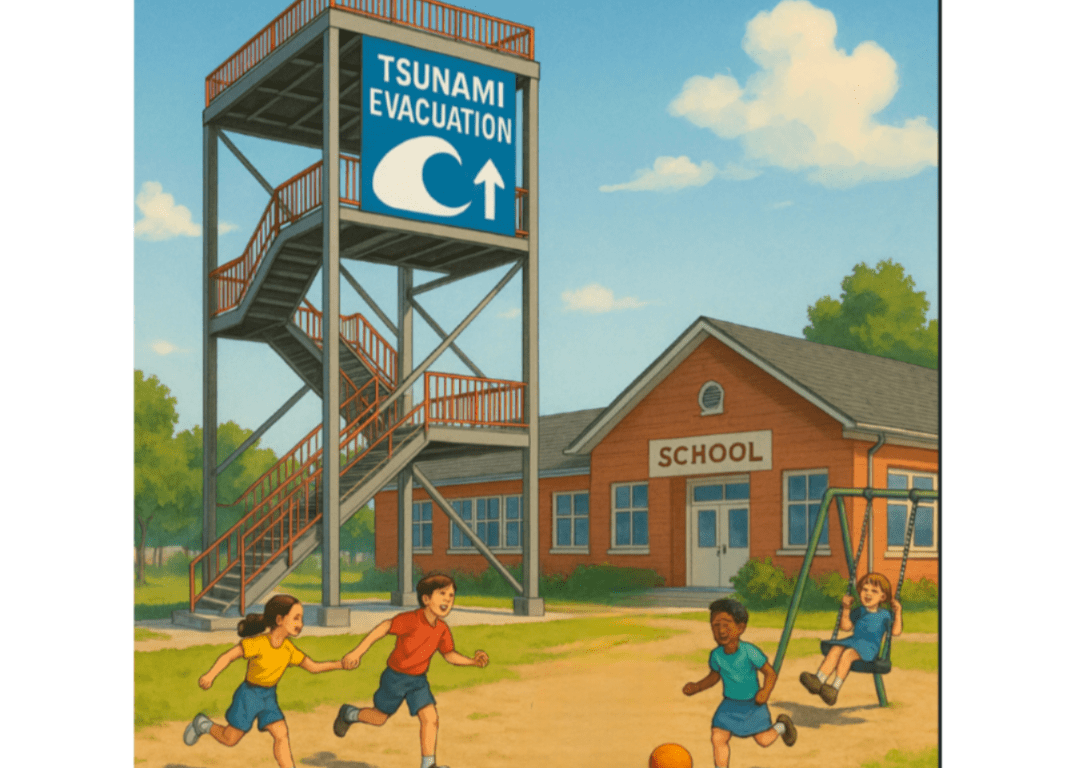
After the devastating 2011 Tōhoku earthquake and tsunami that killed over 15,000 people, Japan invested heavily in tsunami shelters—especially to protect children. Thousands of schools were rebuilt or retrofitted with vertical evacuation towers, and floating shelters were deployed in tsunami-prone regions like Iwate and Miyagi. Japan’s decision was necessary: over 30% of its population lives near the coast, and protecting children became a top priority in high-risk zones. Some tsunami towers cost between $1 million and $4 million each, depending on capacity and elevation needs.
In comparison, the U.S. West Coast—California, Oregon, and Washington—faces a similar threat from the Cascadia Subduction Zone. According to FEMA and state data:
- California has over 120 schools in tsunami hazard zones.
- Oregon has identified more than 60 schools at risk.
- Washington has at least 10 schools in tsunami zones, including several in Pacific County.
- Hawaii – has 222 schools in tsunami zone. This includes 58 schools in the regular tsunami evacuation zone and 164 schools in the extreme tsunami evacuation zone
Yet, few have tsunami shelters. Pacific county in Washington, with a population under 25,000 and a limited tax base, cannot afford the $3–5 million per tower needed to build shelters for each school. The Shoalwater Bay Tribe managed to build a $4.2 million tsunami tower in Tokeland—but only through federal grants and tribal support. Similarly, Ocosta Elementary near Westport added a rooftop refuge for 2,000 people, which cost about $2.5 million, or 20% of the school’s total construction budget.
While Japan builds hundreds of shelters, the U.S. has only a handful—despite having major population centers like San Francisco, Los Angeles, Portland, and Seattle near the coast. More than 1 million children attend school in coastal tsunami zones across the three states.
The contrast is stark:
- Japan: proactive investment in life-saving infrastructure for schools, guided by disaster experience.
- Pacific U.S.: limited shelter availability, despite clear risks and large populations in harm’s way.
To catch up, the U.S. needs bold federal action, public-private partnerships, and clear prioritization of school safety. But certainly schools need to be prioritized to provide structures that can protect children or build tsunami towers. Or build new schools near higher ground. But California with its large populations in coastal areas has the greater need. But for the average person living near the coast is a risk.
The other issue is that many schools aren’t hardened against earthquakes. This is a major concern around Seattle,.SF, Los Angeles, Portland and many other highly populated areas.
A newly released report from Portland Public Schools shows that the condition of 18 other brick schools still poses an enormous risk to the thousands of students who attend school in these buildings.
In Washington, An additional 167000 attended schools already assessed as having “high” or “very high” seismic risks, based on their locations and building conditions.
In the past school year, more than 378000 attended schools with buildings constructed before adopting modern seismic codes with no risk evaluations or retrofits, according to data from the Washington Office of Superintendent of Public Instruction.
Clearly, there is also a need to protect against earthquakes by hardening the large number of schools constructed before adopting modern seismic codes.
Pacific County has limited funds to invest in tsunami towers, and with the federal government already burdened by nearly a trillion dollars in annual interest payments, hundreds of schools remain vulnerable. As major programs like Social Security and Medicare continue to expand, there will be even less funding available for critical safety projects in smaller communities.
Japan has prioritized tsunami towers to protect the large populations near the coast. When considering any tsunami towers for a community, the reality of lack of federal money for even protecting schools sets in.
.
To catch up, the U.S. needs bold federal action, public-private partnerships, and clear prioritization of school safety. If Japan can protect its coastal schools, so can we. But time—and tide—won’t wait.
 Surfside Washington News