
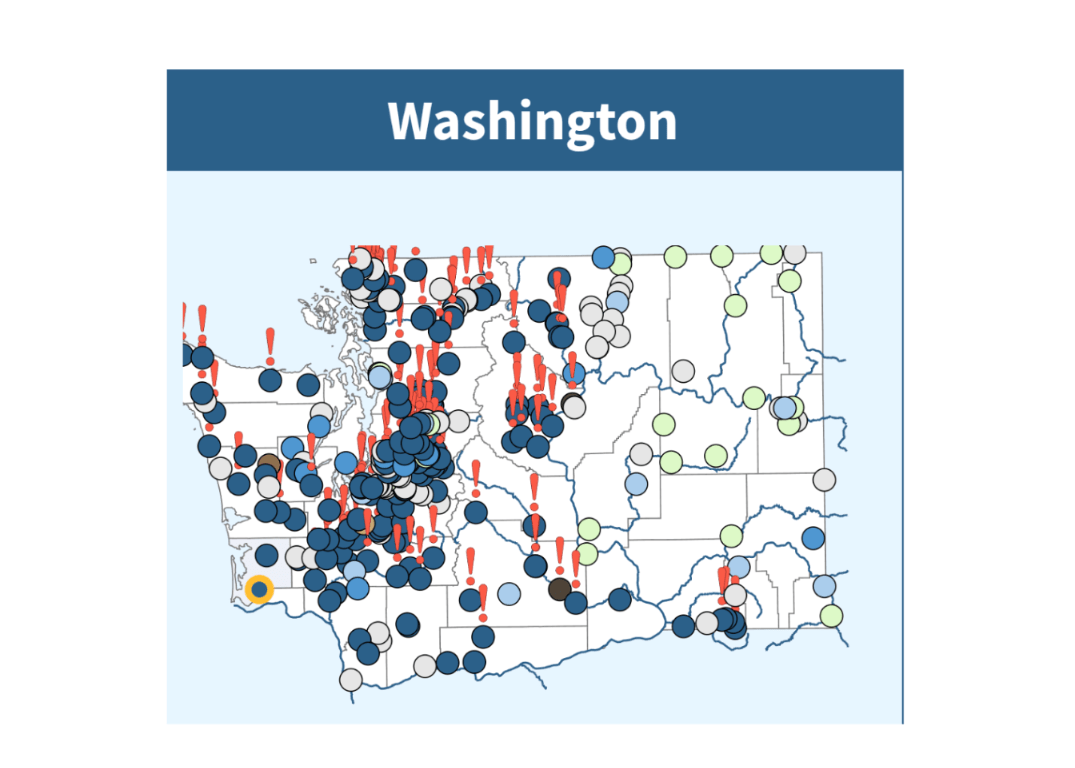
Two of Pacific County’s most important waterways—the Naselle River and the Willapa River—have experienced a dramatic rise in discharge over the past seven days, reflecting the impact of sustained heavy rainfall and repeated atmospheric river events across Southwest Washington. USGS gauges show both rivers surging from low early-week flows to peak discharges near or above 10000 cubic feet per second (cfs), signaling widespread watershed saturation and heightened flood risk across the region.
Washington residents can track real-time river conditions using the USGS statewide monitoring network, which provides up-to-the-minute data on streamflow, discharge, and flooding risk. During heavy rain and atmospheric river events, checking these gauges becomes essential for understanding rising water levels and preparing for potential hazards. Stay informed by monitoring Washington river levels here:
https://waterdata.usgs.gov/state/washington/
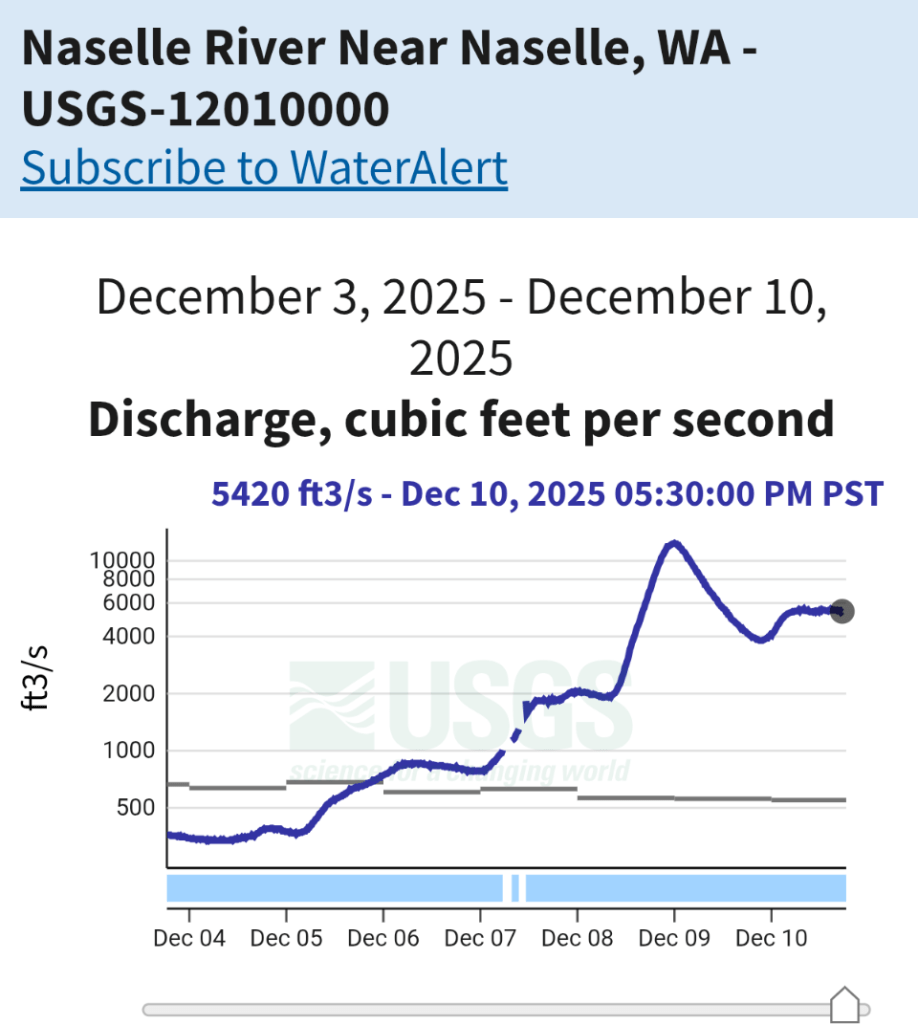
Naselle River: Rapid Climb to Over 5,400 cfs
Between December 3 and December 10, 2025, the Naselle River near Naselle exhibited a steep and continuous rise:
- Dec 3–4: Levels held near 300–400 cfs, reflecting relatively calm baseline conditions.
- Dec 5–6: Discharge steadily climbed past 1,000 cfs as rainfall increased.
- Dec 7–8: The river crossed 2,000 cfs, marking the beginning of significant watershed saturation.
- Dec 9: A sharp spike pushed levels to their weekly high—approaching 10,000 cfs, a major jump associated with peak rainfall from the storm system.
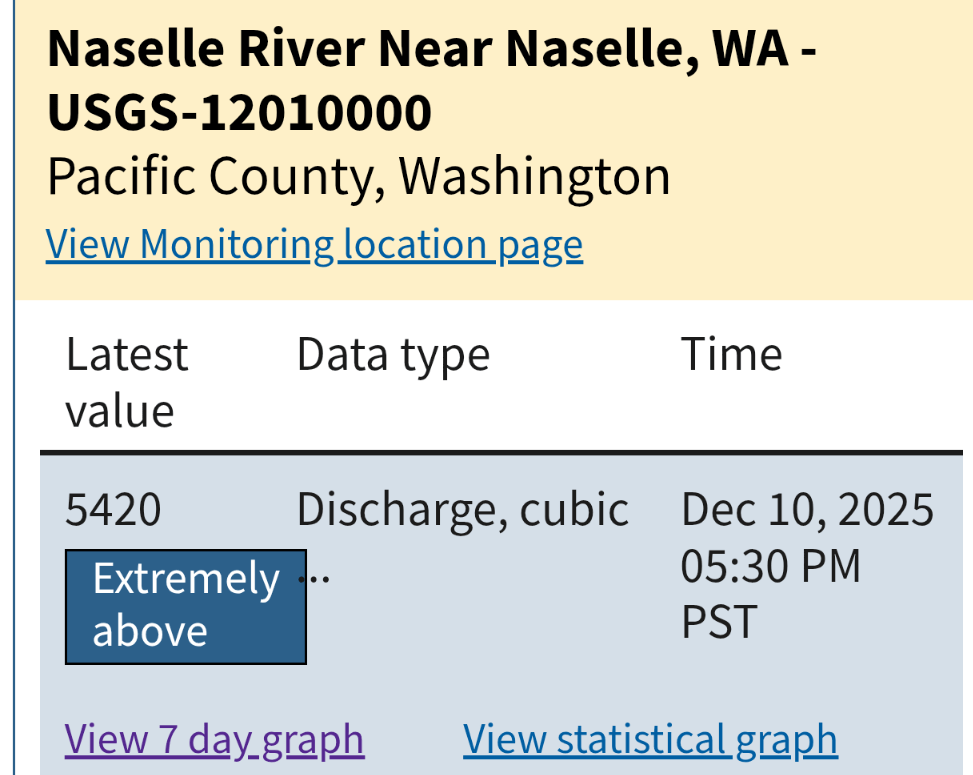
- Dec 10: Flows stabilized near 5,420 cfs, still more than 10 times the early-week discharge.
This pattern shows a classic atmospheric river signature: rapid watershed loading followed by a short plateau and partial recession. Even after the peak, flows remain dangerously elevated.
Current condition
Willapa River: Stronger Peak, Similar Trend
The Willapa River near Willapa mirrored the Naselle’s behavior but reached an even higher daily maximum:
- Dec 3–4: Low, steady flows around 300–400 cfs dominated the early period.
- Dec 5–6: Discharge increased to 800–1,000 cfs, tracking the incoming storm.
- Dec 7–8: The river surged to 2,000–3,000 cfs, indicating widespread runoff from upland forests and valleys.
- Dec 9: Willapa hit a significant peak of roughly 10,000 cfs, one of the strongest flow events of the season.
- Dec 10: Levels settled to 6,490 cfs, still far above flood-watch thresholds.
The Willapa’s steeper rise suggests larger tributary contributions and greater landscape saturation across the Willapa Hills, which funnel water rapidly toward the main channel.


What These Trends Mean for Pacific County
The synchronized rises in both river systems highlight several realities:
1. Watersheds Are Fully Saturated
With both rivers rising by more than 8,000–9,000 cfs in just a few days, soils and tributaries are at maximum absorption capacity.
2. Flooding Risk Remains Elevated
Even though peak discharges have passed, current levels remain extremely high and slow to recede, increasing the possibility of additional flooding with any new rainfall.
3. Upstream Land Use Plays a Role
Forested uplands—particularly areas affected by timber harvests—shed water quickly during intense storms. Reduced canopy and root structures limit natural flood buffering, accelerating runoff into the rivers.
4. Atmospheric Rivers Are Becoming More Intense
The spike in both rivers aligns with ongoing regional trends of stronger, longer storm events delivering tropical moisture directly into the Pacific Northwest.
Conclusion
Over the past seven days, the Naselle and Willapa Rivers have transitioned from calm early-winter flows to powerful surges that strained local floodplains and mirrored the widespread flooding affecting counties across Washington. These sharp increases underscore the importance of real-time river monitoring, resilient land-use planning, and strengthened natural flood defenses—especially as atmospheric river events intensify with each passing year.
 Surfside Washington News