
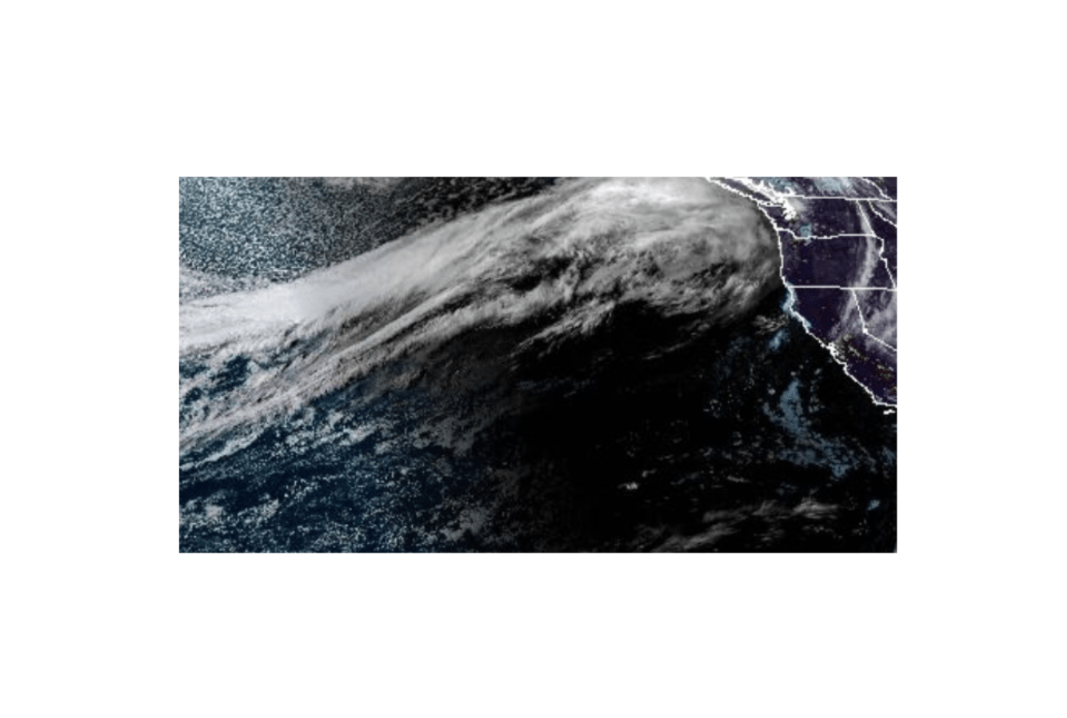
For decades, climate scientists have warned that a warming planet would intensify storms, increase the atmospheric moisture load, and push coastal systems beyond their historical limits. On October 19, 2024, those warnings crossed an essential threshold from projection to confirmation with the publication of a landmark study in Communications Earth & Environment: Response of the Upper Ocean to Northeast Pacific Atmospheric Rivers under Climate Change.
The intensity of this week’s storms across Washington and the Pacific Northwest is yet another example of the best available science becoming a lived reality, as outlined in this study. Scientists have long warned that warming oceans would supercharge atmospheric rivers, allowing storms to carry and release far greater amounts of moisture, and this week’s rainfall totals reflect exactly that pattern—rivers rising rapidly, saturated ground unable to absorb more water, and flooding occurring not as an anomaly, but as a predictable outcome. What once appeared in climate models and peer-reviewed journals is now unfolding in real time, as atmospheric rivers deliver heavier, more persistent rain events that overwhelm infrastructure and communities, underscoring that the era of “theoretical risk” has come to an end. The era of direct impact has begun.
This peer-reviewed research did not speculate about what might happen. It demonstrated—using high-resolution, eddy-resolving Earth system models—what is already happening and what will worsen as the climate continues to warm, particularly along the U.S. West Coast and the Pacific Northwest.
From theory to observed consequence
The study shows that atmospheric rivers do far more than deliver heavy rainfall. Their powerful winds physically push ocean water toward the coast, raising nearshore sea levels during storms. Under climate-change conditions, this effect intensifies dramatically—so much so that storm-driven coastal sea-level rise can exceed 200 percent compared to historical conditions in some regions.
This matters because flooding is no longer just about rain falling from the sky; it is also about the impact of climate change. It is about rainfall, river overflow, coastal water displacement, and long-term sea-level rise occurring simultaneously. When these forces converge, communities face compound flooding events that overwhelm infrastructure, erode shorelines, and damage homes far from the coast.
The Pacific Northwest warning
For the Pacific Northwest, the findings are particularly sobering. Even where future storm frequency remains uncertain, the science is precise on one point: when atmospheric rivers occur, their impacts will be more substantial. Warmer oceans reduce the natural buffering capacity of the upper ocean, making it less able to absorb storm energy. The result is higher coastal water levels during storms, increased erosion, and greater flood risk for coastal and low-lying communities.
This aligns precisely with what residents across Washington and Oregon have begun to experience—record rainfall totals, rivers exceeding flood stage, and coastal flooding that feels no longer “unexpected,” but increasingly familiar.
Best Available Science, finally undeniable
“Best Available Science” is often invoked in policy discussions, environmental reviews, and land-use decisions. Too often, it is treated as abstract, theoretical, or something that applies only to future generations. The October 19, 2024 publication marks a turning point: the science has caught up with lived experience.
What researchers modeled—enhanced storm intensity, amplified coastal impacts, and weakened natural buffers—is now being observed in real time. Atmospheric rivers are no longer rare anomalies. They are becoming defining features of the West Coast climate system.
A moment of accountability
When science becomes reality, the question is no longer if action is needed, but why it was delayed. Coastal planning, stormwater infrastructure, shoreline management, and the protection of natural buffers, such as forests and wetlands, must now be grounded in this updated understanding.
Ignoring best available science is no longer a matter of debate or ideology. It is a measurable risk—one that communities are already paying for with flooded neighborhoods, damaged infrastructure, and mounting recovery costs.
The line has been crossed
October 19, 2024, will stand as a date when the gap between prediction and proof narrowed. Atmospheric rivers, intensified by climate change, are reshaping both the atmosphere and the ocean. The science is no longer ahead of reality—it is struggling to keep pace with it.
The storms are here. The data is clear. The responsibility to act now rests not with scientists, but with decision-makers and communities willing to accept that best available science is no longer a warning—it is a description of the present.
Shields, C. A., Li, H., Castruccio, F. S., Fu, D., Liu, X., Nardi, K., & Zarzycki, C. (2024). Response of the upper ocean to northeast Pacific atmospheric rivers under climate change. Communications Earth & Environment, 5, Article 603. https://doi.org/10.1038/s43247-024-01774-0
 Surfside Washington News