
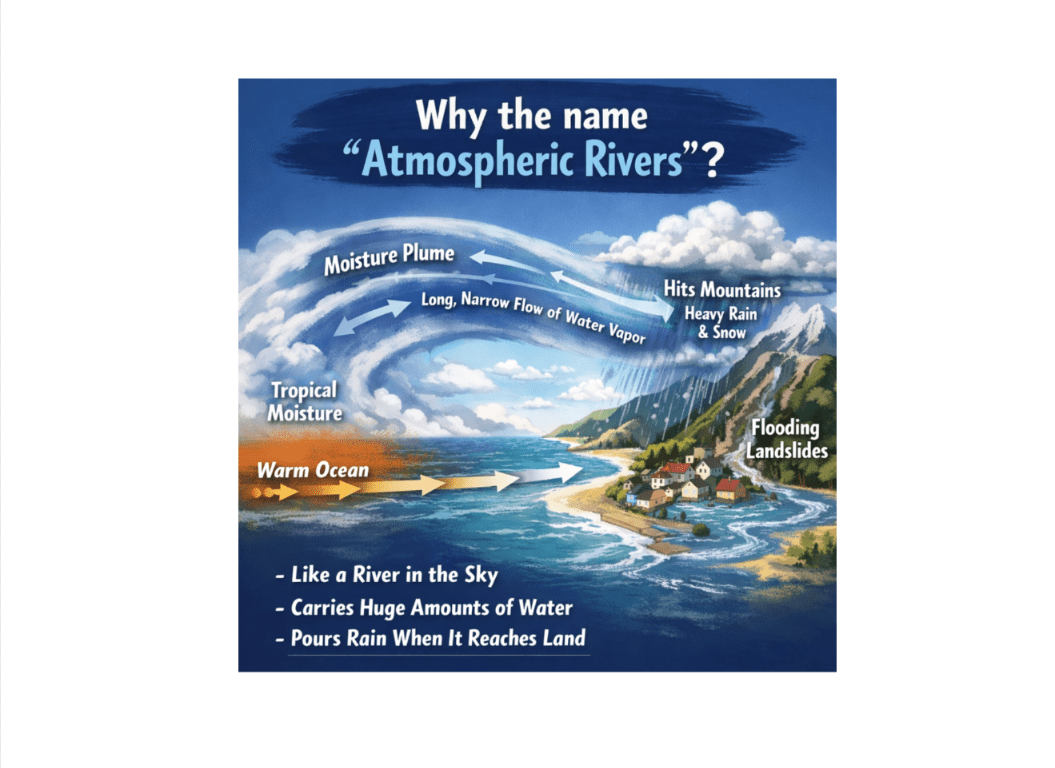
The term atmospheric river sounds poetic, but it was chosen for a very practical reason. Scientists studying global weather patterns discovered that most of the planet’s water vapor does not move evenly through the atmosphere. Instead, it travels in long, narrow bands that behave much like rivers on land—flowing across oceans, transporting enormous volumes of water, and releasing that water when they reach land. These invisible “rivers in the sky” are now recognized as one of the most powerful drivers of extreme weather along the West Coast and across the Pacific Northwest.
The name originated in the early 1990s, when researchers using satellite data observed filament-like corridors of moisture stretching thousands of miles from the tropics into mid-latitude regions. Although these bands cover only a small portion of the atmosphere, they are responsible for moving the vast majority of water vapor around the globe. When these moisture corridors make landfall, the vapor condenses into rain or snow, just as water spills from a river when it reaches its banks.
Atmospheric rivers become destructive because of the sheer amount of moisture they carry. Warm ocean surfaces load the air with water vapor, and warmer air can hold significantly more moisture than colder air. As a result, today’s atmospheric rivers often transport amounts of water comparable to dozens of major terrestrial rivers combined. When that moisture is released over land, it does not fall as a brief downpour, but as sustained, heavy precipitation that can last for many hours or even days.
Their power is amplified further when atmospheric rivers widen. While they are often described as narrow filaments, the most damaging events spread hundreds of miles across, transforming from a single moisture stream into a broad conveyor belt of rain. This means entire watersheds are hit at the same time. Rivers, creeks, and stormwater systems all rise together, leaving little capacity for excess water to drain away safely.
Duration also plays a critical role. Many destructive atmospheric rivers slow down or stall due to jet-stream patterns, continuously feeding moisture into the same region. Soils quickly become saturated, and once that happens, nearly all additional rainfall turns into runoff. This rapid transition from absorption to overflow is what triggers flash flooding, river flooding, and landslides.
Topography adds yet another layer of intensity. When moisture-laden air is forced upward by coastal mountains or inland ranges, it cools and condenses rapidly, releasing even more precipitation through a process known as orographic lift. In places like the Pacific Northwest, this effect can double or triple rainfall totals in headwater regions, sending surges of water downstream long after the storm first makes landfall.
To help communicate risk, scientists developed the Atmospheric River Scale, which rates storms from AR1 to AR5 based on both strength and duration. An AR1 is generally weak and beneficial, often delivering needed rain or snow without major impacts. AR2 and AR3 events are moderate to strong, capable of replenishing water supplies but also causing localized flooding. AR4 and AR5 storms are considered extreme and exceptional, bringing a high risk of widespread flooding, landslides, and infrastructure damage. This scale is important because it shifts the conversation from “any atmospheric river is dangerous” to a more nuanced understanding that some are helpful, while others pose serious threats. It also gives emergency managers, utilities, and the public a clearer, standardized way to prepare for impacts before the worst conditions arrive.
The destructive reputation of atmospheric rivers today is also shaped by cumulative impacts. Back-to-back storms leave little time for landscapes to recover. Saturated soils, elevated rivers, reduced tree canopy, and altered land surfaces all reduce nature’s ability to slow and store water. Each new atmospheric river builds on the damage of the last, pushing infrastructure and ecosystems beyond their limits.
In essence, atmospheric rivers earned their name because they truly function like rivers—long, flowing systems that carry immense volumes of water. As oceans warm and weather patterns shift, these rivers in the sky are becoming wider, wetter, and longer-lasting. Understanding the origin of the name helps explain their power, while tools like the AR1–AR5 rating system help communities better anticipate when these storms will be beneficial—and when they will become destructive.
 Surfside Washington News