
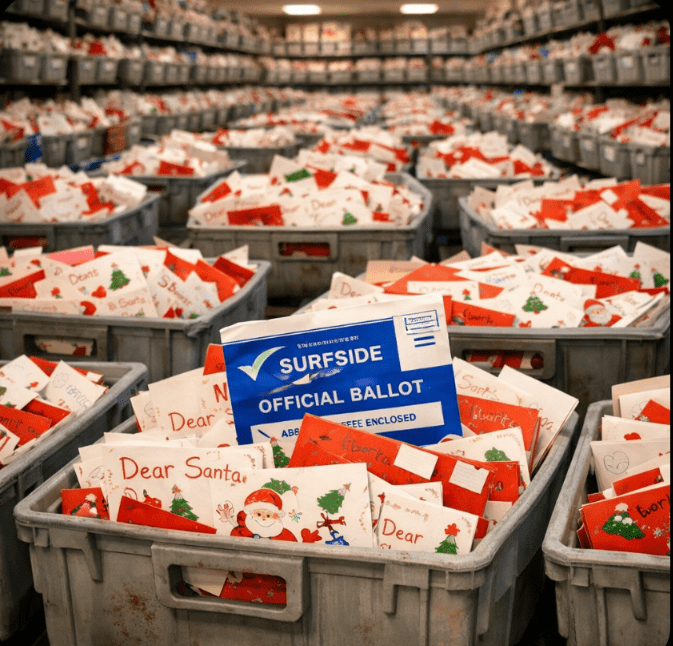
As billions of Christmas cards and holiday packages flood the mail system each December, it’s fair to question whether Surfside’s election ballots will reliably reach voters at all—and why it took so long to mail ballots for just two measures. A December ballot election is simply bad timing. When mail carriers and sorting facilities are operating at peak capacity, even well-planned mailings face delays, making voter disenfranchisement a real risk rather than a hypothetical concern.
An electronic ballot does not get lost in the postal mail and multiple reminders can be sent out to ensure ballots are received. People are still waiting for their ballots..
Does the election committee even think about these things?
How do you trust an election with two ballots and two deadlines and potential for ballots to be swept up in the Xmas rush.
The Holiday Mail Deluge: Christmas Cards and Packages in December
Every December, the U.S. postal system enters its most demanding period of the year. What is normally a steady flow of letters and parcels becomes a tidal wave driven by holiday traditions and modern online shopping. Despite digital communication, Americans still rely heavily on physical mail during the Christmas season—placing extraordinary strain on delivery networks.
🎄 Christmas Cards: Billions Sent in a Single Month
Christmas cards remain a deeply rooted tradition:
- An estimated 1.3 to 2+ billion holiday cards are sent in the U.S. each year, with the vast majority mailed in December.
- Most cards are sent within a narrow window in early- to mid-December, creating a sudden spike in letter mail.
- Many households mail dozens of cards, all competing for space in the same sorting facilities and delivery routes.
While everyday letter mail has declined overall, Christmas cards are a notable exception, concentrating massive volume into just a few weeks.
📦 Packages: The Real Driver of Mail Congestion
Packages are the biggest stressor on the system:
- U.S. carriers deliver roughly 2–2.3 billion packages during the holiday season from Thanksgiving through Christmas.
- The USPS alone processes tens of millions of packages per day during peak weeks.
- Online shopping has turned December into a logistics bottleneck, with parcels prioritized over standard letter mail in many facilities.
This means election ballots—classified as standard mail unless specially handled—are competing with gifts, retail shipments, and seasonal returns.
📬 Why December Is the Worst Month for Ballots
December is not just busy—it is uniquely risky for time-sensitive mail like ballots:
- Sorting delays are common as facilities exceed normal capacity.
- Weather disruptions are more likely, compounding delays.
- Temporary staff and rerouted carriers increase the chance of misdelivery.
- Late mailings leave little margin for error if ballots go to incorrect addresses or require replacement.
When an election involves only two measures, delays in mailing ballots raise serious questions about planning, urgency, and respect for voter access.
🗳️ Election Timing and Voter Confidence
Holding a ballot election in December undermines confidence in the process:
- Many residents travel or split time between residences during the holidays.
- Mail is often left unattended for days or weeks.
- Voters already overwhelmed by holiday obligations may miss deadlines.
- Any mailing error becomes amplified when replacement ballots are sent during peak congestion.
In short, December elections increase the likelihood that ballots arrive late—or not at all—through no fault of the voter.
🎁 Conclusion: Holiday Traditions vs. Democratic Access
December showcases the enduring power of mailed cards and gifts, with billions of items moving through the system in just weeks. But that same surge makes the month ill-suited for elections that depend on reliable, timely mail delivery. When ballots are delayed, misrouted, or lost amid holiday volume, participation suffers. If elections are meant to encourage broad engagement, December mail congestion is a predictable—and avoidable—barrier.
 Surfside Washington News