
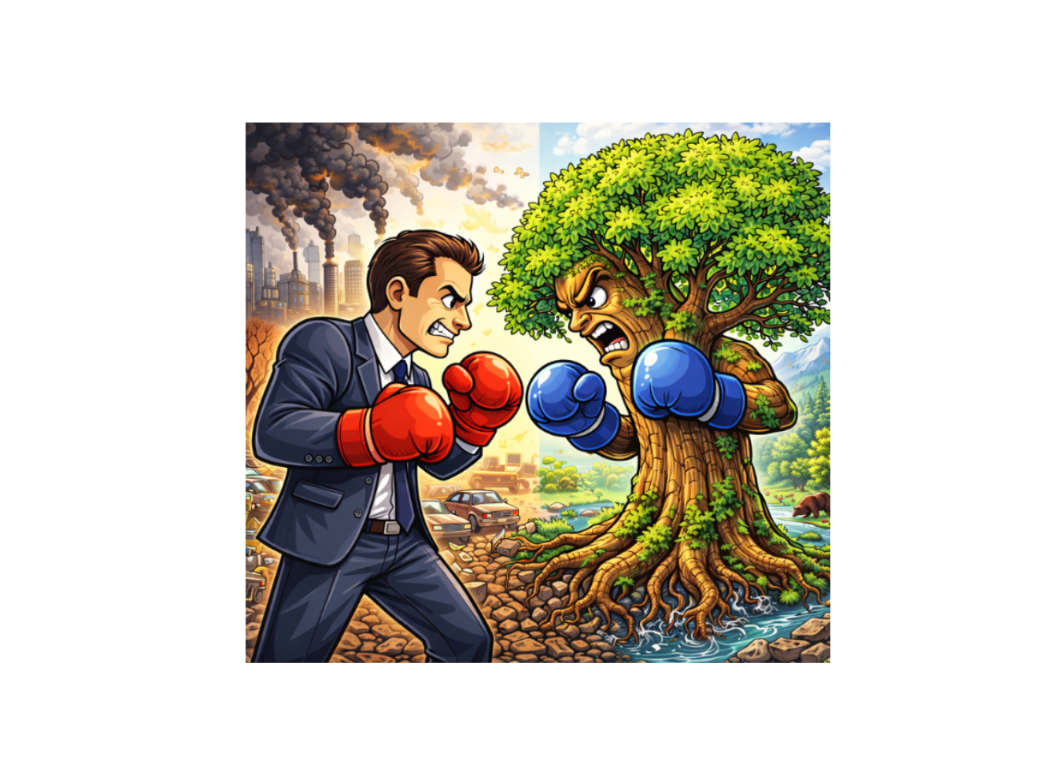
The environmental boxing match of the century
Every new home represents safety, shelter, and stability for people. But it also represents tree loss, carbon emissions, water runoff, pollution, and habitat destruction. Cities and counties routinely approve housing without accounting for the biological infrastructure removed to make room for it. Even worse is when multiple trees are removed by homeowners with no regard for the environmental damage—or for the substantial, long-term benefits each individual tree provides to the community and ecosystem.
This imbalance can be corrected with a simple, fair rule:
For every person living in a newly built home, at least one tree must be planted and preserved long-term within the community. Existing trees should be replaced 1 for 1 if removed.
The reason is not symbolic. It is mathematical, biological, scientific, economic and unavoidable. To argue that a single tree has no economic value is not an opinion—it is ignorance of well-established science and basic environmental economics.
Below is a side-by-side, lifetime comparison of economic and environmental impact between an 80-year-old human and a single mature tree (assume a long-lived coastal conifer or hardwood reaching maturity at ~60–80 years). Values are order-of-magnitude averages drawn from environmental and forestry research; exact numbers vary by species, lifestyle, and location.
🌳 Tree vs 👤 Human (80-Year Lifetime Comparison)
1. Carbon Footprint / Carbon Balance
👤 Human (80 years)
- Carbon emitted:
- ~1,200–2,000 metric tons CO₂
- Includes food production, housing, transportation, goods, energy, healthcare
- Net impact: Carbon source
🌳 Tree (80 years)
- Carbon absorbed & stored:
- ~1–3 metric tons CO₂ stored in wood, roots, and soil
- Continues storing carbon as long as it lives
- Net impact: Carbon sink
Policy meaning:
When a home is built, carbon emissions rise immediately. When a mature tree is removed, decades of stored carbon are lost instantly. Requiring tree planting per resident begins restoring that balance.
Winner: 🌳 Tree (by orders of magnitude)
2. Oxygen: Consumed vs Produced
👤 Human
- Oxygen consumed:
- ~350 liters/day
- ~16 million liters over 80 years
- Produces: None
🌳 Tree
- Oxygen produced:
- ~100–120 kg O₂/year
- Enough oxygen for 2–4 humans annually
- Consumes: Negligible net O₂
Policy meaning:
Every new resident increases oxygen demand. Trees are the only local infrastructure that creates oxygen rather than consuming it.
Winner: 🌳 Tree
3. Food & Animal Consumption
👤 Human
- Animals consumed:
- ~2,400–3,000 animals over a lifetime
- Plant food consumed:
- Thousands of pounds of grains, fruits, vegetables
- Ecological cost:
- Land clearing, fertilizers, methane, fisheries depletion
🌳 Tree
- Consumes:
- Sunlight, CO₂, water, minerals
- Feeds:
- Hundreds to thousands of animals
- Net effect: Creates food webs
Policy meaning:
Housing expansion displaces ecosystems. Tree planting restores local food webs that development removes.
Winner: 🌳 Tree
4. Water: Consumed vs Managed
👤 Human
- Direct water use:
- ~80–100 gallons/day
- ~2.5–3 million gallons over a lifetime
- Indirect use:
- Far higher through food and energy
🌳 Tree
- Water uptake:
- ~50–200 gallons/day (returned via transpiration)
- Stormwater intercepted:
- 30,000–100,000+ gallons per year
- Net effect:
- Flood reduction, aquifer recharge, soil stability
Policy meaning:
New roofs and pavement increase runoff and flooding. Trees are stormwater infrastructure, not amenities.
Winner: 🌳 Tree
5. Pollution Absorbed vs Generated
👤 Human
- Generates:
- CO₂, NOx, PM2.5
- Plastics and microplastics
- Wastewater and chemical residues
- Absorbs: Minimal
🌳 Tree
- Absorbs:
- PM2.5, ozone, NO₂, SO₂
- Heavy metals and airborne toxins
- Microplastics on leaf surfaces
- Public health benefit:
- Reduced asthma and heart disease risk
Policy meaning:
Removing trees transfers pollution costs directly to residents and healthcare systems.
Winner: 🌳 Tree
6. Wind, Storm & Climate Protection
👤 Human
- Wind resistance: Requires shelter
- Storm impact: Structures increase runoff and damage
🌳 Tree
- Windbreak: Reduces wind speeds 30–50%
- Storm buffering: Protects homes and infrastructure
- Coastal & river protection: Reduces erosion and flood velocity
Policy meaning:
Trees reduce emergency response costs and insurance losses—benefits rarely counted in permitting decisions.
Winner: 🌳 Tree
7. Habitat & Biodiversity
👤 Human
- Habitat impact: Net loss
- Species supported: Few
🌳 Tree
- Supports:
- Hundreds of species
- Role: Biodiversity multiplier
Policy meaning:
Each tree removed fragments habitat; each tree planted reconnects it.
Winner: 🌳 Tree
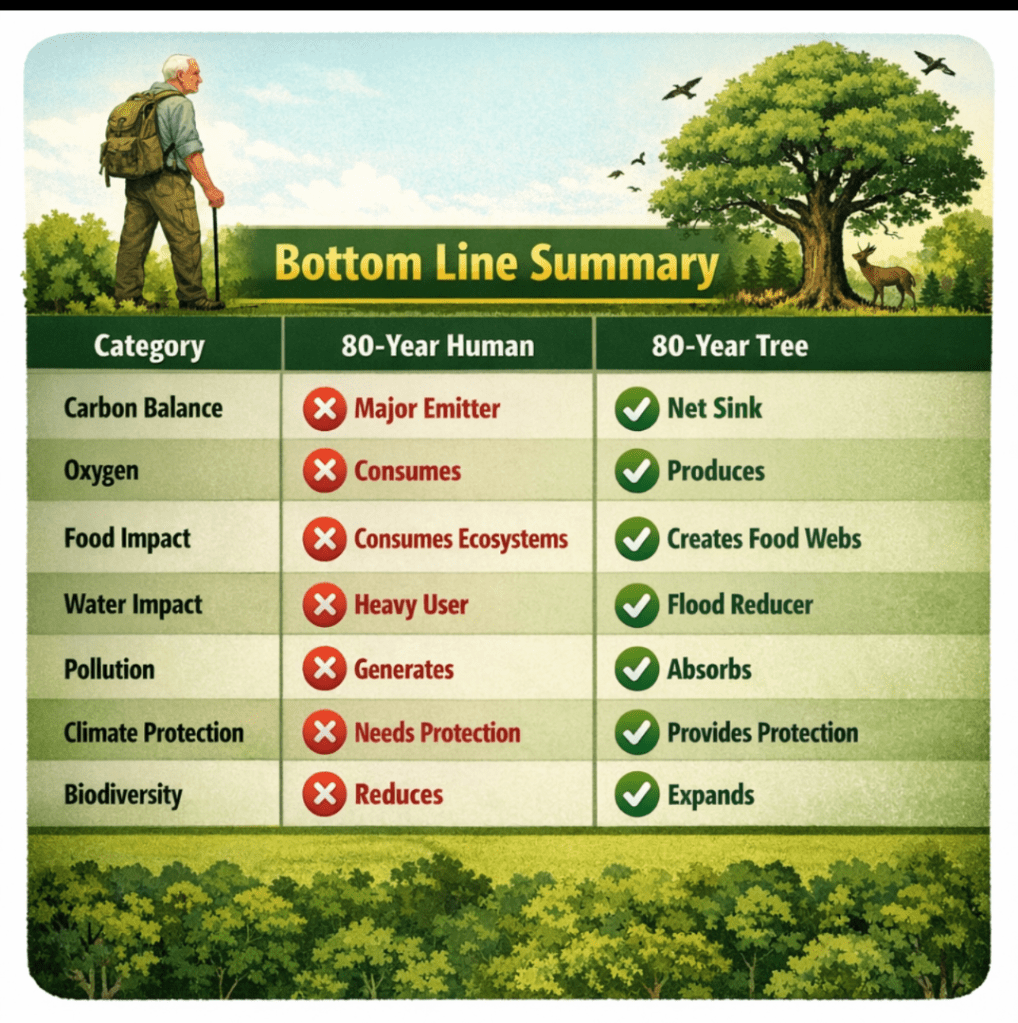
🔚 Bottom Line Summary
Boxing match: 80-Year versus Human 80-Year Tree. Winner 7-0
🌎 Policy Conclusion: Tree Planting Must Be Required, Not Optional
An 80-year-old human is a net environmental cost.
An 80-year-old tree is net environmental infrastructure.
When cities approve housing without tree replacement, they approve permanent environmental deficits—higher flooding, poorer air quality, hotter neighborhoods, and lost biodiversity.
Policy Recommendation for Cities and Counties
✔ Require one tree planted and protected per resident in every new home
✔ Trees must be appropriate species, maintained, and preserved long-term
✔ Mature tree removal must require replacement ratios reflecting decades of lost service
✔ Treat trees as infrastructure, equal to pipes, roads, and storm drains
Economic value:
Cities and municipalities l:
$150,000+ per tree
High-risk areas (flood, heat, coastal):
$250,000+ per tree
Shelter is a human need—but so is the living system that makes shelter survivable.
If we build homes without trees, we build future problems.
Requiring trees with every home is an investment in a safer, healthier, and more sustainable future.
Build a home, plant trees—because the lifetime return on investment from just one tree dwarfs its upfront cost and offsets real environmental damage.
 Surfside Washington News