
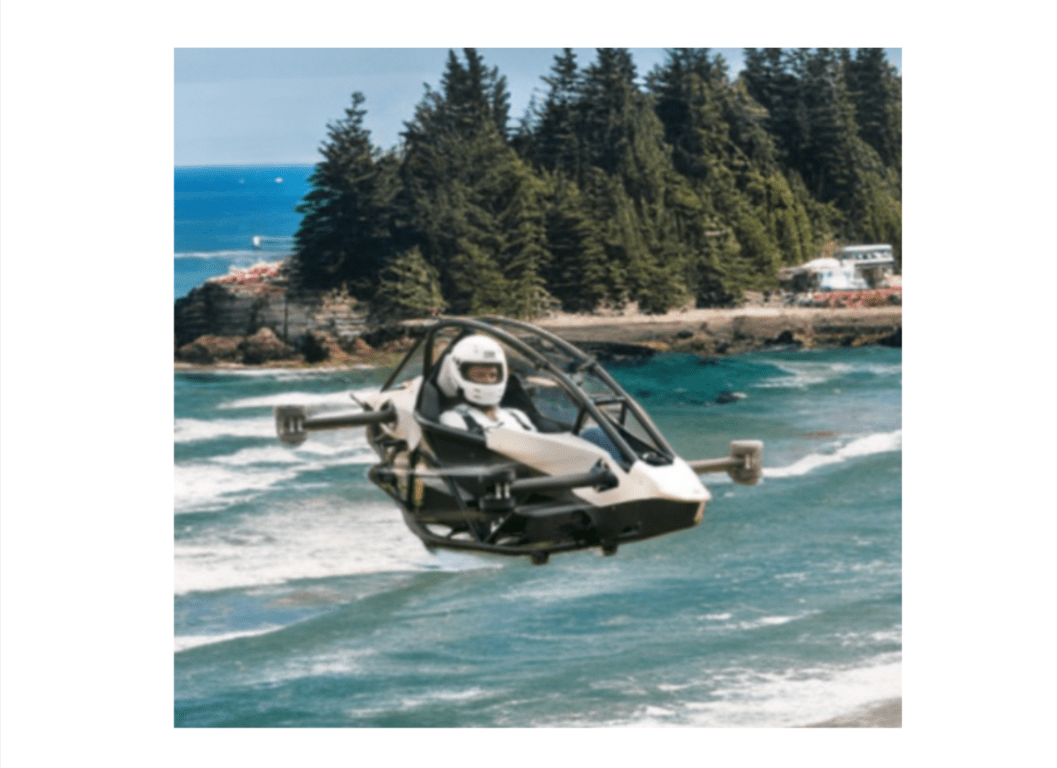
When a tsunami siren sounds or floodwaters surge through Surfside or Long Beach, the biggest threat isn’t water — it’s being stuck on the ground with no way out. Roads flood. Bridges fail. Ground vehicles are limited. But your own drone at the cost of an expensive RV or boat would lift you to safety. It’s expensive but imagine the other fun you can have with your personal drone.
Air, however, remains open.
That is why personnel drones and small electric vertical take-off and landing aircraft (eVTOLs) are emerging as real evacuation solutions — capable of lifting people over hazards and delivering rescue support where ground routes fail.
This isn’t science fiction. These machines are flying today — in pilot programs, human flights, rescue trials, and urban mobility tests worldwide.
How Personnel Drones Work
Personnel drones (eVTOL aircraft) are:
Electric — powered by high-output lithium battery packs
Vertical takeoff and landing — no runway needed
Stabilized by computers and sensors for safety
Autonomous or semi-autonomous — can fly with minimal pilot interaction
In an emergency, they can lift off from:
Driveways
Rooftops
Parking lots
Clearings near beaches or urban centers
And fly over flooded streets and gridlock to safety.
The Battery Reality: Charging and Swapping
Unlike gas helicopters, these aircraft rely on modular electric battery packs that can be:
Recharged from grid power, solar arrays, or micro-grids
Fast charged to significant levels in under 60 minutes
Swapped in minutes at field stations — enabling multiple flights without long delays
This means an evacuation hub with spare batteries could keep drones flying continuously rather than waiting for long recharge cycles.
Real Aircraft You Can See Flying Today
Here are actual eVTOL models and companies that are already in the air — not just on paper.
Jetson – Jetson ONE
Website: https://jetson.com
One-person personal eVTOL aircraft
~20 minutes flight time
Escape range ~10–15 miles
Modular battery packs with fast charge and swap
Price: ~$128,000–$148,000
Real-World Activity:
Jetson has completed rescue trial flights demonstrating the Jetson ONE’s ability to reach remote or inaccessible terrain quickly — including mountain rescue operations where the aircraft reached remote summits in under four minutes.
This shows real emergency-style deployments testing speed and response — not just flights in empty fields.
Pivotal – Helix
Website: https://pivotal.aero
One-seat personal aircraft
~20–25 minutes flight time
~15–25 miles escape range
Quick battery swapping designed into field ops
Price: ~$190,000–$260,000
Operational Focus:
Designed for everyday ownership and repeated flights with rapid battery swaps — Helix’s configuration is aimed at civilian rescue, rapid personal evacuation, and on-demand flight use similar to traditional rescue boats or lifeguard jets, but airborne.
XPeng AeroHT – Voyager X2
Information: https://evtol.news/xpeng-voyager-x2
Two-seat eVTOL aircraft
~35 minutes flight time
~30–40 miles range
Autonomous flight capabilities
Price: ~$126,000–$236,000
Developing Use Cases:
XPeng’s Voyager X2 has completed public flight demonstrations, showing its viability as a personal air vehicle and short-range shuttle — including international exposure during events in cities like Dubai as part of global eVTOL showcases.
Future emergency use would build on these real demonstration operations.
EHang – EH216-S Autonomous Air Vehicle
Website: https://www.ehang.com
Two seats, autonomous flight
~20–25 minutes flight time
~20–30 miles range
Batteries swappable or fast rechargeable
Price: ~$410,000
Real Deployments & Trials:
EHang has conducted pilotless urban flights — including point-to-point passenger tests in Qatar’s major cities under government partnership, demonstrating human flight capability and real operational readiness.
In Europe, EHang’s EH216-S has been part of emergency response flight trials — flying point-to-point routes simulating emergency operations as part of EU-funded urban air mobility programs.
These aren’t isolated demos — they are integration tests with regulators and city governments exploring how autonomous eVTOL aircraft could function in real urban scenarios.
What about autonomous eVTOL
There are autonomous eVTOL aircraft under development and in early real-world testing, meaning they are designed to fly themselves with minimal or no human pilot input. Some are already flying in test campaigns and others are moving toward certification for passenger or cargo use.
Here’s a clear overview with real examples:
Autonomous eVTOL Aircraft: What’s Real Today
EHang — EH216-S Autonomous Air Taxi
- The EHang EH216-S is a production model electric VTOL that has been certified for autonomous operations and has flown demonstration missions without a pilot onboard, carrying passengers under autonomous control.
- EHang pioneered passenger drones starting with earlier models like the EHang 184, which was explicitly designed as an autonomous passenger drone.
- These vehicles use onboard sensors, GPS, and flight computers to plan and execute flights automatically between set waypoints.
This is the closest example today of a passenger-carrying eVTOL that can operate without a pilot onboard.
Wisk Aero — Gen 6 Autonomous eVTOL
- Wisk Aero, backed by Boeing and others, has successfully flown fully autonomous eVTOL prototypes during initial test campaigns.
- Their Gen 6 aircraft has completed vertical take-off, hover, and stabilized flight in California as part of its certification program.
- Wisk plans services leading to true self-flying air taxis, generally aimed for commercial operation in the latter part of this decade.
National & Government Autonomous eVTOL Trials
- Recent trials include a fully autonomous eVTOL test flight in Qatar, marking a milestone in autonomous air taxi demonstrations.
- These flights are part of broader efforts by governments and regulators to evaluate AI-controlled passenger flights over urban landscapes.
Other Autonomous eVTOL Concepts in Development
Several companies and prototypes are pursuing autonomous or tele-operated eVTOL designs, though either still in early stage or intended more for cargo/logistics rather than passenger service:
- Astro Aerospace Elroy — autonomous 2-passenger VTOL transport concept with advanced flight control.
- Unmanned cargo VTOLs such as Boeing’s Cargo Air Vehicle have flown autonomously for cargo missions and research.
- Research projects like the Pipistrel Nuuva V300 feature autonomous or remotely-managed flight control systems for hybrid-electric VTOL cargo.
What “Autonomous” Means in These Aircraft
Most current autonomous eVTOLs operate with a combination of:
- Onboard computers that navigate using GPS and sensors
- Redundant systems for safety
- Pre-programmed routes or operator-assigned missions
- Ground-based monitoring to supervise and intervene if needed
This is usually called supervised autonomy — the vehicle can fly itself, but a human operator still monitors or authorizes flights, especially in populated areas.
Why Autonomous eVTOLs Matter
Autonomous flight capability greatly increases:
- Rescue capacity (no pilot needed in every aircraft)
- Response speed (can be dispatched like a fleet)
- Scalability for evacuation missions
- Safety via AI flight control and obstacle avoidance
For tsunami or flood evacuation planning, this means you could envision fleets of pilotless flying vehicles lifting people out without waiting for trained pilots to be on scene.
Actual Deployments Today (Not Decades Off)
Across the world:
EHang’s pilotless eVTOL has completed human carrying flights in Doha, Qatar, showing autonomous passenger capability in a real city environment — an essential milestone towards emergency and urban use.
In Zaragoza, Spain, EHang participated in one of Europe’s first urban emergency response flight demonstrations with pilotless eVTOLs, simulating point-to-point emergency operations.
Jetson’s aircraft has been used in real rescue trials, reaching remote peaks quickly, showing the suitability of small personal eVTOLs for rapid response.
Joby Aviation, another major eVTOL company, has completed urban eVTOL flights in New York and early prototype deliveries for U.S. government applications, showcasing that battery-powered vertical flight is now operational in major cities.
These examples prove that electric flying vehicles are not future promises — they are flying today under real conditions, with passengers and in operational trials.
Why This Matters for Tsunami and Flood Safety
For coastal communities like Surfside, Long Beach, Ocean Park, or Astoria, traditional evacuation can fail in minutes. But these aircraft:
Fly over flooded roads
Bypass traffic and debris
Lift people directly to high ground
Deploy repeatedly with battery swapping
When seconds matter, air matters.
In an emergency, these aircraft can act as flying lifeboats — lifting people out while ground vehicles fight water and gridlock.
The costs are high, but the solution exists. It costs about the same as an expensive boat
 Surfside Washington News