
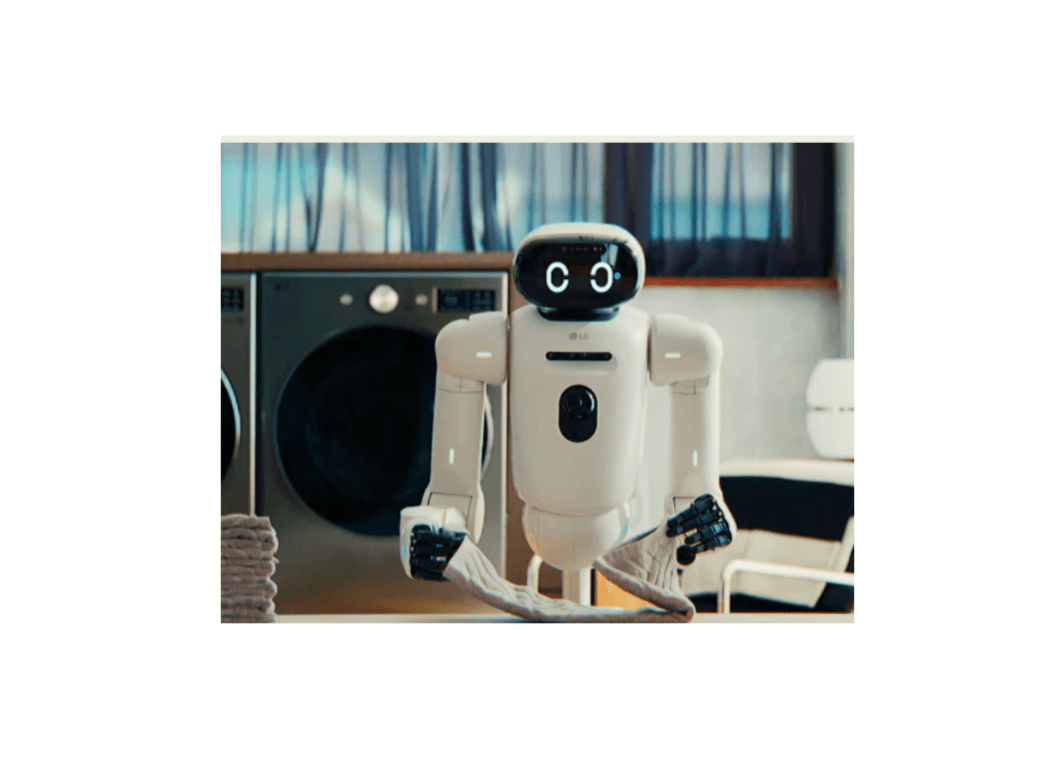
With its debut at CES 2026, LG CLOiD™ moves the idea of a fully automated home from concept to something surprisingly tangible. Unveiled by LG Electronics, the AI-powered home robot is the centerpiece of LG’s Zero Labor Home vision—an approach where intelligent machines take over time-consuming household chores so people can reclaim their time, energy, and attention.
Rather than presenting robotics as futuristic spectacle, LG framed CLOiD as a practical household partner designed to work seamlessly with everyday appliances and real living spaces.
From Smart Appliances to a Smart Home Assistant
LG CLOiD is built to coordinate and perform household tasks across LG’s connected home ecosystem. At CES, demonstrations showed the robot retrieving milk from a refrigerator, placing a croissant into an oven to prepare breakfast, and later initiating laundry cycles once occupants left the home. After drying, CLOiD folds and stacks clothing—illustrating not just automation, but contextual understanding of daily routines.
This level of coordination is made possible through deep integration with LG’s ThinQ™ platform and ThinQ ON hub, allowing CLOiD to orchestrate multiple appliances as a single system rather than isolated devices.
Hardware Designed for Real Homes
Physically, LG CLOiD looks less like a factory robot and more like a household assistant built to coexist safely with people, pets, and furniture. It features a head unit, a torso with two articulated arms, and a wheeled base designed for stability and smooth navigation.
Each arm has seven degrees of freedom—comparable to a human arm—while the hands include five independently actuated fingers capable of fine manipulation. This enables CLOiD to grasp everyday objects, open doors, and operate appliances in kitchens, laundry rooms, and living spaces. The wheeled base, derived from LG’s experience with autonomous robot vacuums, keeps the robot low to the ground to reduce tipping risk.
The Head as a Mobile AI Hub
CLOiD’s head functions as a mobile AI home hub. It houses cameras, sensors, a display, speakers, and voice-based generative AI, allowing the robot to communicate naturally with users through speech and expressive on-screen “facial” cues.
Over time, the system learns household layouts and lifestyle patterns, adapting its actions based on daily routines rather than fixed commands. In practice, this means CLOiD doesn’t just follow instructions—it anticipates needs.
Physical AI: Seeing, Understanding, Acting
At the core of LG CLOiD is LG’s Physical AI, which combines two key technologies:
- Vision Language Model (VLM): Converts images and video into structured, language-based understanding.
- Vision Language Action (VLA): Translates what the robot sees and hears into physical actions.
Trained on tens of thousands of hours of household task data, these systems allow CLOiD to recognize appliances, interpret user intent, and perform appropriate actions—like opening a refrigerator or transferring items from one surface to another.
AXIUM Actuators: The Hidden Enabler
Alongside CLOiD, LG introduced LG Actuator AXIUM™, a new line of robotic actuators that serve as the joints of service robots. Actuators are among the most complex and expensive robot components, and LG is leveraging decades of appliance engineering to deliver compact, high-torque, and efficient designs.
This focus on core robotics components signals LG’s long-term commitment to Physical AI—not just as a product feature, but as a foundational technology platform.
A Roadmap Toward the AI Home
LG’s broader strategy goes beyond a single robot. The company envisions a future that includes appliance robots (like advanced robot vacuums) and robotized appliances—such as refrigerators that automatically open as someone approaches. Together, these systems form an AI Home where routine chores fade into the background.
As Steve Baek, president of LG’s Home Appliance Solution Company, summarized, the goal is simple: make housework a thing of the past so people can focus on what truly matters.
Why CLOiD Matters
LG CLOiD stands out at CES 2026 not because it looks futuristic, but because it feels practical. It reflects a shift in consumer technology—from smarter devices to smarter living—where AI and robotics are judged not by novelty, but by how effectively they reduce friction in everyday life.
If LG’s vision holds, the Zero Labor Home isn’t about replacing people—it’s about giving them their time back.
 Surfside Washington News