
.
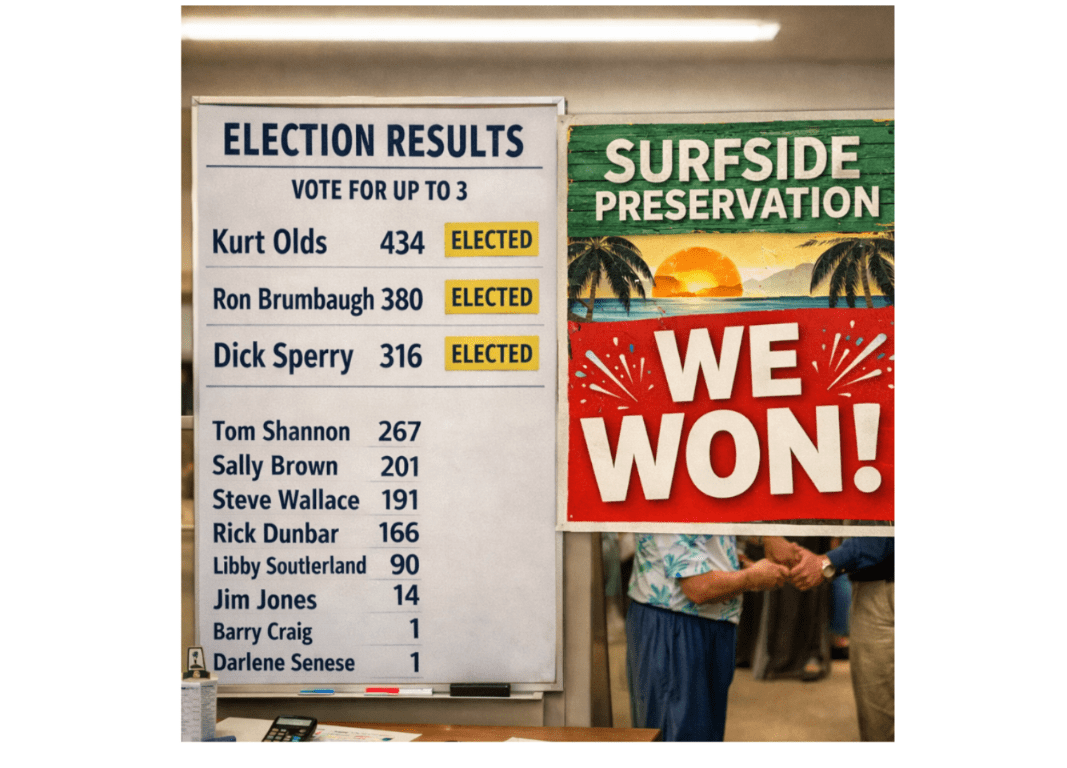
The 2022 Surfside HOA election results weren’t just decisive. They were structured.
Most people look at election results and see winners and losers. Clearly you can see a pattern. And when you sort the candidates by votes received, what you see isn’t a tight cluster—it’s tiers. In this election you could only vote for three candidates.
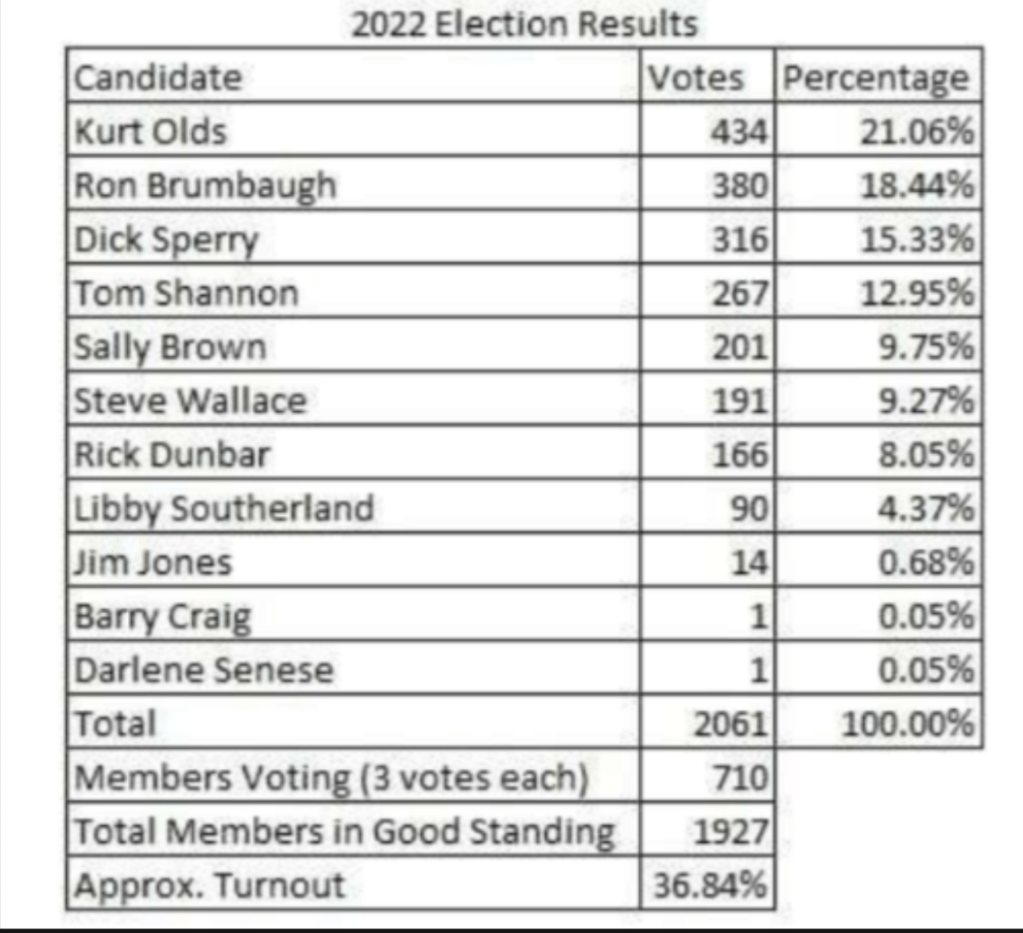
At the top sit Kurt Olds and Ron Brumbaugh, both near the 400-vote mark. Below them is a group clustered around the low 300s. Then another group of Surfside preservation candidates around the low 200s. After that, the numbers fall off sharply. What this shows is that Kurt and Ron voted for themselves then split their remaining two votes amongst the other candidates.
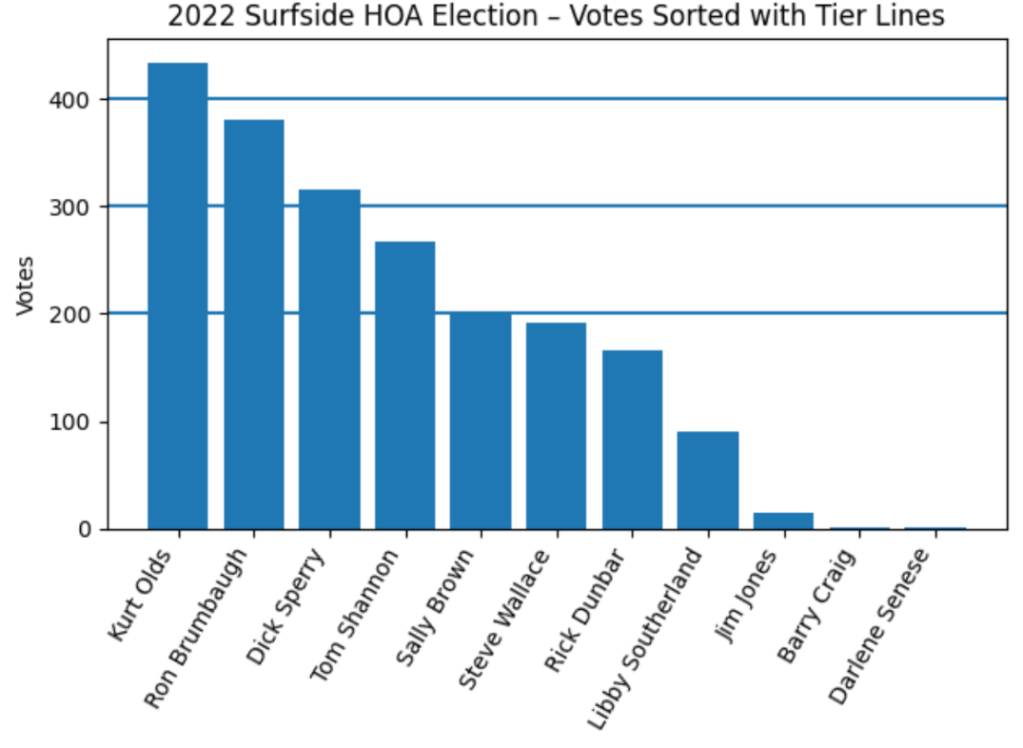
That stepped shape matters.
In a typical, competitive HOA election—where voters are making mostly independent choices—you’d expect the results to compress toward the middle. Some candidates a little higher, some a little lower, but not clean gaps of 100 to 200 votes separating entire groups of candidates.
Here, the gaps are unmistakable:
- The top tier sits about 100+ votes above the next group of essentially Surfside preservation candidates. This is Ron and Kurt getting the most votes. Aligning with the proxy ballot instructions for the Surfside elections, to name them as proxy voters.
- The middle tier sits another ~100 votes above the next.
- Then the bottom drops off a cliff.
That doesn’t look like organic variation. It looks like bloc voting.
And in this case, there was a very specific mechanism that explains the bloc.
Surfside Preservation did not send voting guidance to the entire HOA. It sent ballot instructions on their website and newsletters. In those instructions, Surfside preservation members were told to list Kurt Olds and Ron Brumbaugh as their proxy holders for that election. Kurt’s name was listed first as a proxy recommendation.
That detail is crucial.
A proxy holder doesn’t just cast one vote. A proxy holder can vote across the entire ballot. That means Kurt and Ron weren’t just receiving votes for themselves. They were being handed control of a block of votes that could be cast for the other three Surfside Preservation–aligned candidate as well.
In practical terms, this creates a pre-loaded voting bloc—in this case of about on the order of about 100 proxy votes—that moves in lockstep.
So the math works like this:
- Kurt and Ron theoretically get a number of proxy votes of Surfside preservation members based on the ballot instructions.
- Using those proxies first for themselves and then they cast votes for the rest of the Surfside Preservation slate.
- Independent candidates—who do not have access to this proxy machine—start the race roughly 100 votes behind before most ballots are even counted.
The rest of the candidates now battle over remaining vote and that is exactly what the results look like.
You don’t see a smooth distribution. You see tiers. You see a top tier lifted well above the rest. You see Preservation-aligned candidates consistently outpacing independents by margins that line up with the theoretical size of that proxy bloc. But that doesn’t include the Surfside preservation members who didn’t vote by proxy. This the gap between proxy votes and the next tier of Surfside preservation candidates.
This isn’t about one or two candidates being slightly more popular. It’s about structure. When a disciplined group centralizes its votes through proxies, it doesn’t just influence outcomes—it shapes the entire election landscape.
With roughly 700 members voting out of about 1900 elgible, a coordinated bloc of around 100 voters is enormous. That’s not a small edge. That’s a built-in advantage big enough to define who can realistically win.
And that’s why the numbers don’t look like a normal, competitive community election. They look layered. Stratified. Like the votes were poured into pre allocated buckets.
The results show the pattern.
The proxy ballot instructions explain why the pattern exists. Or gives an indication as to a baseline of how many members exist.
On paper, the system looks fair. In practice, a small, organized group can pre-load the outcome long before independent candidates ever have a real chance.
That’s not just a political observation. It’s what the data says. Back then it was theoretical.
The Surfside preservation candidates Brumbaugh, Olds, Sperry get elected. Some would argue all’s fair in politics as represented by our national elections. But this voting bloc allows members with an agenda to dominate elections. The question is how did they obtain this voting bloc. This Surfside election started a single-minded inner circle going forward with consequences to certain members that will be felt for decades.
 Surfside Washington News