
When I ran for the Surfside board in 2023, I was a complete outsider. I didn’t know any board members. I didn’t know anyone on the committees. I didn’t belong to any group or slate. I had proposed looking at electronic voting—mostly because Surfside has a large number of off-peninsula owners—and I hoped the idea might get a fair look.
I decided to run.
I built my own brochures. I bought my own envelopes. I paid a painful amount for stamps. And when I could, I walked Surfside—east side, west side, around the lake—covering as much ground as my legs would allow. Surfside is big, and I’m not a permanent resident, so I knew I wouldn’t reach anywhere near 2,000 members. Still, I probably handed out 200 to 300 brochures by foot. Maybe 10% were read.
Some people were curious. Some were suspicious—more than a few clearly thought I might be scoping out their property. But I also had some genuinely great conversations: about an electric truck someone owned, about a classic car, and even with a family whose parents had been among the original residents when Surfside was barely developed. I heard a lot of stories. I also heard plenty of frustration about the board and how things were being run.
Before my first board meeting as a candidate, I got a long, unexpected phone call from a board member candidate. We talked for about two hours. We had both traveled overseas. We had things in common. At the time, it felt friendly. In hindsight, I’ve wondered whether it was also a kind of informal vetting—trying to figure out where I stood on before I ever walked into the room for candidate interviews. This same person was part of a coordinated attack of Surfside preservation candidates in the candidate interviews.
The Meeting That Changed How I Saw Things
At that first candidate introduction meeting, I was sitting in the audience with other candidates when a senior woman—clearly a grandmother—was giving her appeal. The president at the time, interrupted her and raised his voice, cutting her off and not allowing her to continue. The way she was treated was jarring. I was raised to respect elders, and I’d never seen an elderly person spoken to like that in a public.
The room actually gasped. The board members and candidates said nothing about the treatment of this grandmother.
Only when the audience reacted did she get to finish her appeal, which she had every right to do. You could see she was shaken. After the meeting, I asked around, got her number, and called her to make sure she was okay. I later learned more about her grandkids and about taking them to an animal farm to hold rabbits and goats and see the animals. It was a small, human conversation—but it made the contrast even sharper. This wasn’t some abstract “case.” This was a real person living alone in Surfside who had just been publicly mistreated.
That was the first moment I realized something about the culture here was deeply wrong.
The Interviews: How I Became “The Opposition”
When the candidate interviews started, nobody really knew me. I had no local history, no faction, no allies. One of the first questions was about tree covenants. My answer was simple: covenants should be applied fairly and universally. It isn’t right that some areas of Surfside are subject to much stricter rules than others. I had also talked to a native American resident on Facebook who was harassed by Surfside preservation members. I reached out and offered to install a webcam. But she had wisdom about nature and how her culture treats trees as part of the family, all part of nature. I came to her defence and others regarding tree covenants.
From that point on, anyone who questioned the existing tree covenant structure was treated as an enemy. I was now, by definition, “opposition” or a troublemaker to Surfside Preservation.
I also suggested a few practical things:
- Training or online tutorials so residents—especially seniors—could actually understand the covenants before getting fined.
- Looking at EV charging stations, based on real conversations I’d had walking the neighborhood.
- Electronic voting, to increase participation, especially since a large share of members live outside Pacific County.
- Provide free expertise to run the election something that would take a day.
The responses were telling. Training? They didn’t want to pay for it. EV charging? Also no. Electronic voting? Polite responses about “needing to look at it more carefully”—followed by no real discussion at all, and then coordinated opposition by Surfside preservation.
There was another moment during the interviews that stuck with me. One candidate aligned with the existing board arrived with a prepared statement. No other candidate had been told to prepare one. None of us had been given notice that this would even be part of the process. Yet somehow, this person knew to bring one. They are currently running the election committee.
The number of people online was less than a dozen. The people in the room was about 20 including seven candidates.
At the time, it felt odd. Later, it felt revealing about being an outsider ton Surfside preservation.
That same candidate would later chastise me publicly at the member meeting for putting on my brochure that supporters could use me as their proxy if they couldn’t attend the meeting. The criticism at the member meeting was framed as if I had done something improper or unethical.
The irony was hard to miss. Given that I tried to have the board discuss and rule on it, and was ignored. Also ironic that these were instructions provided by Surfside Preservation to supporters to use Kurt Olds and Ron Brunbaugh as designated proxies
My proxy request was on my own campaign brochure, sent openly and transparently. Meanwhile, Surfside Preservation was publishing targeted voting instructions on their own website and through their own newsletters—telling their members exactly who to vote for and how to fill out the ballot the previous year, naming two board candidates as proxies. That guidance was not provided to the full HOA membership in the same way.
So on one hand, I was being scolded in public for a plainly stated, transparent request. On the other hand, a coordinated group was privately distributing detailed voting instructions in the prior year to supporters and that was treated as normal.
Taken together, it reinforced a pattern I was already starting to see: some candidates were operating with inside lanes and advance knowledge, while others were expected to just show up and play by rules that weren’t being applied evenly. And a voting block that didn’t make sense to me.
At the same time, anything I said or proposed at the candidate interview started getting attacked—online and in meetings—by Surfside Preservation and aligned board members. I was compared to a “snake oil salesman” over electronic voting. I was accused, absurdly, of wanting to sell email addresses—even though I went out of my way to protect data with encryption, strong passwords, and secure storage. Ironically, the president, Rom Brumbaugh, would later urge residents to remove their emails to prevent them from being sold in the Surfside weekenders, the hoas newsletter.
The message was clear: the issue wasn’t the ideas. The issue was that I wasn’t “one of them.”
Proxies, Campaigning, and a Chaotic Member Meeting
The board never took up my question about the ethics of putting your name on a proxy. So I made a straightforward decision: I put on my brochure that if someone couldn’t attend the meeting and wanted to support me, they could list me as their proxy, and I would make sure their vote was submitted. At the time, voting required either being present or assigning a proxy. That was the system.
I kept campaigning as best I could. More walking. More brochures. More conversations.
Then came the big member meeting. Over 200 people showed up, split between Surfside Preservation and everyone else. The atmosphere was hostile—honestly, it felt like Game of Thrones.
A member rose to propose a reasonable compromise on the tree covenants. Still, he was shouted down with cries of “shame” and rebuke from a prominent member of the tree committee about staying in cooperation with said member, who worked with the committee, in a scene that recalled the public shaming of Cersei in Game of Thrones. But there was more drama to come.
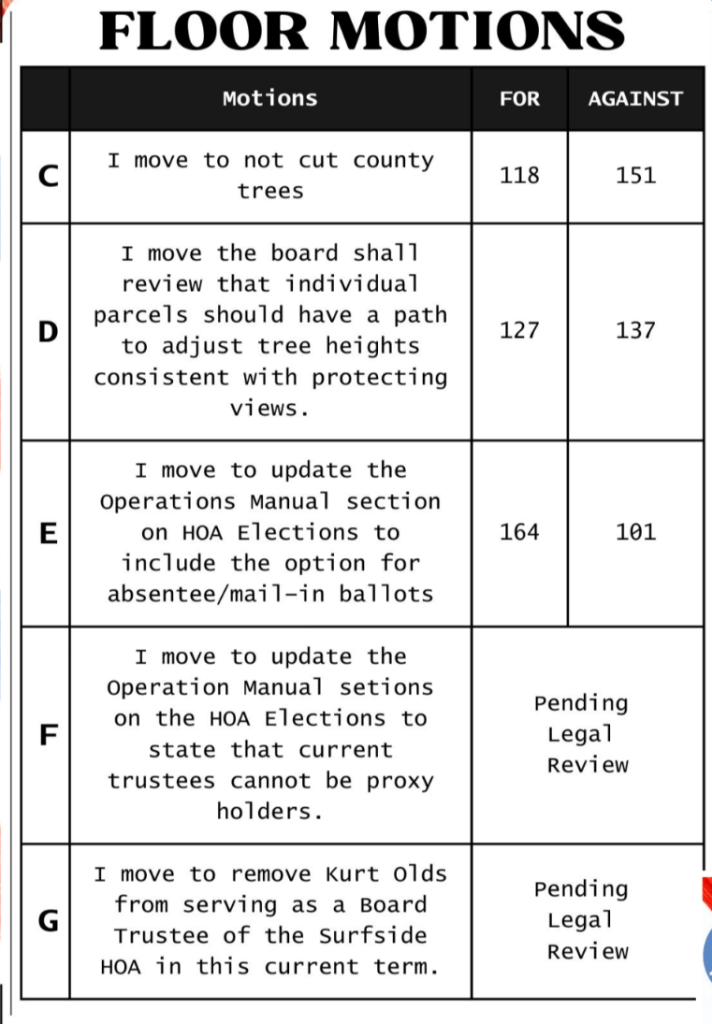
Then a former woman board member stepped forward and introduced a motion to remove the president, citing his treatment of women, staff, and volunteers. The vote happened. The results were delayed. Then they were released. And then the board said, essentially: this vote doesn’t count despite passing by a large margin, 138-105. Because Surfside is a nonprofit, they claimed you needed 30 days’ notice before a vote to remove a board member.
What happened next was one of the strangest things I’ve ever seen in any organization. Instead of addressing the motion as submitted, the board reframed them as a separate, controlled ballot—a kind of popularity vote. The president got to write his response as a vote for me candidate declaration. The original motion reason was stripped out. The women member who brought the complaint was, in effect, forced into a public, humiliating position—having to watch her motion and concerns sanitized into a ballot question sent to the entire membership. She asked to write the response arguing the law aspects of the vote and not the original motion.
Imagine an issue raised to an HR department responding to a serious complaint about a manager’s behavior or actions by sending out a small company ballot asking, “Do you like this company president?” That’s what this felt like.
That ballot, kept the president as a board member. Where was the process on the board to objectively look at the actions of the president and the treatment of office staff and other members. Ironically, most of the office staff no longer works for the HOA.
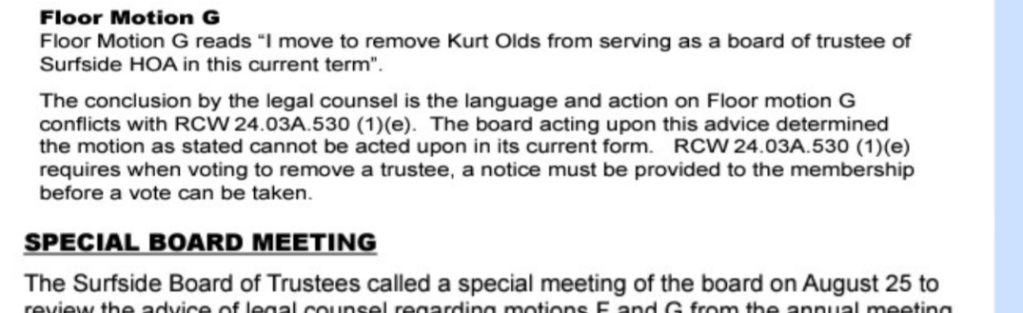
The vote on motion G passed 138 to 105. Despite overwhelming support, the board took no action. Instead, they overturned the motion. Stating. Notice is required before members can vote to remove a trustee.
The reasoning was
The Numbers That Didn’t Sit Right
The independent candidate campaign where Steve Wallace and I had combined resources and published a joint brochure. We were both clearly in the opposition camp now. We attempted to reach members. Although we gained votes compared to the previous year
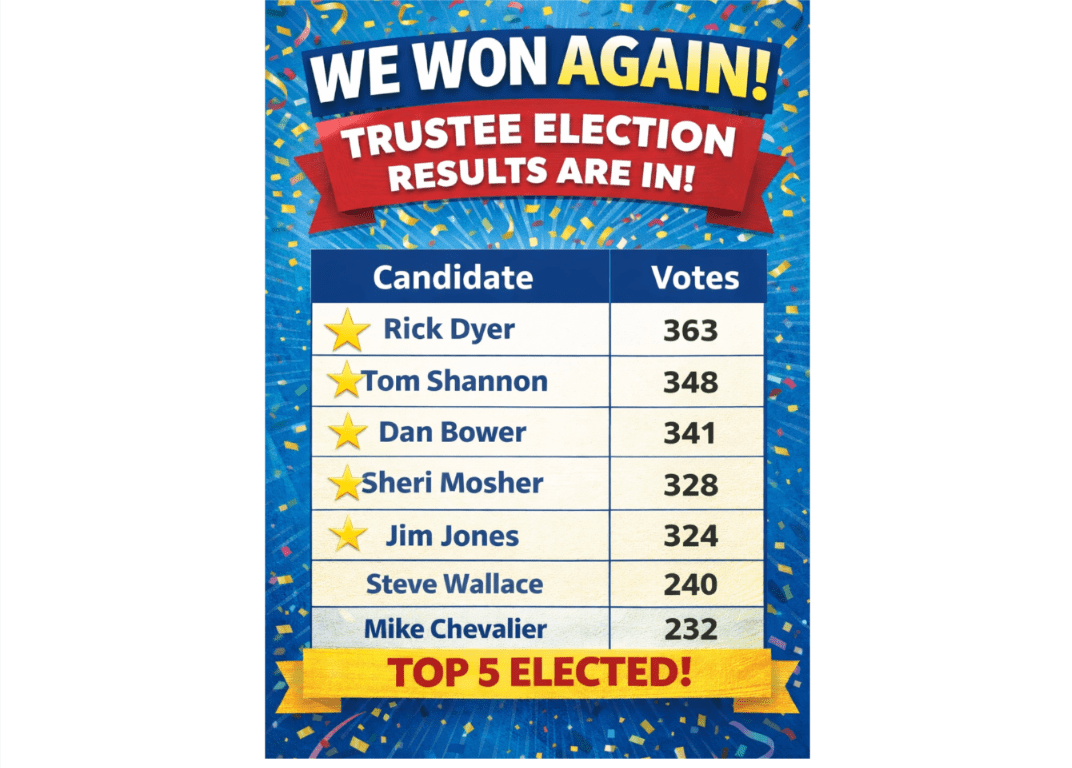
We lost by close to 100 votes.
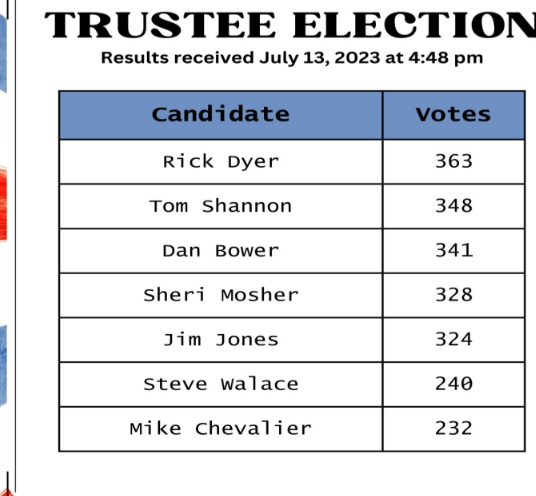
What struck me was how familiar that number was. It was roughly the same margin that had appeared in the previous election—an election that had relied heavily on proxy ballots. This election was no different.
The second learning was seeing that five preservation candidates ran for five positions to maximize their voting if giving instructions to Surfside preservation members. There were also only two independent candidates. And I can say I was never part of Surfside United since they were part of the previous election.
At the November member meeting, votes on motion G were passed overwhelmingly. But in the general election, there was again a large, consistent gap in favor of the Surfside Preservation candidates.
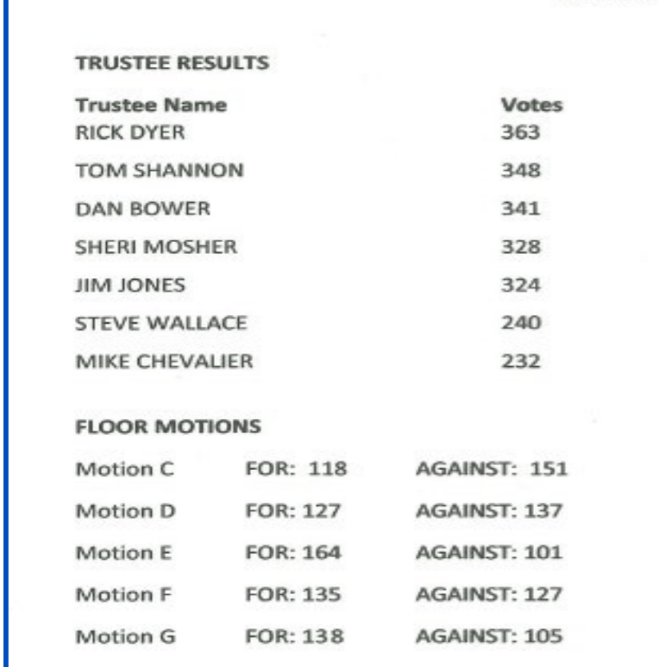
And remember: most of the candidates that year had no real name recognition in Surfside. They were mainly new. Yet the results weren’t close.
Rick Dyer, Tom Shannon, Dan Bower, Sherri Mosher, and Jim Chones all got elected. They just attached their names to a Brochure. Did they walk in Surfside? No. Did they create a brochure stating their own positions? No. Did they make any effort in providing money to pay for stamps, fill envelopes, or mail brochures? No. I spent three days printing individual brochures on my printer.
Surfside Preservation, meanwhile, had:
- A website
- Newsletters
- Detailed voting instructions telling their members exactly who to vote for and how to fill out the ballot.
- Running only the number of Surfside preservation candidates to match open positions as if they were appointed or preselected.
- Surfside Board members in charge of the process and election committee running elections including vote counts.
- Organized opposition and members in the audience in support of preservation candidates with targeted questions.
- Referred to the group that outed the president as a flash mob and loud and disruptive group. No mention of the tree committee member who yelled Shame.
A flash mob—or 138 residents standing up for women and for the former board member who introduced the motion to hold the president accountable and protect staff, volunteers, members, and board members?
So I started wondering some uncomfortable questions:
How does a select group get such detailed voting instructions while the broader membership doesn’t?
Who exactly receives those newsletters?
How does that kind of coordinated instruction change outcomes in a low-participation election?
How a motion meant to oust a board member to protect women passes overwhelmingly, gets overturned in a special ballot by close to a 100-vote margin?
I didn’t have the full answer yet. But the pattern was there.
Between the treatment of residents and candidates, the way motions were procedurally neutralized, the inside lanes some candidates seemed to have, the communication advantages of a private organization, control of lection committees and rules. and the persistent vote margins that didn’t match what I was seeing in the room, it became clear to me that something was off.
This article is about looking Back after a recent major realization.
Because once you start looking at the numbers, there is a clear pattern?
As an engineer, once provided with data, you can determine why the margins are. I will reveal the reason in a future article.
 Surfside Washington News