
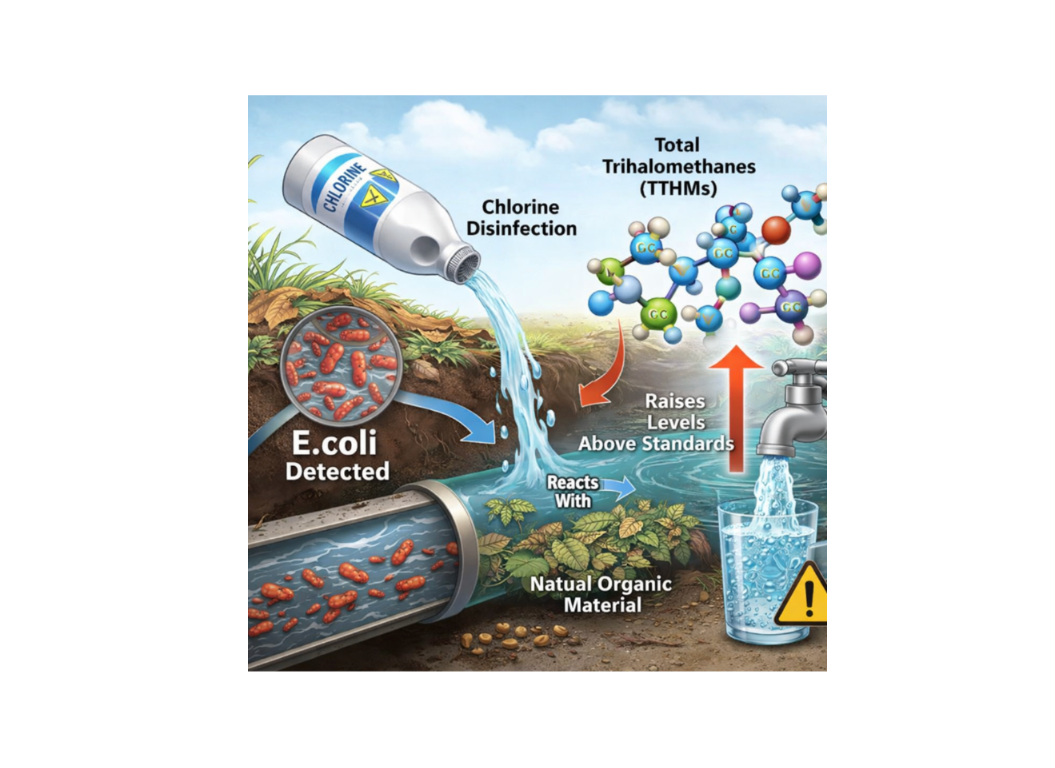
Residents in Surfside recently received an important drinking water notice dated March 10, 2026, informing customers that the community water system has exceeded federal standards for Total Trihalomethanes (TTHMs)—a group of chemical byproducts formed during the water disinfection process.
According to the public notice, routine monitoring over four quarters between March 2025 and February 2026 found that the Surfside water system exceeded the federal Maximum Contaminant Level (MCL).
Federal limit: 80 micrograms per liter (µg/L)
Surfside system average: 85.3 µg/L
Officials stated that residents do not need to switch to bottled water and may continue normal activities such as drinking tap water, showering, and doing laundry.
State Letter Confirms Regulatory Violation
A separate letter from the Washington State Office of Drinking Water confirms that the Surfside Homeowners Water System has officially exceeded the Maximum Contaminant Level for trihalomethanes.
The most recent testing results show:
106.9 µg/L recorded at 304th Place and Stackpole Road
Elevated readings at 295th Place and G Street
Locational Running Annual Average (LRAA): 85.3 µg/L
These results exceed the federal drinking water standard of 80 µg/L, triggering a formal MCL violation notification requirement.
The state also noted that Surfside has experienced multiple elevated TTHM readings in past years, including:
February 2026
December 2024
May 2024
September 2023
December 2021
Because of the repeated exceedances, the Washington Office of Drinking Water has required the water system to submit an action plan to address disinfection byproduct compliance and evaluate treatment changes.
Why TTHMs Form in Drinking Water
Trihalomethanes are not intentionally added to drinking water. Instead, they form when chlorine used for disinfection reacts with naturally occurring organic material in water.
The four most common TTHMs include:
Chloroform
Bromodichloromethane
Dibromochloromethane
Bromoform
These compounds are created when disinfectants interact with substances such as decaying vegetation, algae, or other organic matter present in raw water sources.
Possible Link to Earlier E. coli Disinfection
One possible explanation for elevated TTHM levels is the increased use of chlorine following earlier bacterial contamination events.
When E. coli is detected in a water system, utilities typically raise chlorine levels to disinfect pipes and protect public health. While chlorine effectively kills bacteria, it can also react with natural organic material in the water, forming trihalomethanes as a chemical byproduct.
In simple terms:
More chlorine used to kill bacteria can result in higher levels of TTHMs forming in the water.
Why These Chemicals Are a Concern
Health agencies monitor TTHMs because long-term exposure above federal limits may increase health risks.
According to federal drinking water guidance, prolonged exposure may be associated with:
Increased risk of certain cancers, particularly bladder cancer
Possible impacts on the liver and kidneys
Effects on the central nervous system
Potential reproductive concerns with long-term exposure
The current notice states that the situation does not pose an immediate health risk, but the standards exist to reduce potential risks over many years of exposure.
What Happens Next
The Washington Office of Drinking Water has instructed the Surfside water system to submit a corrective action plan by April 2026.
Possible solutions could include:
Improving removal of organic material before chlorination
Adjusting disinfection methods
Modifying treatment processes
Conducting further evaluation of the water system
State engineers will review the plan and work with the water department to bring the drinking water supply back into full regulatory compliance.
 Surfside Washington News