
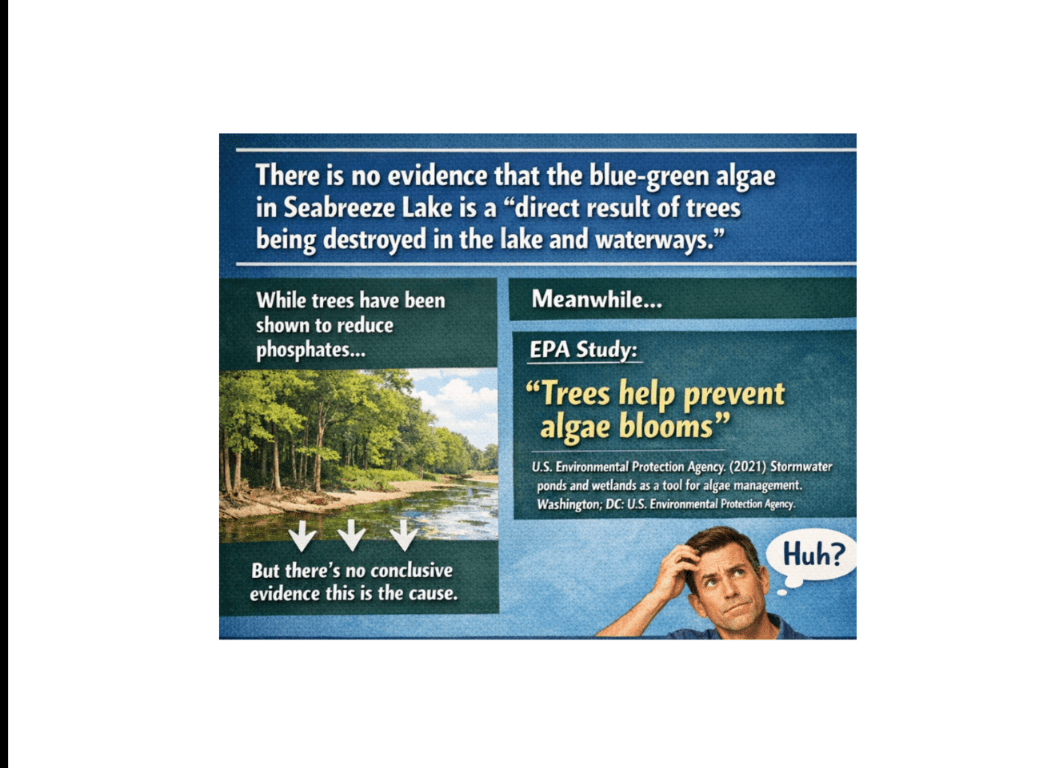
The Surfside Tree Committee claims there is no direct evidence linking the destruction of trees around Seabreeze Lake to the rise of blue-green algae, even while acknowledging that trees reduce phosphorus and stormwater runoff—two of the primary drivers of algae blooms. This poster illustrates the contradiction between that conclusion and the well-established science showing that tree canopy helps filter nutrients and protect lakes from harmful algae. The article explains the questionable logic applied implying
In the same post accusing me of being the manager of mischief, the Surfside preservation post states
“Furthermore, Mr. Chevalier states he has “science on his side” yet there is no evidence that the blue green algae in Seabreeze lake is a “direct result of trees being destroyed in the lake and waterways“. While trees have been shown to reduce phosphates there is no conclusive evidence this is the cause for the issues with Seabreeze Lake. Much more likely contributors, as noted by the EPA are stormwater, wastewater, fertilizers, and yard and pet waste.
My Our Fish and Waterways minutes reflect the vote to not to treat the lake in 2022 that likely caused or greatly contributed to the current conditions. Further review of minutes dated 12/8/22 include a 2020 discussion with Kathleen Sayce, Biologist, Shoalwater Botanical, Principal noting the issue of “Homeowner bad habits—dumping grass and yard clippings in water and on banks, tossing pet poo in water, encouraging resident geese and ducks by feeding, planting nonnative invasive species in yards and in water, failing or poorly maintained septic systems, stormwater runoff over ground into canals”
I do appreciate that the tree committee member is acknowledging that trees are being destroyed in the lake and waterways. They forgot to mention aggressive enforcement and denial of appeals and heavy fines and the threat of lawsuits causes the trees to be destroyed.
This claim suggests that while trees may reduce phosphates, there is no conclusive evidence linking tree loss to the algae problems in Seabreeze Lake. Instead, the argument points to stormwater runoff, wastewater, fertilizers, and yard or pet waste as the likely causes of nutrient pollution.
Ironically, this statement actually reinforces the importance of trees.
By losing trees resulting in reduced tree canopy, you increase stormwater runoff carrying pollutants into nearby waterways.
Ironically, stormwater runoff was specifically identified as a major pathway carrying pollutants into the water. Claiming that trees play no meaningful role in reducing this process ignores well-established environmental science. Trees intercept rainfall, increase soil absorption, and slow runoff—reducing the transport of nutrients, bacteria, and contaminants into lakes and canals. To acknowledge stormwater runoff as a major pollutant pathway while arguing that tree canopy does nothing to mitigate it is itself a logical contradiction.
The argument for trees
The U.S. Environmental Protection Agency and decades of urban forestry research identify stormwater runoff as one of the primary pathways that carries pollutants into lakes, rivers, and coastal waters. Rainwater flowing across streets, roofs, driveways, and lawns collects contaminants and transports them directly into nearby waterways. Those contaminants include fertilizers rich in phosphorus and nitrogen, pet waste bacteria, decomposing yard debris, oils from vehicles, heavy metals, and microscopic tire particles produced by roadway traffic.
This is precisely why cities and counties across the United States adopt urban forestry and tree-preservation policies. Trees are not simply aesthetic landscape features; they are a critical component of stormwater management infrastructure.
Tree canopies intercept rainfall before it hits the ground, reducing the velocity and volume of water reaching the soil. At the same time, tree roots improve soil structure and increase infiltration, allowing rainwater to be absorbed rather than becoming surface runoff. These natural processes significantly reduce the amount of polluted stormwater entering lakes and waterways.
Scientific studies show that mature trees can intercept hundreds to thousands of gallons of rainfall each year. Urban forests collectively function as a natural filtration system that slows stormwater, captures pollutants, and reduces nutrient loading into nearby water bodies.
Without sufficient tree canopy, rainfall rapidly becomes surface runoff. That runoff then carries fertilizers, pet waste, organic matter, and roadway pollutants directly into lakes and canals, where nutrients such as phosphorus and nitrogen fuel algae growth. In other words, the pollutants identified as causes of algae blooms typically reach the water through stormwater runoff—the very pathway that tree canopy helps control.
This is why many municipalities throughout Washington State and the Pacific Northwest set tree-canopy targets and incorporate tree protection into stormwater management plans. Maintaining tree canopy is widely recognized as one of the most effective natural methods for reducing runoff and improving water quality.
The debate surrounding Seabreeze Lake therefore should not focus solely on whether fertilizers or pet waste contribute nutrients to the water. Those sources are well documented. The more important question is how those pollutants are transported into the lake.
Where tree canopy is abundant, rainfall is intercepted, absorbed, and filtered before it can reach waterways. Where tree canopy has been reduced, rainfall becomes runoff that rapidly carries pollutants into lakes and canals.
Tree Canopy and Stormwater: The Visible Difference Between East and West Surfside
A clear example of how trees help reduce stormwater runoff can be seen by comparing East Surfside and West Surfside. East Surfside does not exhibit the same level of algae bloom problems seen in Seabreeze Lake and the canals on the west side. One of the most important differences between the two areas is tree canopy coverage and tree height.
In East Surfside, trees commonly reach heights of approximately 35 feet, and there has historically been little enforcement of restrictive tree-height limits, allowing the area to maintain a robust tree canopy exceeding 40 percent. In contrast, West Surfside is subject to stricter height restrictions of 16 and 24 feet, and decades of enforcement have reduced the tree canopy to roughly 14 percent.
This difference is significant. Larger and more numerous trees intercept rainfall in their canopy, increase groundwater absorption through extensive root systems, and improve soil infiltration. These processes reduce the volume and speed of stormwater runoff that carries pollutants into nearby lakes and canals. Numerous scientific studies and federal environmental guidance recognize urban tree canopy as an important natural component of stormwater management.
The contrast between East and West Surfside illustrates how taller trees and greater canopy coverage can significantly increase water absorption and reduce polluted runoff before canals and lakes
The argument for ignoring trees helping with algae blooms, ends up sounding like someone explaining that car crashes cause injuries and fatalities, carefully listing all the reasons—and then concluding seatbelts probably don’t save lives. Even though the evidence shows seat belts save lives. If there was a covenant in Surfside stating no seatbelts, this board would uphold it until the members voted it down..
Ironically, in New Hampshire, adults (18 and older) are not legally required to wear a seatbelt. Despite overwhelming evidence that seatbelts save lives, common sense has not fully carried the day there. In contrast, most states recognize the value of proven safety measures and require seatbelts for drivers and passengers.
The same principle applies to environmental policy. Across Washington, counties and cities have adopted urban forestry ordinances that protect existing trees and encourage planting them throughout neighborhoods. These policies generally avoid restrictive height limits because communities understand what decades of research shows: mature trees absorb stormwater, reduce flooding, improve air quality, and protect public health and well-being.
Environmental science reached its conclusion decades ago: trees are one of the most effective natural defenses against stormwater runoff and the pollution it carries into lakes. And like New Hampshire, surfside continues to ignore the best available science. Pacific county continues to do the same thing by allowing Surfside to enforce tree height restrictions despite the best available science to protect and grow trees being applied to future neighborhood development.
References
Berland, A., Shiflett, S. A., Shuster, W. D., Garmestani, A. S., Goddard, H. C., Herrmann, D. L., & Hopton, M. E. (2017). The role of trees in urban stormwater management. Landscape and Urban Planning, 162, 167–177. https://doi.org/10.1016/j.landurbplan.2017.02.017
Xiao, Q., McPherson, E. G., Ustin, S. L., Grismer, M. E., & Simpson, J. R. (2000). Winter rainfall interception by two mature open-grown trees in Davis, California. Hydrological Processes, 14(4), 763–784. https://doi.org/10.1002/(SICI)1099-1085(200003)14:4<763::AID-HYP971>3.0.CO;2-7
References
American Forests. (2002). Urban ecosystem analysis: Puget Sound region. American Forests.
Nowak, D. J., Hirabayashi, S., Bodine, A., & Greenfield, E. (2014). Tree and forest effects on air quality and human health in the United States. Environmental Pollution, 193, 119–129. https://doi.org/10.1016/j.envpol.2014.05.028
U.S. Environmental Protection Agency. (2021). Stormwater management and green infrastructure. https://www.epa.gov/green-infrastructure
U.S. Environmental Protection Agency. (2023). Nutrient pollution: Sources and solutions. https://www.epa.gov/nutrientpollution
Xiao, Q., McPherson, E. G., Ustin, S. L., Grismer, M. E., & Simpson, J. R. (2000). Winter rainfall interception by two mature open-grown trees in Davis, California. Hydrological Processes, 14(4), 763–784. https://doi.org/10.1002/(SICI)1099-1085(200003)14:43.0.CO;2-7
 Surfside Washington News