
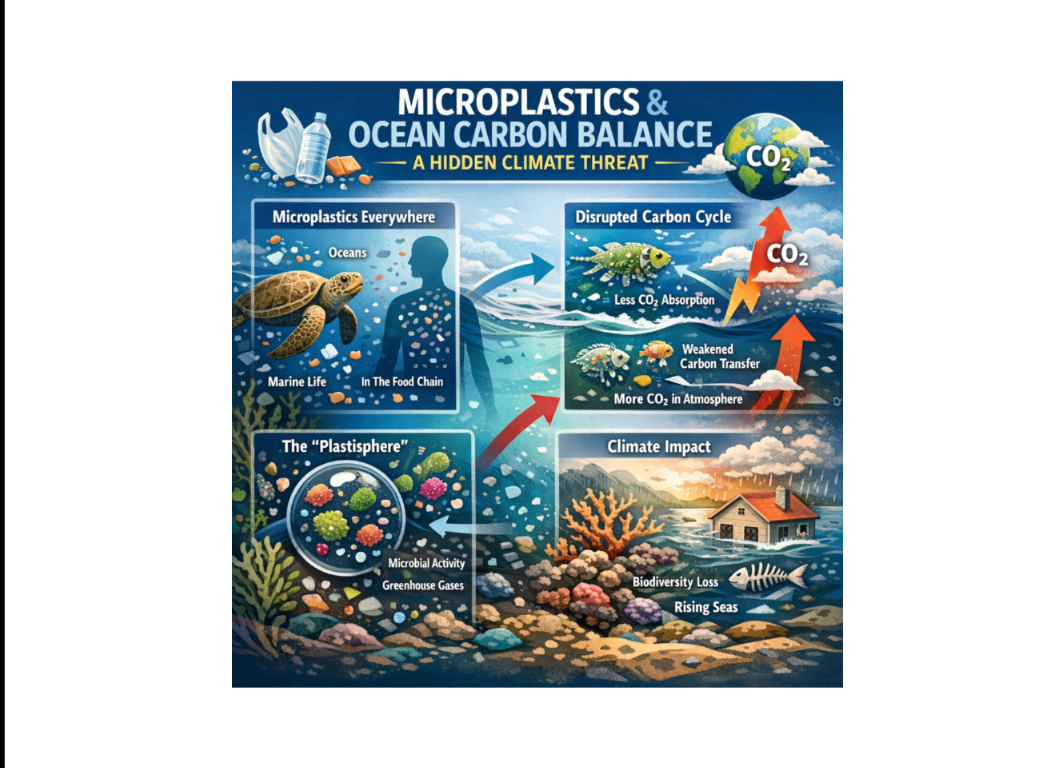
Microplastics—tiny plastic fragments less than five millimeters in size—have become one of the most pervasive pollutants on Earth. Once considered primarily a marine debris issue, they are now understood to be a far more complex environmental threat, with implications that extend into climate regulation itself. Scientists are increasingly warning that microplastics may be interfering with the ocean’s ability to absorb carbon dioxide, a process essential for stabilizing global temperatures.
A Planet Saturated with Plastic
Over the past several decades, plastic production has surged to staggering levels. Lightweight, durable, and inexpensive, plastics are used in nearly every sector—from food packaging to medicine and construction. But this convenience comes at a cost. As plastics degrade, they fragment into microplastics that disperse across ecosystems worldwide.
Today, microplastics have been detected in oceans, rivers, lakes, soil, the atmosphere, Arctic ice, and even inside the human body. Their persistence and mobility make them especially dangerous. Acting as carriers for toxic chemicals, these particles are ingested by marine organisms and enter the food chain, contributing to ecosystem disruption, declining biodiversity, and potential human health risks.
Oceans: Earth’s Largest Carbon Sink
The ocean plays a central role in regulating the planet’s climate. It absorbs a significant portion of atmospheric carbon dioxide (CO₂), helping to moderate global warming. This process relies heavily on what scientists call the “biological carbon pump”—a system driven by microscopic marine organisms.
Phytoplankton, tiny photosynthetic organisms, absorb CO₂ from the atmosphere. When they are consumed by zooplankton or die, carbon is transferred deeper into the ocean, where it can be stored for centuries. This natural cycle is one of Earth’s most important defenses against climate change.
However, emerging research suggests that microplastics are disrupting this delicate system.
Disrupting the Biological Carbon Pump
A recent study published in the Journal of Hazardous Materials: Plastics highlights how microplastics interfere with oceanic carbon cycling. According to the researchers, these particles can reduce phytoplankton’s ability to photosynthesize, limiting their capacity to absorb CO₂. At the same time, microplastics impair zooplankton metabolism, weakening the transfer of carbon to deeper ocean layers.
This disruption undermines the efficiency of the biological carbon pump, reducing the ocean’s ability to act as a carbon sink. Over time, this could lead to higher concentrations of CO₂ in the atmosphere, accelerating global warming.
The Role of the “Plastisphere”
Another emerging concern is the formation of the so-called “plastisphere”—a community of microorganisms that colonize the surface of microplastics. These biofilms are not just passive passengers; they actively participate in biochemical processes.
Scientists have found that microbes within the plastisphere can contribute to greenhouse gas emissions through their metabolic activity. As microplastics degrade, they may also release gases directly, further compounding their climate impact.
Together, these effects represent a previously underappreciated link between plastic pollution and climate change.
A Compounding Environmental Crisis
The consequences extend beyond the environment. Ocean warming, acidification, and biodiversity loss threaten fisheries, food security, and coastal communities around the world.
The interaction between microplastics and climate systems is complex and still not fully understood. However, researchers agree that the risks are significant. By disrupting marine ecosystems, weakening carbon storage mechanisms, and contributing to greenhouse gas emissions, microplastics could intensify some of the very processes driving climate change.
Gaps in Research—and a Call to Action
Despite growing evidence, scientists emphasize that the relationship between microplastics and climate change remains underexplored. Much of the existing research has focused on detecting microplastics and developing cleanup strategies, rather than understanding their role in global climate systems.
To address this gap, researchers are calling for more interdisciplinary studies that connect ocean science, climate modeling, and pollution research. They also urge policymakers to recognize plastic pollution as a climate issue—not just a waste management problem.
The Scale of the Problem
Global plastic production now exceeds 400 million tonnes per year, with a large proportion designed for single use. Alarmingly, less than 10 percent of plastic waste is recycled. The rest accumulates in landfills or leaks into the environment, where it continues to break down into microplastics.
Without significant intervention, plastic production is expected to increase dramatically in the coming decades, further intensifying the problem.
Toward Integrated Solutions
Addressing microplastic pollution will require coordinated global action. Researchers recommend reducing single-use plastics, improving waste management infrastructure, and investing in biodegradable alternatives. They also highlight the need for innovative monitoring technologies and stronger international policies.
Importantly, tackling microplastics could have dual benefits: protecting ecosystems while also preserving the ocean’s ability to absorb carbon dioxide.
Conclusion
Microplastics represent a hidden but growing threat to the Earth’s climate system. By interfering with the ocean’s natural carbon absorption processes, they may be weakening one of the planet’s most vital defenses against global warming.
As scientific understanding evolves, one message is becoming clear: the fight against climate change cannot be separated from the fight against plastic pollution. Addressing both challenges together may be essential for safeguarding the future of the planet.
Obaidullah, I. (2025). Microplastics and global warming: A hidden climate threat uncovered in a new perspective,
https://doi.org/10.1016/j.hazmp.2025.100032
.
 Surfside Washington News