
Across the Pacific Northwest, communities are facing a future shaped by stronger and more frequent atmospheric river (AR) events—long, narrow bands of moisture that deliver intense rainfall over short periods. These storms, increasingly amplified by climate change, are now recognized as a primary driver of flooding, infrastructure stress, and environmental degradation.
Yet while counties and cities invest heavily in engineered stormwater systems, one of the most effective—and scientifically proven—flood mitigation tools is often overlooked or even restricted: trees.
The Science: How Trees Reduce Flooding
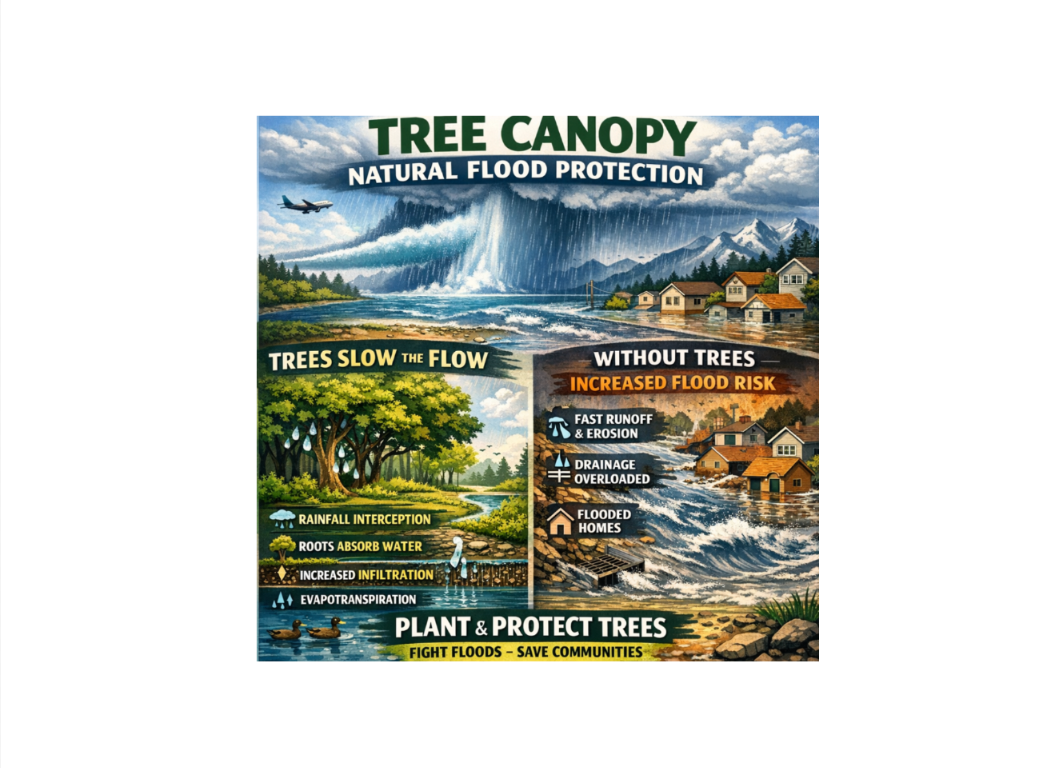
Tree canopy acts as a multi-layered defense system against flooding. Unlike hard infrastructure that simply channels water away, trees actively slow, absorb, and redistribute rainfall before it ever reaches the ground.
1. Rainfall Interception
Leaves, branches, and bark capture rainfall during a storm, preventing a significant portion from hitting the ground immediately. Studies show that mature trees can intercept 10–40% of rainfall, depending on species and canopy density.
2. Slowing Runoff
Water that does reach the ground beneath trees moves more slowly. Tree roots and leaf litter create porous soil conditions that reduce surface flow and erosion.
3. Increased Infiltration
Tree root systems break up compacted soils, allowing water to soak into the ground rather than rushing into storm drains, canals, and lakes.
4. Evapotranspiration
Trees return water to the atmosphere through evapotranspiration, reducing the total volume of water that contributes to flooding.
Atmospheric Rivers: Why the Threat Is Growing
Atmospheric rivers are not new—but their intensity and frequency are increasing. Warmer air holds more moisture, meaning AR events now deliver heavier rainfall over shorter timeframes.
According to research from institutions like NOAA and the Scripps Institution of Oceanography, these storms are expected to:
- Increase peak rainfall intensity
- Expand floodplain boundaries
- Overwhelm aging stormwater infrastructure
- Increase the frequency of “100-year” flood events
For coastal communities like Surfside and Ocean Park, where soils are sandy and water systems are interconnected with lakes and ocean outfalls, the risks are even greater.
The Critical Link: Tree Canopy and Flood Mitigation
The relationship between tree canopy and flooding is not theoretical—it is measurable, immediate, and profound.
Urban Canopy vs. Bare Landscape
Condition Flood Impact High Tree Canopy (40%+) Slower runoff, lower peak flows, reduced flooding Low Tree Canopy (<20%) Rapid runoff, overwhelmed drainage, higher flood risk
In areas like West Surfside, where canopy has been reduced to roughly 14–16%, the land behaves less like a sponge and more like a hard surface, accelerating water movement into canals and Seabreeze Lake.
This leads to:
- Flashier runoff during storms
- Increased sediment and nutrient loading
- Greater likelihood of flooding and infrastructure failure
Trees vs. Infrastructure: A False Choice
Modern climate resilience planning across cities like Seattle, Portland, and Vancouver emphasizes green infrastructure—with trees as a central component.
These cities recognize that:
- Pipes and drains move water
- Trees manage water at the source
Without upstream mitigation from canopy, stormwater systems become overwhelmed faster, requiring expensive upgrades that still fail during extreme events.
The Consequences of Canopy Loss
When tree canopy is reduced—whether through development, policy, or enforcement—the impacts compound:
- Increased Flooding: Faster runoff overwhelms canals and drainage systems
- Water Quality Decline: Pollutants wash directly into lakes and waterways
- Algae Blooms: Nutrient-rich runoff fuels harmful blooms
- Ecosystem Damage: Fish kills and habitat degradation follow
- Public Health Risks: Contaminated water and heat exposure increase
In coastal systems connected to the ocean, these impacts don’t stay local—they propagate outward, affecting broader ecosystems.
A Policy Disconnect
Despite overwhelming scientific consensus, some local policies continue to limit tree height or encourage canopy reduction, even in areas identified as high-risk for flooding and climate impacts.
This creates a contradiction:
- Climate assessments identify flooding as a major threat
- Tree canopy—the most effective natural mitigation tool—is restricted
It is the equivalent of acknowledging a flood risk while removing the very systems that prevent it.
The Path Forward: Restore the Canopy
To address the growing threat of atmospheric river-driven flooding, communities must shift from reactive to proactive strategies.
Key Actions:
- Eliminate restrictive tree height limits in all areas
- Adopt urban forestry plans aligned with climate threats like increasing heat, flooding, and rising seas
- Prioritize canopy equity, especially for seniors and vulnerable populations living in areas like Surfside
- Integrate trees into stormwater management systems
- Protect all trees so they can grow to become mature trees, which provide the greatest hydrological benefit
Conclusion
Flooding from atmospheric rivers is not a distant threat—it is a present and accelerating reality. But the solution is not purely technological.
It is ecological.
Tree canopy represents one of the most cost-effective, immediate, and scientifically supported defenses against flooding. Removing it—or failing to restore it—does not just ignore the problem.
It makes it worse.
In the face of intensifying storms, the question is no longer whether we can afford to protect and expand tree canopy.
It is whether we can afford not to.
 Surfside Washington News