
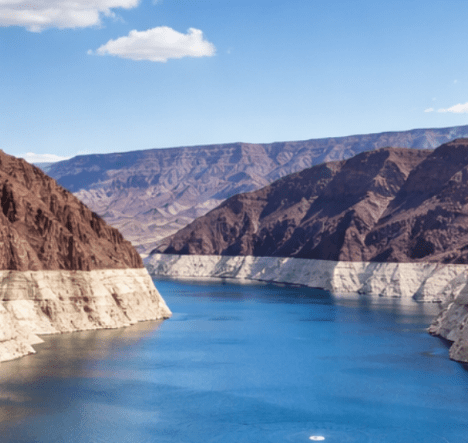
The American West is facing a slow-moving crisis that is no longer theoretical—it is visible in shrinking reservoirs, drying farmland, and growing conflict between states. At the center of it all is the Colorado River, a lifeline for nearly 40 million people, millions of acres of agriculture, and entire regional economies. Yet today, that lifeline is under unprecedented strain.
A River Promised More Than It Can Deliver
The Colorado River was divided up a century ago under the assumption that it carried abundant water. It doesn’t anymore.
- Original allocations promised roughly 15 million acre-feet annually
- Current flows are closer to 12 million acre-feet or less
- In 2025, flows dropped to about 8.5 million acre-feet in some estimates
The math no longer works. Demand exceeds supply—and the gap is widening.
This mismatch has created what many experts call a structural deficit, where even “normal” years cannot meet commitments.
The Megadrought Reality
The Colorado River Basin is not just in a drought—it is in a long-term megadrought driven by climate change.
- 100% of the basin has experienced drought conditions
- Warmer temperatures are reducing snowpack, the river’s primary source
- Groundwater losses since 2002 equal the entire capacity of Lake Mead
Recent winters have delivered record-low snow levels, meaning less spring runoff to replenish the system .
Even worse, rising temperatures are changing how water moves through the landscape. Plants are now pulling more groundwater during hot periods, reducing the amount that ever reaches the river—a phenomenon scientists call the “drought paradox.”
Reservoirs in Decline
The most visible sign of crisis is the dramatic drop in the two largest reservoirs in the United States:
- Lake Mead: hovering around one-third capacity
- Lake Powell: nearing levels that threaten hydropower generation
These reservoirs act as the West’s savings accounts—and they are being drained faster than they are refilled.
The famous “bathtub ring” etched into canyon walls is not just a visual—it’s a warning.
Agriculture: The First to Feel the Pain
Agriculture uses roughly 70–80% of Colorado River water, making it the first sector hit by shortages.
Farmers are already adapting:
- Cutting irrigation deliveries in half in some regions
- Leaving fields unplanted
- Switching to less water-intensive crops
- Investing in precision irrigation systems
But adaptation has limits. Entire farming communities face economic collapse if water cuts deepen.
Cities Under Pressure
Urban areas—from Denver to Phoenix to Los Angeles—are beginning to feel the squeeze.
- Cities are implementing watering restrictions and conservation mandates
- Snowpack feeding municipal supplies has dropped dramatically
- Some regions rely on snowmelt for up to 90% of their water
As population continues to grow in the Southwest, cities are competing with agriculture and ecosystems for the same shrinking resource.
Groundwater: The Hidden Crisis
As surface water disappears, many regions turn to groundwater—but this is not a sustainable solution.
- Aquifers are being depleted faster than they recharge
- Land subsidence (sinking ground) is already occurring in places like Arizona
- Some areas lack regulation, allowing over-extraction
Groundwater is often treated as a backup plan—but in reality, it is a one-time reserve.
A Basin Divided
Seven U.S. states depend on the Colorado River:
- Upper Basin: Colorado, Wyoming, Utah, New Mexico
- Lower Basin: California, Arizona, Nevada
They are now locked in a difficult negotiation over who should cut back—and by how much.
- Existing rules expire soon
- States have struggled to agree on new allocations
- Federal intervention is increasingly likely
The conflict is simple:
Everyone depends on the river. No one wants to give up their share.
The Bigger Picture: Climate and Policy Failure
This crisis is not just about water—it is about governance, climate adaptation, and long-term planning.
Key drivers include:
- Over-allocation of water rights
- Climate-driven aridification
- Population growth in desert regions
- Agricultural practices tied to historic water abundance
Even aggressive conservation efforts have not been enough. As one water manager put it:
“We have to do even more than we’ve been doing.”
What Comes Next?
The Colorado River is approaching a turning point.
Possible futures include:
- Mandatory water cuts across all sectors
- Major shifts in agriculture
- Increased water pricing and conservation
- Federal control over allocation decisions
- Technological solutions like desalination and recycling
But one reality is already clear:
The era of unlimited water in the American West is over.
Final Thought
The Colorado River crisis is not just a regional issue—it is a preview of what water scarcity will look like across the globe.
A river that once symbolized abundance now represents limits.
And those limits are arriving faster than anyone expected.
 Surfside Washington News