
In a significant policy shift, the U.S. Environmental Protection Agency (EPA) is moving to make microplastics and PFAS (“forever chemicals”) a central focus of national environmental and public health regulation. This emerging priority reflects growing scientific evidence, public concern, and political pressure to address contaminants found in water, food, and even the human body.
A New Category of Concern: Microplastics
For the first time, the EPA is formally advancing microplastics—tiny plastic particles less than 5 millimeters in size—as a potentially regulated contaminant in drinking water.
- The agency plans to include microplastics in its Contaminant Candidate List (CCL) under the Safe Drinking Water Act
- This designation triggers nationwide monitoring, research funding, and risk assessment
- It is a precursor to future regulation, though not yet a binding limit
This move follows pressure from state governments and over 175 environmental and health organizations, who argue that microplastics are widespread and insufficiently studied
Why Microplastics Matter
Scientific concern is rapidly growing:
- Found in tap water, oceans, air, and human organs
- Can act as carriers for toxic chemicals, including PFAS and heavy metals
- Evidence suggests links to cancer, reproductive harm, and inflammation, though research is still evolving
Microplastics are not just pollution—they are vectors of toxicity, making them a complex regulatory challenge.
PFAS: The “Forever Chemicals” Crisis
Alongside microplastics, the EPA continues to escalate its response to PFAS (per- and polyfluoroalkyl substances)—a group of thousands of synthetic chemicals known for their extreme persistence.
What Makes PFAS Dangerous
- They do not break down in the environment
- They accumulate in human blood (detected in ~99% of Americans)
- Linked to:
- Cancer
- Immune system suppression
- Hormonal disruption
- Reproductive and developmental harm
EPA Actions on PFAS
- Established the first national drinking water standards for key PFAS compounds
- Designated certain PFAS as hazardous substances under Superfund (enabling cleanup enforcement)
- Funding billions for testing and treatment infrastructure
- Expanding reporting requirements for manufacturers
However, critics argue that regulation still lags behind the scale of contamination and exposure.
Tree as Natures defence
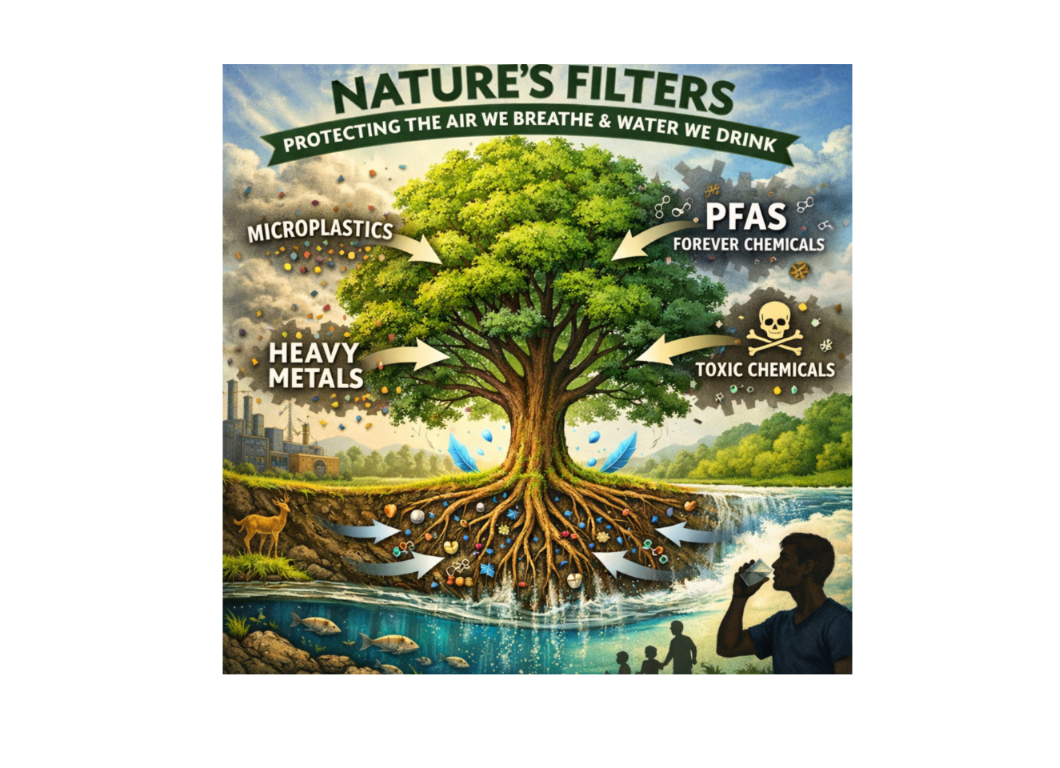
Trees serve as a critical natural filtration system for many of the very pollutants now prioritized by the U.S. Environmental Protection Agency, including microplastics, PFAS (“forever chemicals”), and associated toxic compounds. Through their leaves and bark, trees capture airborne microplastics and particulate-bound pollutants before they can be inhaled or deposited into water systems. At the same time, their root networks and surrounding soils slow stormwater runoff, allowing microplastics, PFAS, and heavy metals to bind to organic matter and sediments rather than flowing untreated into lakes, canals, and coastal waters. This interception is especially important because microplastics can act as carriers for PFAS and other toxins, meaning trees help reduce not just individual pollutants, but their combined and compounding effects. By filtering air, stabilizing soils, and enhancing infiltration, trees function as living infrastructure—quietly reducing human exposure to persistent contaminants that conventional treatment systems still struggle to remove.
Why This Shift Matters
The EPA’s new focus signals a broader transformation in environmental policy:
1. From Known Pollutants to Emerging Threats
Historically, regulation focused on chemicals like lead or arsenic. Now, attention is shifting to new, less-understood contaminants that are already widespread.
2. Monitoring Before Regulation
By placing microplastics on the CCL, the EPA is following a data-first strategy:
- Measure exposure
- Study health impacts
- Then set enforceable limits
3. Convergence of Risks
Microplastics and PFAS are increasingly linked:
- Microplastics can carry PFAS into the body
- Both persist and accumulate
- Both are difficult to remove with current water treatment systems
Policy Gaps and Criticism
Despite progress, major concerns remain:
- Regulation lag: Many contaminants stay on EPA watchlists for years without limits
- Cumulative exposure ignored: Current rules often assess chemicals individually, not combined effects
- Source control lacking: Critics argue the EPA is not doing enough to limit production of plastics and PFAS at the source
At the same time, industry groups emphasize the need for “science-based” regulation, warning against premature restrictions.
The Bigger Picture: A Public Health Turning Point
The EPA’s prioritization reflects a growing realization:
- Pollution is no longer just visible waste—it is microscopic and systemic
- Exposure is no longer localized—it is global and constant
- Environmental policy is increasingly public health policy
With microplastics now entering regulatory frameworks alongside PFAS, the U.S. is entering a new phase of environmental governance—one that must grapple with invisible pollutants that persist for generations.
Conclusion
The EPA’s decision to elevate microplastics and “forever chemicals” marks a critical shift toward confronting the most pervasive pollutants of our time. While still in early stages, this effort lays the groundwork for future regulation that could reshape water safety, industrial practices, and environmental health policy.
The good news is that in neighborhoods rich in trees, these natural filters help capture harmful pollutants before they reach your lungs or our water supply.
 Surfside Washington News