
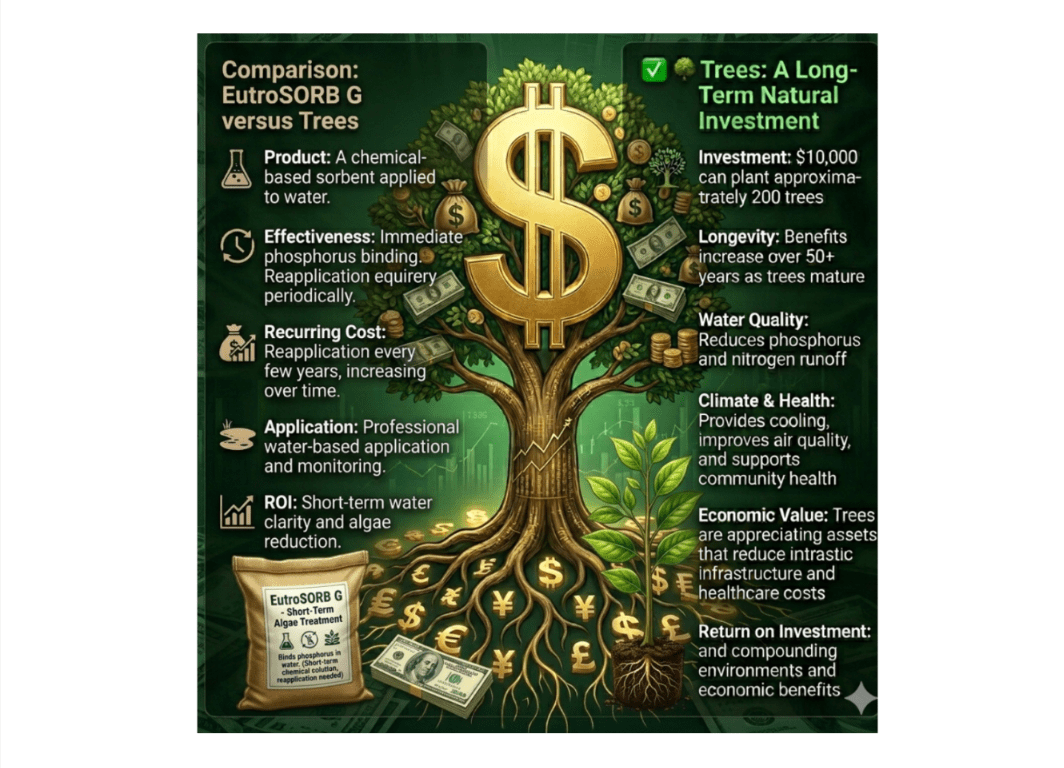
If a community had $10,000 to invest in improving water quality and reducing algae blooms, which option would provide the greatest return on investment—planting approximately 200 trees or applying $10,000 worth of EutroSORB? While EutroSORB can offer rapid but temporary relief from algae blooms, planting trees represents a long-term, appreciating investment that addresses the root causes of nutrient pollution and flooding. The contrast between East and West Surfside provides a compelling real-world example of how these choices shape environmental resilience and economic sustainability. Now remember that this is the cost for in year. Those trees don’t require 10000 every year. So after ten years you would have spent 100000 on che.kcal treatments.
⚗️ Option 1: $10,000 Investment in EutroSORB
EutroSORB is a lanthanum-modified clay designed to bind phosphorus in lake water and sediments. By removing this key nutrient, it can quickly suppress algae blooms and improve water clarity. However, its benefits are primarily short-term and do not prevent new phosphorus from entering the lake..
Benefits of Investing $10,000 in EutroSORB
- Immediate Results
- Rapid reduction in bioavailable phosphorus.
- Visible improvement in water clarity and reduction of algae blooms within weeks.
- Targeted Remediation
- Effective for addressing internal phosphorus loading in sediments.
- Useful as an emergency or short-term intervention for severely impaired lakes.
Limitations and Costs
- Temporary Effectiveness
- Does not address nutrient inputs from stormwater runoff or surrounding land uses.
- Reapplication is often necessary as new phosphorus enters the system.
- Recurring and Inflation-Sensitive Costs
- Future treatments are likely to become more expensive due to inflation, labor, and material costs.
- Dependence on lanthanum, a rare earth element, exposes pricing to global market fluctuations.
- Operational and Regulatory Expenses
- Requires permitting, environmental monitoring, and specialized application equipment.
- Additional administrative and compliance costs increase overall expenditures.
- Insurance and Liability Considerations
- Communities must ask a critical question:
Does the manufacturer and applicator carry adequate insurance to cover potential environmental, property, or public health liabilities?
- Communities must ask a critical question:
- Limited Co-Benefits
- Provides little to no additional environmental, health, or economic advantages beyond algae control compared to trees.
🌳 Option 2: $10,000 Investment in Planting 200 Trees
Investing $10,000 in planting approximately 200 trees creates a form of living infrastructure that becomes more valuable and effective over time. Unlike chemical treatments, trees address the root causes of algae blooms by reducing nutrient runoff and enhancing watershed resilience.
Environmental Benefits
- Prevention of Nutrient Pollution
- Tree canopies intercept rainfall, reducing stormwater runoff.
- Root systems enhance soil infiltration, allowing phosphorus and nitrogen to be absorbed before reaching waterways.
- Stabilized soils prevent sediment-bound phosphorus from entering lakes.
- Increasing Effectiveness with Maturity
- As trees grow, their capacity to manage stormwater and filter pollutants expands.
- Mature trees intercept significantly more rainfall than young plantings, providing increasing environmental benefits over time.
- Flood Protection
- Trees slow runoff and reduce peak storm flows, lowering the risk of flooding.
- Enhanced groundwater recharge supports long-term watershed stability.
Public Health and Community Benefits
- Improved Air Quality
- Trees filter pollutants, reducing respiratory and cardiovascular health risks.
- Heat Reduction
- Shading and evapotranspiration lower ambient temperatures, protecting vulnerable populations such as seniors.
- Mental and Social Well-Being
- Access to green spaces promotes physical activity, reduces stress, and strengthens community cohesion.
Economic Advantages
- Appreciating Asset
- Trees increase in value as they mature, unlike chemical treatments that require repeated expenditures.
- Reduced Infrastructure Costs
- Natural stormwater management decreases the need for expensive engineered systems.
- Higher Property Values and Energy Savings
- Tree-lined neighborhoods are more desirable and benefit from reduced cooling costs.
- Minimal Sensitivity to Inflation
- After establishment, maintenance costs are relatively low compared to recurring chemical treatments.
East vs. West Surfside: Evidence of Tree Canopy Benefits
The differing landscapes of East and West Surfside illustrate the tangible benefits of mature tree canopy.
East Surfside
- Taller and more mature trees provide extensive rainfall interception and nutrient filtration.
- Reduced stormwater runoff lowers the likelihood of algae blooms.
- Enhanced flood protection and environmental stability.
- Cooler temperatures and improved air quality.
- Reduced reliance on costly chemical treatments.
West Surfside
- Tree height restrictions have led to reduced canopy and diminished environmental protection.
- Increased runoff and nutrient loading contribute to algae blooms.
- Greater susceptibility to flooding and heat.
- Increased dependence on expensive interventions such as EutroSORB.
- Higher long-term financial and liability exposure.
Policy Implications: The Impact of Tree Height Restrictions
Policies that limit tree height or encourage excessive pruning significantly undermine the environmental and economic benefits of trees.
Environmental Consequences
- Reduced rainfall interception and stormwater management.
- Decreased nutrient filtration, increasing the risk of algae blooms.
- Loss of cooling and carbon sequestration benefits.
- Weakened habitat and ecosystem resilience.
Economic Consequences
- Increased reliance on costly chemical treatments and engineered infrastructure.
- Reduced property values and community appeal.
- Higher healthcare costs associated with heat and air pollution.
- Loss of appreciating natural assets.
Tree height restrictions inadvertently shift communities away from sustainable natural infrastructure and toward more expensive and temporary solutions.
⚖️ Return on Investment: Trees vs. EutroSORB
Investing $10,000 in EutroSORB
- Provides rapid but temporary improvement in water quality.
- Requires repeated applications, leading to ongoing expenses.
- Costs increase with inflation and regulatory requirements.
- Introduces potential insurance and liability risks.
- Offers limited long-term environmental and economic benefits.
Investing $10,000 in 200 Trees
- Provides long-term and increasing environmental benefits.
- Reduces nutrient runoff and prevents algae blooms.
- Enhances flood protection and climate resilience.
- Improves public health and community well-being.
- Represents an appreciating asset with minimal liability.
- Delivers extensive co-benefits that compound over time.
Conclusion
If a community invests $10,000, planting approximately 200 trees provides a far greater and more enduring return on investment than applying the same amount of EutroSORB. While EutroSORB can temporarily suppress algae blooms, it does not address the underlying causes of nutrient pollution and requires ongoing expenditures. Trees, on the other hand, offer a sustainable, low-liability solution whose effectiveness and value grow as they mature.
The contrast between East and West Surfside clearly demonstrates how mature tree canopy serves as protective natural infrastructure. Policies such as tree height restrictions significantly diminish these benefits, increasing environmental vulnerability and long-term costs.
Investing in trees—and adopting policies that allow them to reach full maturity—is a fiscally responsible strategy that maximizes environmental protection, public health, and long-term economic return.
One-Sentence Summary
A $10,000 investment in planting 200 trees yields far greater long-term returns than spending the same amount on EutroSORB, providing lasting protection against algae blooms, flooding, and health risks while avoiding recurring costs.
 Surfside Washington News