
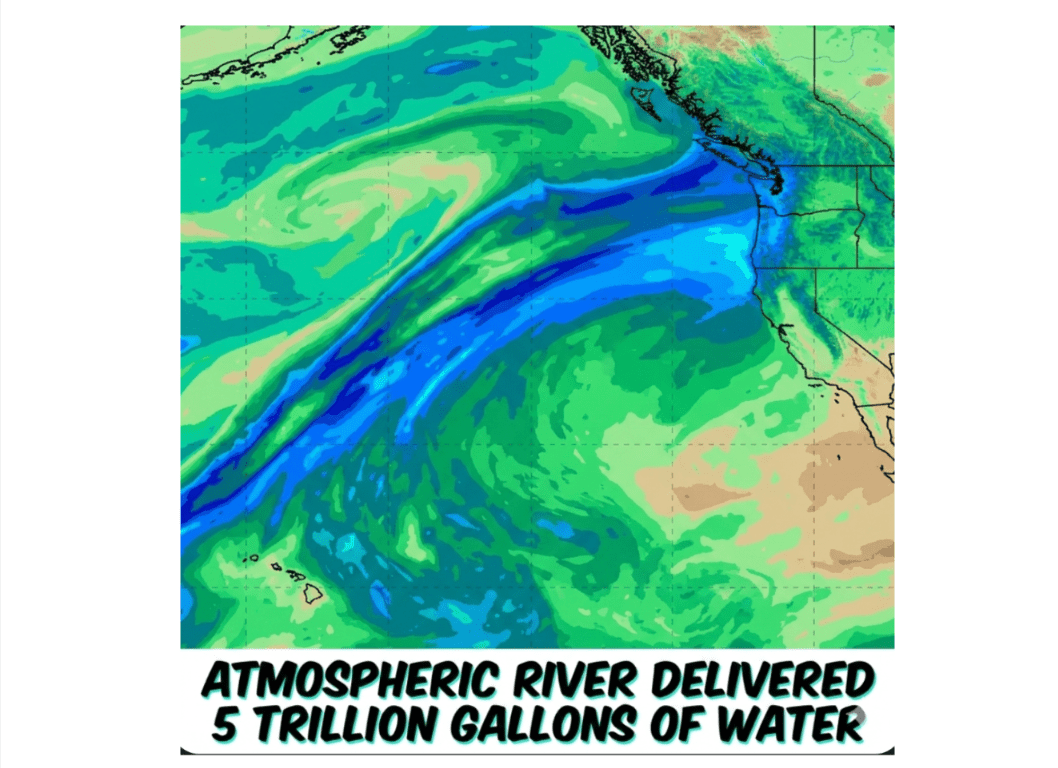
A powerful series of atmospheric rivers drenched Washington State in early December, producing extraordinary five-day rainfall totals that overwhelmed rivers, saturated soils, and triggered widespread flooding concerns. A Public Information Statement issued by the National Weather Service (NWS) Seattle/Tacoma at 6:34 AM PST on December 11, 2025, confirms that dozens of locations across Western Washington recorded more than five inches of rain, with many mountain and coastal sites exceeding 10 to 16 inches in just five days. The list below reflects locations receiving greater than five inches of rain.
Olympic Peninsula and Coastal Counties: The Epicenter of Rainfall
The heaviest rain fell along the Olympic Peninsula and Washington Coast, where moist Pacific air was forced upward by steep terrain, wringing out staggering amounts of precipitation.
Olympic National Park – Bishop Quinault: 16.58 inches
Owl Mountain (Jefferson County): 14.44 inches
Humptulips – 6 E Nielton (Grays Harbor County): 13.92 inches
Toms Creek (Clallam County): 11.07 inches
Communities such as Forks, Quinault, Aberdeen, and Hoquiam all recorded totals between 5 and 7 inches, underscoring how widespread the event was even at lower elevations.
Cascades and Foothills: Double-Digit Totals Over a Broad Area
The Cascade Mountains and foothills also experienced exceptional rainfall, significantly increasing flood risk for major river systems including the Skagit, Snoqualmie, Skykomish, Puyallup, and Chehalis Rivers.
Notable totals include:
Skykomish area (King County): 13.40 inches
Johnson Ridge (Snohomish County): 13.08 inches
Finney Creek (Skagit County): 12.36 inches
Paradise SNOTEL (Mount Rainier, Lewis County): 11.70 inches
Ohanapecosh (Lewis County): 14.15 inches
These numbers reflect prolonged, terrain-enhanced rainfall rather than a single storm burst—an important factor in why rivers continued rising even after rain intensity briefly eased.
South Sound and Lowlands: Still Well Above Normal
While rain-shadow effects reduced totals in some urban areas, the South Sound and I-5 corridor still saw rainfall far above typical December averages.
Centralia: 10.89 inches
Shelton: 6.81 inches
Olympia Regional Airport: 6.23 inches
Tumwater and Lacey: approximately 5–6 inches
Even these “lower” totals were enough to cause localized flooding, ponding, roadway closures, and drainage system overloads.
Northern Washington and Mount Baker Region
Heavy rain also extended northward into Whatcom and Skagit Counties, affecting the Mount Baker region and upper Skagit watershed.
Diablo area (Whatcom County): 10.86 inches
Glacier: 9.00 inches
Gorge Reservoir: 7.44 inches
Sumas: 5.87 inches
These totals are especially concerning in flood-prone areas with a history of agricultural and residential inundation.
Why This Event Matters
According to NOAA and the National Weather Service, this event stands out not just for how much rain fell, but how long it lasted. Repeated atmospheric river pulses delivered moisture day after day, preventing rivers from receding and leaving soils unable to absorb additional rainfall.
Meteorologists and hydrologists note that these types of prolonged, high-volume rain events are becoming more frequent and more intense, increasing pressure on aging infrastructure, floodplains, and communities across Washington.
A Reminder Going Forward
NOAA emphasizes that rainfall observations come from a mix of automated gauges and volunteer observers, and while not all data points are considered “official,” the consistency across hundreds of stations leaves little doubt: this was an exceptional and dangerous rainfall event.
As Washington continues to recover, this storm serves as a stark reminder of the growing risks posed by atmospheric rivers—and the importance of flood preparedness, resilient infrastructure, and long-term land-use planning grounded in climate science.
Source: National Weather Service Seattle/Tacoma, NOAA Public Information Statement, December 11, 2025.
 Surfside Washington News