
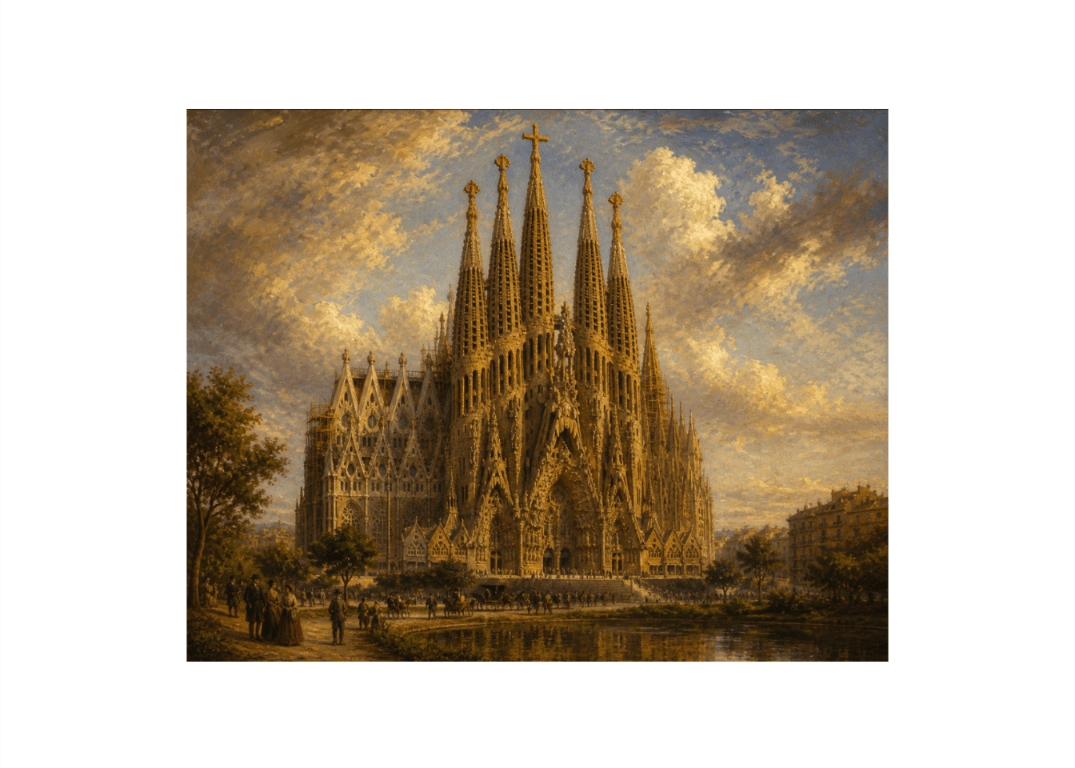
For more than a century, the soaring basilica of La Sagrada Familia stood as the world’s most famous unfinished church. Now, after generations of architects, artisans, and engineers carried forward a singular vision, the monumental structure in Barcelona has finally reached completion—transforming from a symbol of patience into a testament to human creativity, faith, and persistence.
I was fortunate to visit Barcelona while traveling for Intel, and one of the highlights of that trip was seeing La Sagrada Familia. It is, without question, one of the most extraordinary structures I’ve ever experienced. The exterior alone is breathtaking, with its intricate detail and towering forms, but stepping inside is something else entirely—the light, the scale, and the flowing, almost natural shapes make it feel like you’re walking through a living work of art. I spent most of the day just exploring the interior, taking it all in from every angle, and it’s something that stays with you long after you leave.
Learning that the basilica has finally been completed makes that experience even more meaningful. Designed by Antoni Gaudí and built over more than a century, it stands as an incredible achievement not just of one visionary, but of generations of craftsmen and engineers who carried his work forward. To see something so ambitious actually brought to completion is rare—and it reinforces just how special La Sagrada Familia truly is.
A Vision Born in the 19th Century
Construction began in 1882, but it was the genius of Antoni Gaudí who redefined the project. Gaudí envisioned not just a church, but a living expression of nature, geometry, and spirituality. He devoted the final years of his life entirely to the basilica, knowing he would never see it finished.
When Gaudí died in 1926, less than a quarter of the structure was complete. Wars, funding challenges, and the sheer complexity of his designs slowed progress for decades.
What Completion Means
The long-awaited completion—achieved in the 2020s after major structural milestones like the central tower—marks the fulfillment of Gaudí’s vision:
- 18 Towers Completed: Representing the Twelve Apostles, the Virgin Mary, the Four Evangelists, and Jesus Christ
- Central Tower: The tallest church tower in the world, rising above Barcelona’s skyline
- Three Grand Facades: Nativity, Passion, and Glory—each telling a different chapter of Christ’s life
Despite modern tools, architects stayed remarkably faithful to Gaudí’s original models, many reconstructed from fragments after the Spanish Civil War destroyed early plans.
Architecture That Feels Alive
Walking inside La Sagrada Familia feels like stepping into a stone forest:
- Tree-like Columns branch upward, mimicking nature
- Stained Glass Windows flood the interior with shifting color and light
- Mathematical Precision—hyperboloids, helicoids, and fractals—create both beauty and strength
Gaudí famously said his client was not in a hurry—referring to God. The result is a structure that seems grown rather than built.
A Global Cultural Milestone
The completion of La Sagrada Familia is more than an architectural achievement—it’s a historic moment for the world:
- It closes one of the longest construction timelines in modern history
- It reinforces Barcelona’s identity as a center of art and innovation
- It attracts millions of visitors annually, supporting local culture and economy
Already a UNESCO World Heritage Site (for its earlier sections), the finished basilica elevates its global significance even further.
Tradition Meets Technology
Modern completion relied on tools Gaudí never had:
- 3D modeling and AI-assisted design to interpret his geometric concepts
- Advanced materials and prefabrication to accelerate construction
- Digital reconstruction of lost plans
Yet the craftsmanship—stone carving, symbolic detail, and artistic storytelling—remains deeply rooted in traditional methods.
More Than a Building
La Sagrada Familia stands today as a rare achievement: a project spanning generations that stayed true to its original vision while embracing innovation.
It is a reminder that some works are worth the wait—and that human ambition, when guided by purpose and imagination, can transcend time itself.

