
October 9, 2026
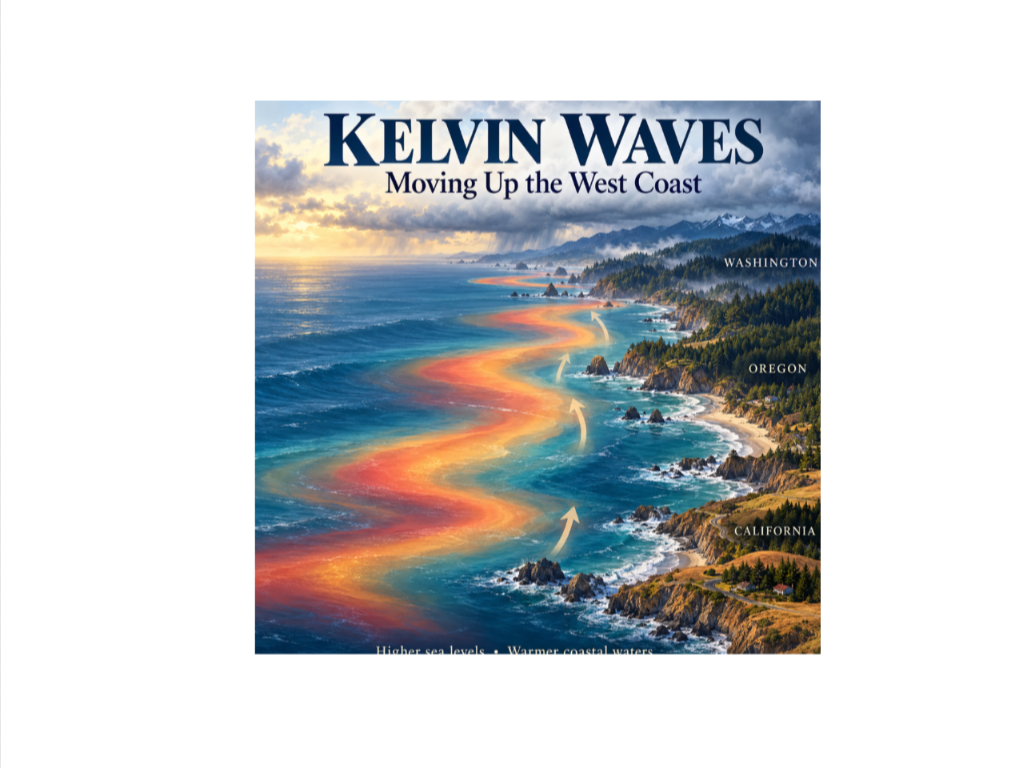
A broad ocean pulse associated with El Niño is moving north along the West Coast, temporarily raising sea levels and changing ocean temperatures. California, Oregon, and Washington could experience greater coastal flooding and erosion when elevated water levels coincide with high tides and winter storms.
In an October 6 explanation, NOAA Fisheries confirmed that one Kelvin wave was making its way up the North American coast, with one or two additional waves still in the tropics.
What is a Kelvin wave?
Oceanic Kelvin waves are long disturbances that can travel east along the equatorial Pacific. When they reach the Americas, part of their energy continues north along the coastline as coastally trapped waves.
These disturbances do not arrive as a towering wall of water or a breaking surf wave. Their passage changes the ocean beneath the surface and can produce a broad, temporary increase in coastal sea level. NOAA says they typically travel about 150 miles per day and can add approximately 6–12 inches to sea levels.
That range is not a prediction of the increase at every beach. Local observations and forecasts are needed to determine conditions at a particular location.
California: Higher water gives storms a greater reach
For California, the concern is the combination of elevated sea levels, high tides, storm surge, and large surf. With the ocean starting from a higher level, storm waves can reach farther onto beaches and against coastal infrastructure.
This can increase the potential for beach erosion, overtopping, and flooding in vulnerable shoreline areas. A Kelvin wave alone does not establish that a particular neighborhood will flood.
NOAA’s October 8 outlook says El Niño continues to strengthen, with a strong-to-very-strong event likely through January–March 2027. That supports continued attention to winter hazards, but does not specify where or when damaging storms will occur.
Oregon: Coastal hazards and changes in the food web
Oregon faces the same potential overlap between elevated coastal water and winter storms. Low coastal areas, beach access points, and exposed infrastructure warrant attention when local forecasts call for high tides and heavy surf.
Ocean conditions also matter to fisheries. NOAA researchers monitoring waters off Newport track changes in tiny crustaceans called copepods. During El Niño, warmer source waters can bring copepod communities with less fat available to fuel the marine food chain—conditions generally less favorable for young salmon entering the ocean.
These ecological changes develop over time and cannot be attributed to a single passing wave alone.
Washington: A coastal concern despite a potentially drier winter
Washington’s outer coast also lies along the northward pathway of these ocean disturbances. For the Long Beach Peninsula and other exposed coastal communities, the practical concern is whether elevated water coincides with strong storms and the season’s highest tides.
El Niño often favors warmer, drier winter conditions across the northern United States. That seasonal tendency does not eliminate individual heavy-rain events or coastal flooding. Rainfall totals and ocean water levels are different hazards.
NOAA also explains that atmospheric changes associated with El Niño have a particularly important influence on Pacific Northwest ocean conditions, while the direct ocean connection is especially influential off Southern California.
What coastal residents should watch
Follow local National Weather Service coastal flood and high-surf alerts, along with tide forecasts and emergency-management updates. A report that a Kelvin wave is moving north should prompt awareness, while local forecasts should guide decisions about beach visits and property preparation.
The temporary rise associated with these waves is distinct from long-term sea-level rise. Its importance this winter is the extra water it can place beneath high tides and storm waves along an already vulnerable coastline.
Sources
NOAA Fisheries — Kelvin Waves, Explained:
https://www.fisheries.noaa.gov/feature-story/kelvin-waves-explained
NOAA Fisheries — Ocean Indicators We’re Tracking for El Niño’s Arrival on the West Coast:
https://www.fisheries.noaa.gov/feature-story/ocean-indicators-were-tracking-el-ninos-arrival-west-coast
NOAA Climate Prediction Center — ENSO Diagnostic Discussion:
https://www.cpc.ncep.noaa.gov/products/analysis_monitoring/enso_advisory/ensodisc.shtml
NOAA Ocean Service — What Are El Niño and La Niña?
https://oceanservice.noaa.gov/facts/ninonina.html

