
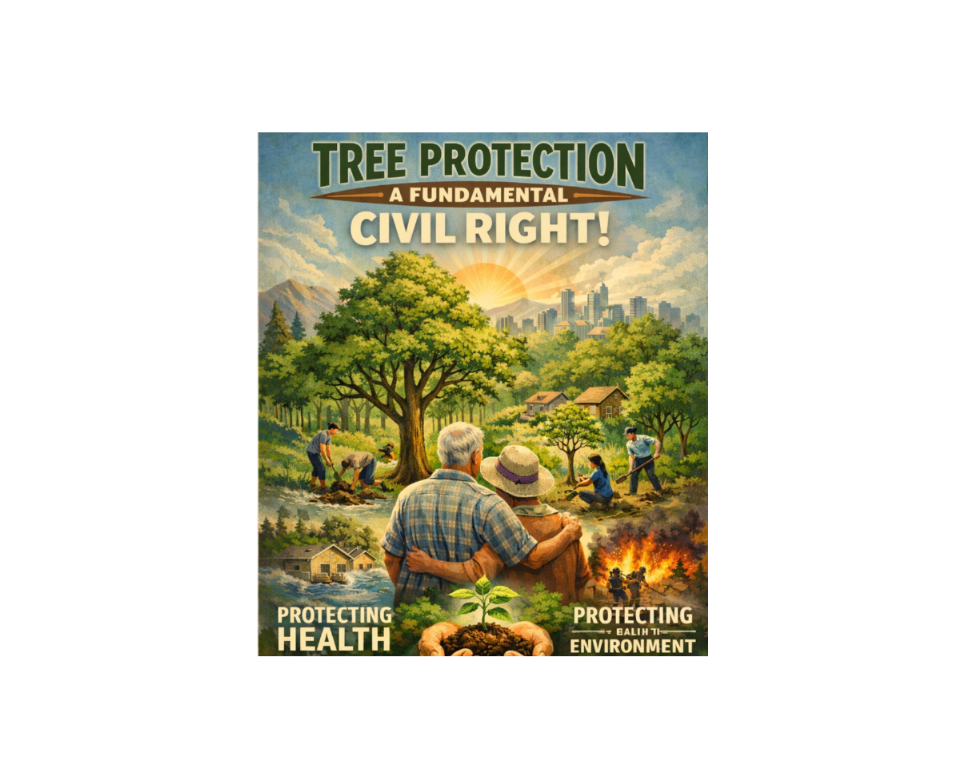
In many communities, tree height restrictions were originally created to protect views or maintain neighborhood aesthetics. However, when these rules require homeowners to repeatedly top or remove healthy trees, they can undermine environmental protection and raise serious questions about the civil rights of residents—particularly seniors who are often most vulnerable to environmental harms and financial penalties.
Trees provide far more than landscaping. Modern environmental science shows that trees function as natural infrastructure, protecting communities from flooding, extreme heat, air pollution, and storm damage. Urban forestry research demonstrates that tree canopy reduces temperatures during heat waves, improves air quality, stabilizes soils, and absorbs stormwater runoff. These environmental protections are particularly important for senior citizens, who face higher health risks from heat exposure, respiratory illness, and environmental pollution.
When regulations force the topping or removal of healthy trees through strict height limits, the long-term effect is often the degradation of the tree canopy and the loss of these environmental protections. Trees that are repeatedly topped frequently become weakened, diseased, or structurally unstable, eventually dying or requiring removal. The result is not safer neighborhoods but reduced environmental protection and increased exposure to climate-related risks.
When enforcement of these rules relies on punitive fines, compliance penalties, and legal threats, serious civil rights concerns emerge. Seniors living on fixed incomes can face escalating fines or lawsuits for trees that die or become hazardous due to compliance with height restrictions. These financial penalties can create a disproportionate burden on elderly residents, raising questions about whether such policies effectively discriminate against vulnerable populations.
The connection between environmental protection and civil rights has increasingly been recognized by courts. A notable example is the recent decision in Held v. Montana, where the Montana Supreme Court affirmed that the state constitution guarantees citizens the fundamental right to a “clean and healthful environment.” The court ruled that government actions that knowingly worsen environmental conditions can violate constitutional protections designed to safeguard the health and welfare of residents.
Montana’s constitutional provision reflects a broader legal principle emerging across the United States and internationally: environmental protection is closely tied to the protection of fundamental human rights, including the rights to life, health, and property. When government policies or regulations weaken environmental protections—particularly when scientific evidence demonstrates the importance of those protections—citizens may argue that such policies conflict with their constitutional rights.
In the context of tree regulations, this principle becomes particularly important. If local rules require the removal or weakening of healthy trees despite overwhelming scientific evidence that trees protect communities from flooding, heat, and pollution, the policy may conflict with the duty of government to protect the environmental conditions necessary for public health and safety.
Courts and policymakers are increasingly recognizing that environmental protection is not merely a policy preference—it can be a constitutional obligation. When environmental regulations disproportionately harm certain groups, such as seniors, while also degrading natural protections like tree canopy, communities risk creating policies that conflict with both environmental science and civil rights principles.
Communities facing climate change must ensure that their policies protect residents rather than weaken the natural systems that safeguard public health. Modern urban forestry programs in many cities now focus on expanding tree canopy rather than restricting it, recognizing the critical role trees play in protecting neighborhoods from environmental hazards.
Ultimately, the issue is not simply about trees. It is about whether communities recognize that access to a healthy environment is a fundamental right—and whether regulations support that right or undermine it. When policies damage the natural systems that protect residents, particularly vulnerable populations such as seniors, they raise important legal and ethical questions about the responsibility of government to safeguard both environmental health and the civil rights of the people it serves.
 Surfside Washington News