
Insights from the Insurance Institute for Business & Home Safety
A Wind-Driven Disaster Becomes an Urban Conflagration
The 2025 Palisades Fire will be remembered not just as a wildfire—but as a structure-driven urban fire event.
What conditions lead to the fire:
The conditions during the Palisades Fire were considered among the most dangerous wildfire weather combinations seen in Southern California in years. Key measurements included:
- Humidity: Relative humidity dropped into the single digits, often 5–10%, creating extremely dry air that rapidly removed moisture from vegetation.
- Wind Speeds: Santa Ana wind gusts were forecast between 60–90 mph, with some mountain gusts approaching 100 mph. These winds rapidly spread embers and flames across neighborhoods.
- Temperatures: Winter temperatures climbed into the upper 70s to low 80s °F, unusually warm for January and contributing to additional drying of fuels. Similar Southern California fire events in 2025 saw temperatures exceed 100°F inland during extreme fire weather episodes.
- Drought Conditions: Southern California had experienced approximately eight months without measurable rainfall, leaving brush and chaparral critically dry. Much of the region was classified under moderate to severe drought conditions.
- Fuel Moisture: Dead vegetation moisture levels in many western wildfire zones during 2025 fell below 5%, meaning grasses and brush could ignite almost instantly from sparks or embers.
- Vegetation Stress: Prolonged drought and heat had severely stressed vegetation and depleted soil moisture, producing what CAL FIRE described as the “perfect recipe for a large wildfire.”
Together, the combination of:
- extremely low humidity,
- hurricane-force dry winds,
- prolonged drought,
- elevated temperatures,
- and critically dry vegetation
created “critical fire weather” conditions where fires could spread explosively and overwhelm suppression efforts within hours. These conditions are not found in coastal communities in Washington State.
While the fire began under extreme weather conditions, the most rapid and destructive phase occurred after it entered neighborhoods, where homes, decks, and connective materials became the dominant fuel. Trees were also a factor but the report points to other critical factors.
https://ibhs.org/wp-content/uploads/2025-LAFires-EarlyInsights-FINAL.pdf
According to the IBHS technical analysis, the fire’s behavior shifted dramatically on the morning of January 8, when scattered ignitions inside the built environment triggered rapid expansion and spot fires across communities.
Rapid Spread: From Ignitions to Explosion
In the early hours:
- Wind-driven embers ignited structures across developed areas
- Fires spread quickly west into wildland fuels
- Additional ignitions appeared near Altadena and Pasadena
This phase highlights a critical point:
Fires were not advancing as a single flame front—they were jumping ahead through embers, igniting multiple locations simultaneously.
🏘️ Conflagration: When Homes Become the Fuel
As the fire reached areas like Las Flores Canyon and E Loma Alta Drive, conditions changed:
- Tighter spacing between homes
- Increased presence of “connective fuels”
- Transition from wildfire → urban conflagration
What are connective fuels?
IBHS identifies several other culprits contributing to fire spread:
- Pergolas
- Wooden fences
- Sheds
- Attached decks
These features:
- Physically connect one structure to another
- Allow fire to move laterally between homes
- Act as bridges for flame spread
A burning pergola or fence can carry fire directly from one house to the next.
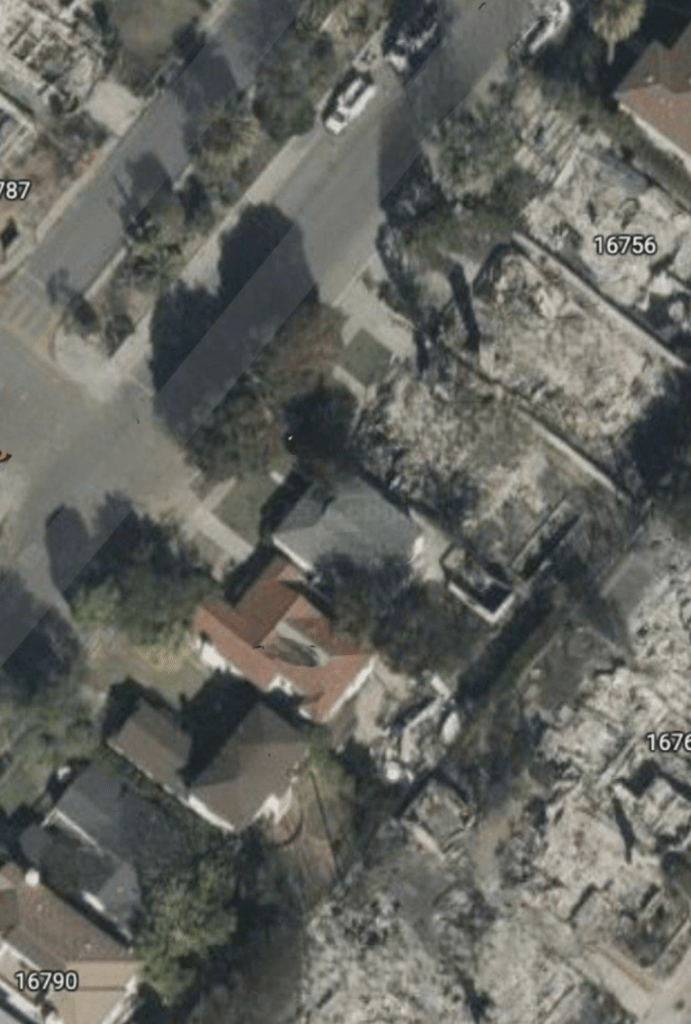
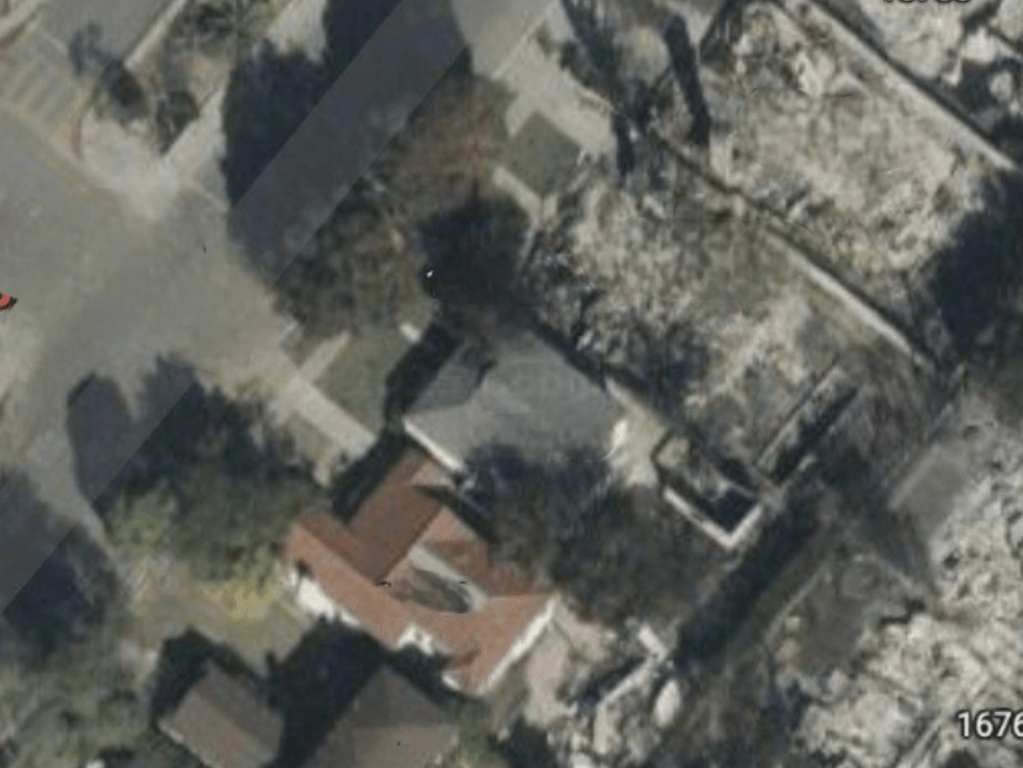
Notice the tight density of homes. And some homes that survived had trees surrounding the homes. Surprisingly the trees survived as did the homes and other homes were completely destroyed but trees survived it’s not to say there were no trees destroyed just that many survived.
Ember Storm: Structures Feeding the Fire
One of the most important findings comes from radar data:
- Dual-polarimetric radar detected large embers
- Carried 1–3 miles downwind
- These embers were primarily generated from burning structures—not vegetation
This is a crucial shift in understanding:
Once neighborhoods ignited,
homes themselves became the main source of fire spread
A Catastrophic Timeline
By approximately 10:30 a.m. on January 8:
- Fire had grown to 10,600 acres
- Around 1,000 structures destroyed
- 0% containment
- Air resources grounded due to extreme winds
Later that day:
- Spot fires reached Sierra Madre and La Cañada
- Fire spread slowed only after winds subsided
What This Changes About Fire Risk
The IBHS findings reinforce a critical reality:
Vegetation was an initial source of the fire. And trees certainly was also a source.
The most destructive phase was not vegetation-driven
It was structure-driven
Key drivers:
- Wind carrying embers
- Closely spaced homes
- Connective fuels between structures
- Combustible materials (decks, fences, pergolas)
The Misunderstood Role of Trees
Notably absent as a primary driver:
- Large, healthy neighborhood trees
A news article showing before And after pictures shows singed trees And burnt ones with a slider that shows these same trees fully healthy and grown in many cases. Check it out here:
Certainly trees were burnt or in many cases singed but the pictures show many survived and images show healthy mature tree. The second picture shows a large mansion surrounded by trees untouched as if the trees protected the home.
Instead, the report emphasizes:
- Built environment features as the main accelerants
- Structural fuels as the dominant ember source
This challenges the idea that “trees” broadly caused neighborhood fire spread. The Palisades Fire spread rapidly through dry brush and vegetation 18%, trees 20% and 62% structural and connective fuels. But fire spread under extreme winds, and once it reached neighborhoods, it was driven primarily by structure-to-structure ignition.
Large, healthy trees typically ignite more slowly and burn less intensely than dry grasses or brush, which helps limit the speed of fire spread. Because of their higher moisture content and thicker structure, they are less likely to drive rapid, fast-moving fire fronts compared to fine, dry fuels.
The Palisades Fire demonstrates a shift in wildfire behavior:
Once fire enters a community, it often stops being a wildfire driven by dried brush—and becomes an urban fire problem.
The IBHS analysis makes it clear:
- The disaster was driven by how communities are built
- Not simply by surrounding vegetation
What actually matters for protection
To reduce future losses, the evidence points to:
- Fire-resistant construction
- The Focus on connective fuels decks, wood siding, fences, roofs, and other house to house spread.
- Increasing spacing or hardening structures
- Managing the immediate zone around homes (0–5 feet)
The Palisades Fire was a wind-driven, ember-fueled urban conflagration, where understanding other reasons for spreading fires:
- Homes ignited other homes
- Decks, fences, sheds and pergolas spread fire
- Structures generated embers that drove further destruction
Trees played a role but the homes themselves, their construction, and the connections between them—were also major critical factors. Trees were a factor but do not burn as hot or generate embers like a home.
The other critical point is coastal environments in Oregon and Washington where local conditions are far different than southern California and when it comes to wildfire risk. So equating wildfires in California and places like eastern Washington with coastal environments in western Washington.

