
What began as a fight to protect homeowners in a small coastal community in Washington State has evolved into part of a much larger national movement demanding accountability, transparency, and fairness in homeowners associations across the United States.
At the center of that movement is
HRLNG – HOA Reform Leaders National Group
and advocate Patrick Johansen, whose grassroots efforts have helped inspire legislative discussions and reform proposals in multiple states, including Georgia, Florida, Arizona, Colorado, and beyond.
It also inspired a published book written by Patrick Johansen, Candace Carteen and Michael Chevalier outlining the legislative reforms
Legislative Strategies: Combating HOA Corruption
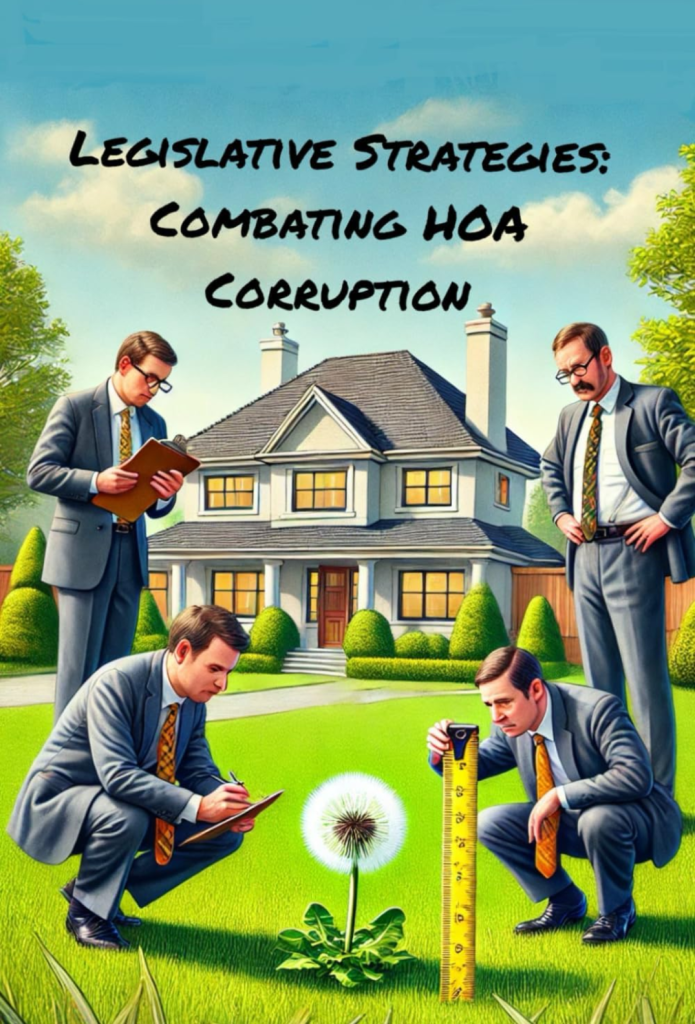
The book may be purchased here
For years, many homeowners across America have complained about abusive fines, selective enforcement, excessive legal fees, foreclosure threats, lack of transparency, election irregularities, and limited oversight of HOA boards and management companies. Yet for a long time, these concerns were often dismissed as isolated disputes.
That is changing.
Today, legislators in numerous states are introducing or passing reforms designed to increase homeowner protections and place limits on HOA power. In Georgia, lawmakers recently advanced significant HOA reform legislation addressing issues such as transparency, collections, foreclosure procedures, and homeowner rights. Similar efforts have emerged nationwide as homeowners increasingly organize and share experiences online and through advocacy groups.
The growth of the movement reflects something larger than any single HOA dispute. It represents millions of Americans asking a fundamental question:
Who protects homeowners when the organization governing their neighborhood becomes unaccountable?
A Grassroots Movement Born From Local Frustration
The roots of this movement can be traced back to communities like Surfside located in Washington, where residents raised concerns over governance, enforcement practices, elections, fines, and environmental policies affecting homeowners.
Critics in Surfside often mocked or minimized reform advocates. Patrick Johansen himself was reportedly labeled the “Pied Piper” by opponents attempting to discredit the movement and those questioning the status quo.
But history has shown that grassroots reform efforts are often ridiculed by small minded political opponents before they are recognized.
What some individuals dismissed as complaints from a handful of residents ultimately contributed to a broader conversation now influencing legislation affecting millions of homeowners nationwide.
Behind nearly every major HOA reform battle stands a powerful and deeply entrenched industry network.
Organizations such as Community Associations Institute, along with HOA law firms, management companies, developers, and industry lobbyists, wield enormous influence in state legislatures across America. Collectively, millions of dollars are spent shaping and promoting HOA laws that critics argue often favor associations, attorneys, collection firms, and developers more than the homeowners who actually live under those rules.
For decades, HOA legislation in many states was largely written with heavy input from industry professionals whose businesses financially benefit from expanded HOA authority, enforcement powers, fines, liens, collections, and litigation. Developers benefit from governance structures that reduce municipal responsibilities and transfer infrastructure costs onto homeowners. HOA attorneys and management companies often benefit from complex enforcement systems that generate recurring legal fees, collection costs, administrative penalties, and ongoing disputes.
Meanwhile, ordinary homeowners typically enter these legislative battles with little money, few lobbyists, and limited political influence.
That imbalance is precisely why grassroots organizations like HRLNG have become increasingly important. Homeowners across the country have begun organizing not because they possess institutional power, but because they often feel they have none.
Instead of disappearing, the reform movement expanded.
Through research, collaboration with homeowners across the country, and legislative drafting efforts, HRLNG became a platform where residents could share experiences, compare state laws, and propose reforms aimed at restoring balance between homeowners and HOA governance.
The organization’s website includes legislative proposals, reform discussions, educational materials, and policy recommendations designed to help lawmakers understand recurring homeowner concerns nationwide.
The Growing Push for Accountability
Many of the reforms discussed by HRLNG and homeowner advocates focus on common themes:
- Transparency in HOA finances and records
- Fair election procedures
- Protection against abusive fines and collections
- Limits on foreclosure authority
- Access to electronic voting
- Fair appeals processes
- Protection of homeowner speech rights
- Oversight of management companies and attorneys
- Greater accountability for boards acting beyond their authority
These concerns are no longer isolated to one state or one community.
Across the country, homeowners are increasingly questioning systems that allow private associations to wield significant power with limited independent oversight.
For many advocates, this is not anti-HOA activism. It is pro-homeowner accountability.
From Local Conflict to National Influence
What makes the story remarkable is that the movement did not begin with major political organizations or corporate funding. It began with ordinary homeowners frustrated by policies impacting their neighborhoods and quality of life.
In Surfside, debates over elections, homeowner rights, governance, and environmental policies became catalysts for larger discussions about power, accountability, and fairness inside HOA communities.
Those debates eventually helped fuel broader advocacy efforts reaching far beyond one coastal community.
The reform work also expanded into published resources, including legislative proposals and books outlining potential reforms homeowners and lawmakers can use as reference material when evaluating HOA laws and governance structures.
One of the central messages of the movement is that homeowners should not fear retaliation for asking questions, requesting records, criticizing leadership, or advocating for reform.
Democracy, advocates argue, does not end at the entrance to an HOA.
Silencing Critics No Longer Stops the Conversation
One reason the movement continues growing is that attempts to silence critics often have the opposite effect.
Many homeowners report that censorship, intimidation, selective enforcement, or dismissive treatment by boards only strengthens demands for reform and transparency.
In communities where reform advocates were once marginalized, many of the same issues they raised years ago are now appearing in state legislatures and national policy discussions.
That shift reflects a growing realization that HOA governance affects real people’s homes, finances, mental health, voting rights, and daily lives.
The conversation is no longer confined to neighborhood meetings.
It is becoming a national policy issue.
A Movement Still Growing
The HOA reform movement remains largely grassroots-driven, powered by homeowners, researchers, advocates, and volunteers rather than large institutions.
Organizations like HRLNG continue to serve as hubs for homeowners seeking information, legislative comparisons, and reform proposals.
Whether one agrees with every position advanced by reform advocates or not, the broader impact is difficult to deny:
A movement that started with residents trying to protect approximately 2,000 homeowners in Surfside has now contributed to discussions influencing HOA legislation and reform efforts affecting millions across America.
And for many homeowners, that movement is only beginning.

