
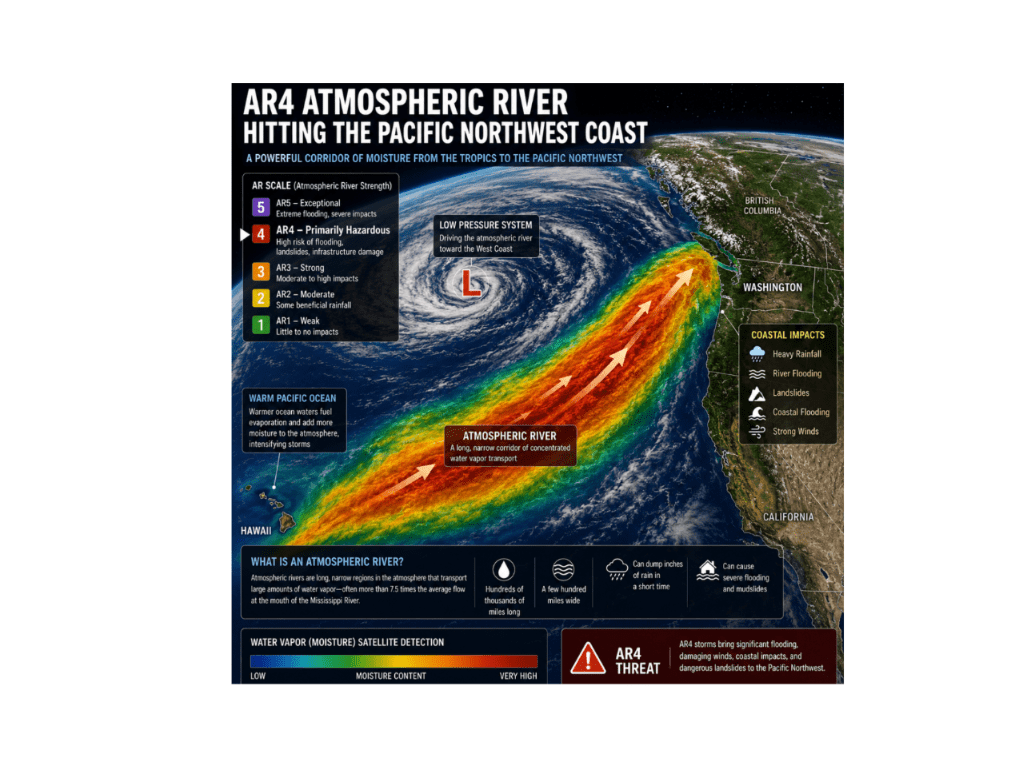
The severe flooding and storm damage that struck Western Washington during December 2025 provided another powerful warning about the growing climate threats facing the Pacific Northwest. Following the destructive AR4 atmospheric river and bomb cyclone events of October and November 2024, the December 2025 storms demonstrated how warmer oceans, rising sea levels, and increasingly intense atmospheric rivers are combining to produce more dangerous flooding events across coastal and inland communities.
From flooded roads and overflowing rivers to widespread power outages, landslides, levee failures, and coastal erosion, these storms revealed how vulnerable modern infrastructure has become as climate conditions continue changing.
December 2025 Flooding and Human Impact
The December 2025 atmospheric river flooding became one of the most significant flood disasters in recent Washington history. Multiple powerful storms stalled over Western Washington, delivering extraordinary rainfall totals that overwhelmed rivers and flood-control systems.
The flooding caused:
- At least 2 confirmed deaths
- Thousands of evacuations
- Hundreds of damaged homes
- Major levee failures
- Widespread transportation shutdowns
- Long-term infrastructure damage across Western Washington
One of the worst disasters occurred near the City of Pacific, Washington, where a White River levee breach displaced more than 600 residents after floodwaters impacted over 200 homes.
In Burlington and surrounding Skagit Valley communities, floodwaters inundated neighborhoods and forced evacuations affecting thousands of residents. Approximately 55 homes and parts of downtown Burlington were flooded, while emergency crews conducted large-scale evacuations throughout the region.
Washington emergency officials warned that as many as 75,000 residents in low-lying portions of Skagit County could potentially require evacuation if levees failed during peak river flooding.
Across the region:
- Around 220 homes sustained significant flood impacts in some of the hardest-hit areas
- Roughly 800 residents were directly displaced in several flood zones
- Major highways including US-2, US-12, and SR-410 suffered severe flood and landslide damage
- Some transportation corridors remained closed for months due to washouts and slope failures
The monetary damage from the flooding reached into the hundreds of millions of dollars when accounting for:
- Residential property damage
- Road and bridge destruction
- Levee repairs
- Emergency response costs
- Business interruptions
- Landslide cleanup
- Utility infrastructure damage
While final statewide totals continue to be assessed, officials described the event as one of the costliest flood disasters in decades for parts of Western Washington. Federal disaster assistance and emergency declarations were issued due to the scale of the destruction.
The Growing Threat of AR4 and AR5 Storms
Atmospheric rivers are long corridors of concentrated moisture flowing through the atmosphere. Scientists rank these systems from AR1 to AR5 based on intensity and duration.
- AR1–AR2: Mostly beneficial rainfall
- AR3: Strong storms with localized hazards
- AR4: Primarily hazardous and capable of major flooding
- AR5: Exceptional storms capable of catastrophic destruction
The October-November 2024 storm season already demonstrated the destructive power of these events. Western Washington experienced:
- Massive flooding
- Hundreds of thousands of power outages
- Major tree failures
- Landslides
- Transportation shutdowns
- Coastal erosion
- Fatalities caused by falling trees
The November 2024 bomb cyclone alone left roughly 650,000 customers without power across Washington as hurricane-force winds struck already saturated forests and neighborhoods. At least two people were killed by falling trees during the storm.
By December 2025, many communities were still dealing with weakened infrastructure and unstable slopes when additional atmospheric rivers delivered another round of severe flooding.
Why Ocean Warming Is Making Storms Worse
The Pacific Ocean is absorbing enormous amounts of heat caused by greenhouse gas emissions. As ocean temperatures rise, evaporation increases, placing more moisture into the atmosphere.
A warmer atmosphere can hold significantly more water vapor, allowing atmospheric rivers to transport extraordinary amounts of rainfall into the Pacific Northwest.
When these moisture-rich systems collide with coastal mountains and cooler air masses, extreme precipitation can occur rapidly.
Climate scientists increasingly warn that warming oceans are contributing to:
- More intense rainfall
- Stronger atmospheric rivers
- Increased flood frequency
- Greater landslide risk
- More severe coastal erosion
- Stronger windstorms
The combination of warmer oceans and rising sea levels creates a dangerous “compound flooding” effect in coastal regions.
Compound Flooding Along the Coast
Coastal communities now face multiple flood threats occurring simultaneously:
- Extreme rainfall from atmospheric rivers
- River flooding from inland runoff
- High tides and storm surge
- Sea-level rise reducing drainage efficiency
In many low-lying areas, stormwater systems and ocean outfalls become overwhelmed during major storms. Instead of draining outward, water can back up into neighborhoods, canals, wetlands, and lakes.
This problem becomes especially dangerous in areas with:
- Low elevation
- Poor drainage
- Aging infrastructure
- Reduced tree canopy
- Filled wetlands
- Shoreline erosion
The December 2025 flooding revealed how vulnerable many coastal communities remain to these overlapping climate threats.
The Importance of Trees and Natural Infrastructure
One of the most effective defenses against flooding is healthy tree canopy and natural infrastructure.
Trees reduce flooding by:
- Capturing rainfall before it reaches the ground
- Slowing stormwater runoff
- Increasing soil absorption
- Stabilizing slopes and dunes
- Reducing erosion
- Filtering pollutants from runoff
Wetlands, riparian buffers, dunes, and forests also function as natural flood protection systems.
Unlike concrete infrastructure that deteriorates over time, healthy ecosystems often become more effective as they mature.
Communities that remove large amounts of tree canopy may unintentionally increase flooding risks by accelerating runoff and reducing the land’s natural ability to absorb water.
Public Health and Environmental Impacts
Flooding creates serious public health risks, especially for seniors and vulnerable populations.
Major flood events can increase:
- Mold growth in homes
- Sewage overflows
- Contaminated waterways
- Respiratory illness
- Stress and mental health impacts
- Harmful algae blooms in lakes and canals
Coastal flooding can also transport pollutants, debris, and contaminated stormwater into marine ecosystems and shellfish-growing areas.
A Warning for the Future
The AR4 and AR5 storms of 2024 and the flooding events of December 2025 show that Western Washington is entering a new era of climate-driven weather extremes.
What were once considered rare storms are becoming more frequent and more destructive.
Communities that invest in:
- Tree canopy protection
- Wetland restoration
- Climate-resilient infrastructure
- Floodplain protection
- Improved drainage systems
- Shoreline resilience
will likely be far better prepared for future atmospheric river events.
The lessons from recent storms are becoming increasingly clear: ocean warming is not simply raising temperatures — it is reshaping flooding, erosion, infrastructure risks, and the long-term safety of communities across the Pacific Northwest.

