
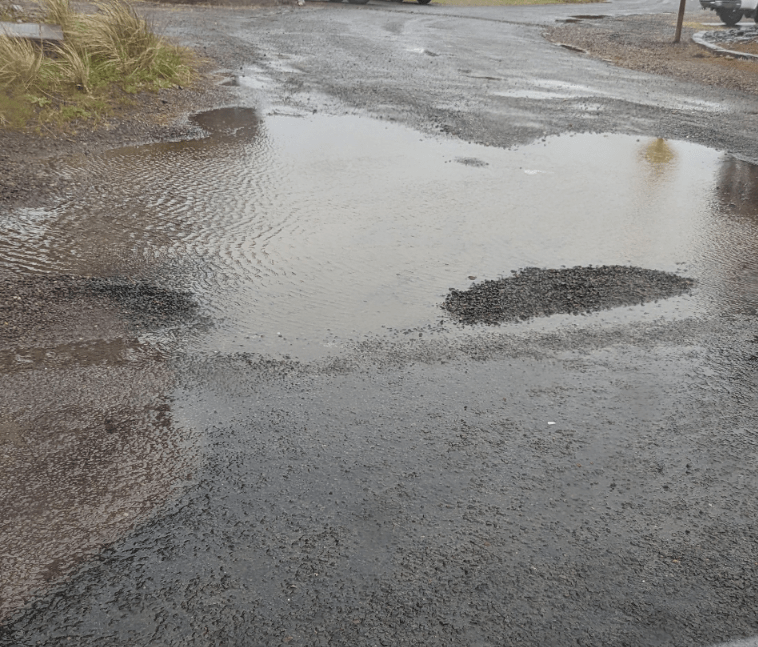
For seniors living in coastal communities, the statistical risk of being injured or killed from falls caused by potholes, uneven pavement, flooded roads, and poor walking conditions is dramatically higher than the risk of being struck by a falling tree branch.
The image above illustrates a common hazard in coastal neighborhoods: standing water covering potholes and broken pavement during heavy rain events. In regions exposed to repeated atmospheric river storms, roads can deteriorate quickly, creating hidden hazards for elderly residents.
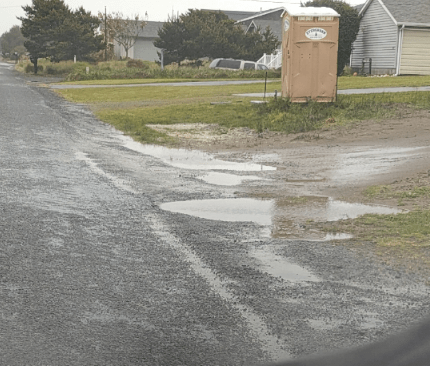
Falls among older adults are one of the largest public health threats in the United States:
- More than 35 million falls occur annually among seniors.
- Over 3.8 million seniors are treated in emergency rooms yearly for fall injuries.
- More than 43,000 Americans age 65 and older die annually from preventable falls.
Falls are also responsible for the overwhelming majority of hip fractures:
- About 95% of hip fractures in older adults are caused by falls.
- Nearly 319,000 older adults are hospitalized annually for hip fractures.
- Roughly 20–25% of seniors who suffer a hip fracture die within one year.
- Many others never fully regain their independence or mobility.
Seniors walking along roads and coastal streets should pay close attention to potholes, pavement indentations, loose gravel, standing water, and other hidden obstacles that can increase the risk of falling. After heavy rainstorms, many hazards may be concealed beneath puddles or debris, making uneven surfaces harder to see. Many older adults may benefit from using hiking or walking poles, which are widely used on Pacific Northwest trails to improve balance and stability on uneven ground. Walking poles can help reduce falls, improve confidence while walking, and lessen stress on joints, especially in areas with damaged roads or poor conditions on walk areas.
By comparison, deaths from falling tree branches nationwide are extremely rare. Estimates typically range from only a few dozen fatalities annually across the entire United States.
Most branch-related injuries or deaths occur during:
- Severe windstorms
- Ice storms
- Tree removal accidents
- Failure of dead or decaying limbs
- Trees weakened by disease or root damage
This means the number of older Americans dying from falls each year is hundreds to thousands of times greater than the number of people killed by falling branches nationwide.
Why Roadside Trees Are Important for Roads and Sidewalks
Ironically, removing too many roadside or right-of-way (ROW) trees can actually worsen the very infrastructure problems that create dangerous fall hazards for seniors.
Modern stormwater and urban forestry research shows that mature roadside trees play a major role in protecting roads, sidewalks, and drainage systems by reducing stormwater runoff.
Tree canopies intercept rainfall before it hits the ground. During heavy storms:
- Leaves and branches slow rainfall velocity
- Root systems absorb and store water
- Soil beneath trees allows infiltration into groundwater
- Trees reduce erosion along road shoulders
- Trees help stabilize roadside soils
Without sufficient tree canopy, rainwater strikes pavement directly and rapidly flows across roads and sidewalks. This increases:
- Flooding
- Standing water
- Pothole formation
- Asphalt cracking
- Shoulder erosion
- Sidewalk undermining
- Moss and algae growth on wet pavement
In coastal communities exposed to intense AR4 and AR5 atmospheric river storms, stormwater runoff can become overwhelming when vegetation and tree canopy are removed.
Roadside trees also help lower pavement temperatures during summer heat. Excessive heat weakens asphalt, causing roads to crack and degrade faster. Shade from mature trees can significantly extend pavement life while improving pedestrian comfort for seniors.
Properly managed ROW trees can therefore function as a form of natural infrastructure by:
- Reducing runoff volumes
- Improving drainage performance
- Lowering infrastructure maintenance costs
- Reducing erosion
- Protecting sidewalks and road edges
- Improving public safety for pedestrians
Urban forestry experts increasingly describe mature trees as “green infrastructure” because they perform many of the same functions as expensive engineered stormwater systems.
Conclusion
Most people who live in the Pacific Northwest do not spend their daily lives worrying about being struck by falling tree branches. The region is defined by forests, tree-lined neighborhoods, and communities built around nature. Residents throughout Seattle, Portland, Tacoma, and Vancouver regularly live among large mature trees that provide beauty, shade, storm protection, wildlife habitat, and environmental benefits.
The Pacific Northwest contains thousands of miles of hiking trails through dense forests, and millions of people safely recreate in these environments every year. Trees are part of the identity and natural infrastructure of the region.
While the possibility of falling branches can never be completely eliminated, most residents understand that the overall benefits of healthy trees far outweigh the relatively small risk posed by branch failures. Proper maintenance, pruning, and hazard inspections can further reduce those risks while preserving the enormous environmental and public health value trees provide.
For many communities, especially coastal communities facing stronger storms and increasing rainfall, maintaining healthy tree canopy may actually be one of the best long-term strategies for protecting roads, sidewalks, drainage systems, neighborhoods, and public safety.

