
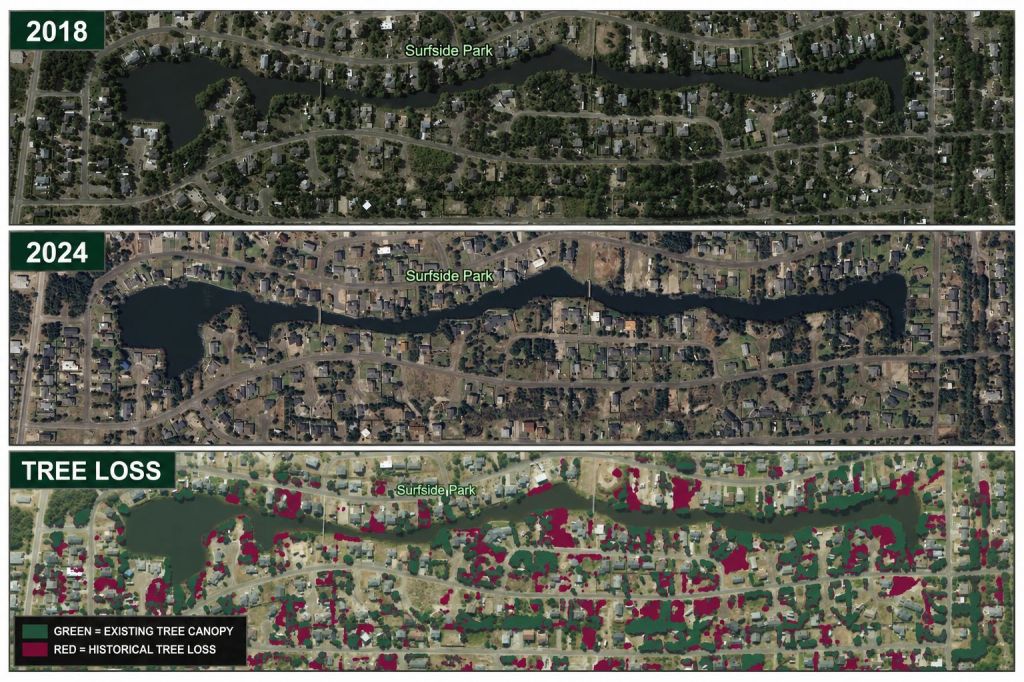
The aerial comparison between 2018 and 2024 around Seabreeze Lake in Surfside, Washington, reveals a dramatic reduction in tree canopy, with an estimated loss approaching one-third of the original canopy coverage in some areas surrounding the lake. The results are from Google Earth, a state-of-the-art environmental tool. The bottom image highlights the extent of the change, with red areas showing historical tree loss and green areas representing the remaining canopy. What was once a heavily shaded, ecologically balanced lakeside environment is increasingly fragmented, exposed, and vulnerable to climate-related stress.
Over the past several years, Pacific County’s own 2027 planning efforts have already identified increasing climate threats facing coastal communities, including stronger atmospheric river storms, heavier winter precipitation, flooding, high wind events, and rising temperatures. Yet during roughly this same period, Surfside’s policies continued emphasizing view preservation and aggressive tree height reduction practices that substantially weakened one of the community’s most important natural climate defenses — its mature tree canopy.
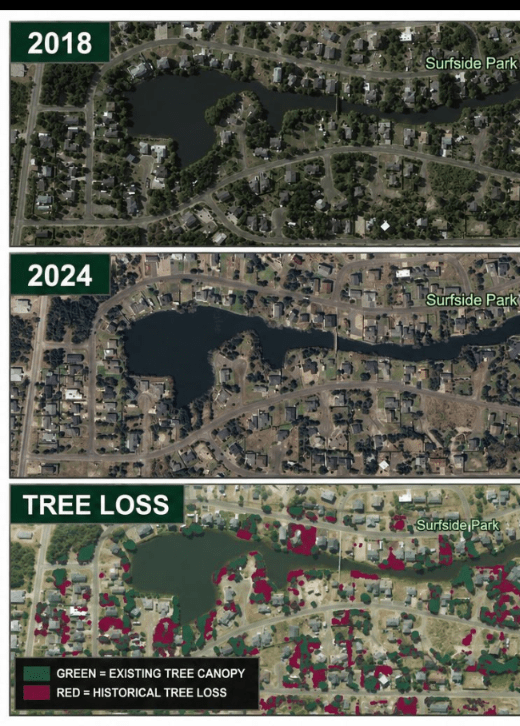
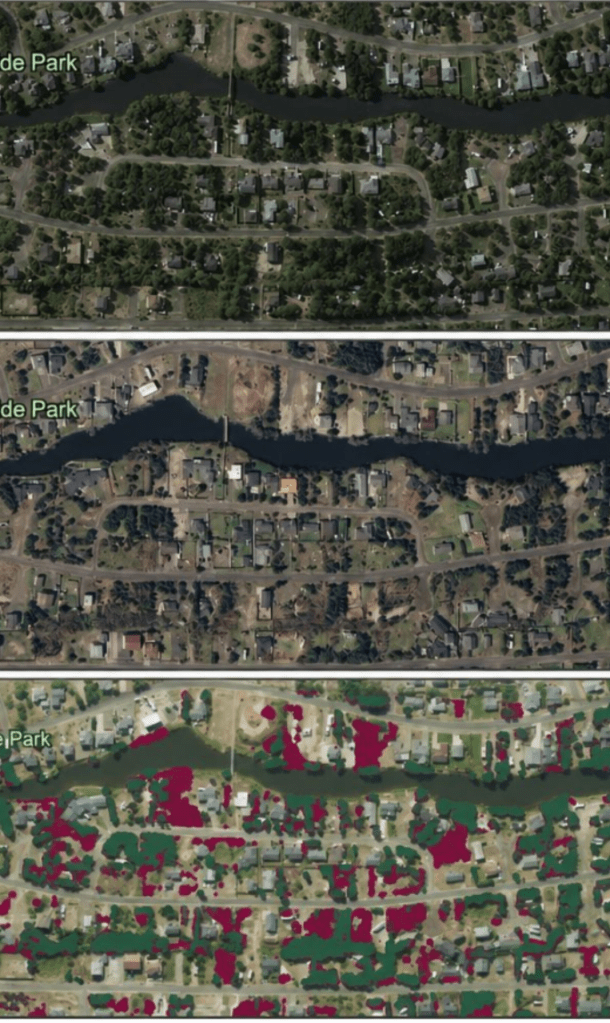
The board actively removed trees in the riparian zone years ago and admitted they were not replaced. This is a board that actively pursues members for free height violations but ignores riparian protection of trees.
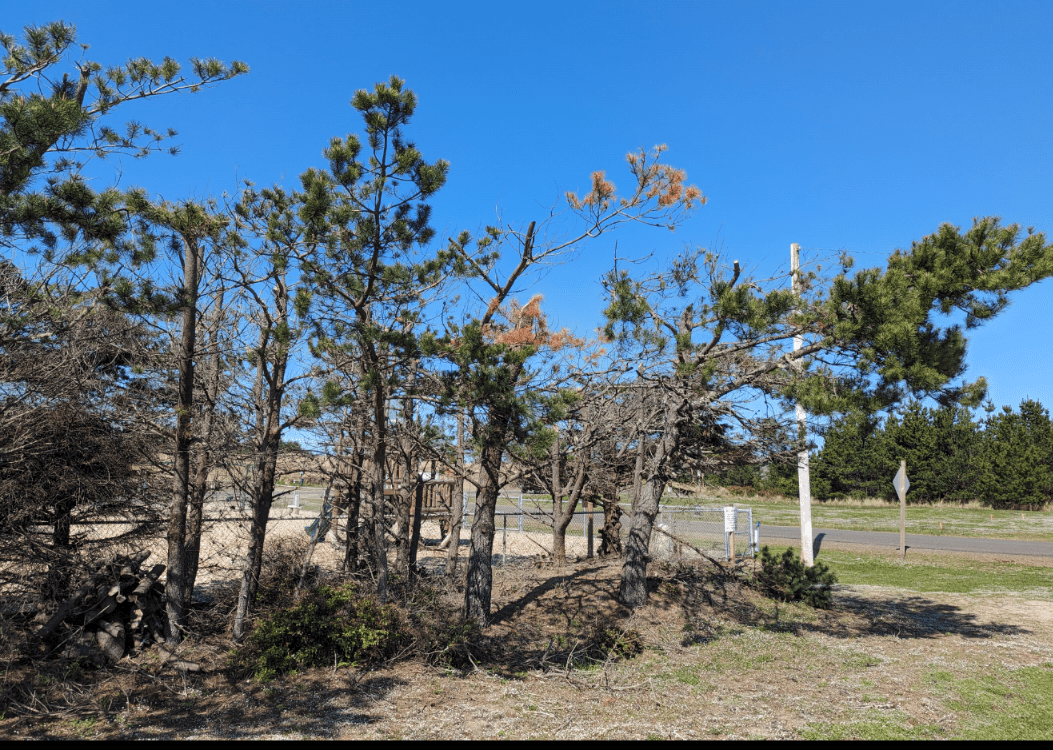
For years, many residents have warned that aggressive tree height restrictions around Seabreeze Lake — particularly the widespread practice of limiting trees to roughly 16 feet — would eventually weaken the health of the ecosystem. Trees that are repeatedly topped or heavily cut often lose their ability to develop strong crowns, deep shade, and healthy root systems. Around the lake, many surviving trees now resemble shortened poles rather than mature coastal forest canopy capable of performing meaningful environmental functions.
The environmental consequences become increasingly visible. Reduced shade exposure allows sunlight to heat shallow lake water more rapidly during summer months. Warmer water temperatures, combined with nutrient runoff and declining natural filtration from trees, create ideal conditions for algae blooms and eutrophication. Residents have increasingly raised concerns about murky water, algae growth, declining water quality, and fish die-offs occurring during warmer periods. Trees play a critical role in intercepting stormwater, filtering pollutants, stabilizing soils, reducing nutrient loading, and cooling aquatic environments. As canopy disappears, those natural protections weaken. The board has started spending thousands of dollars on Eutrosorb G to mitigate the algae blooms in the lake. Although it is shown effective, proper lake management is to restore damaged shorelines by fixing vegetation and grow tree canopy.
Scientific research consistently shows that mature tree canopy is one of the most effective forms of natural climate infrastructure. Trees reduce urban heat, filter airborne pollution, intercept rainfall, improve groundwater infiltration, and lower stormwater runoff into lakes and waterways. In coastal communities facing stronger atmospheric river storms, warmer summers, and changing precipitation patterns, tree canopy becomes even more important.
The reduction of Surfside’s estimated canopy from roughly 20% down toward 14% places the community well below the commonly recommended 30% urban canopy target promoted by urban forestry and public health researchers. Studies by researchers such as Kathleen L. Wolf have shown that trees provide especially important health benefits for older populations, including reductions in heat stress, respiratory irritation, cardiovascular strain, anxiety, depression, and overall mortality during extreme weather events.
This issue is particularly important because Surfside has a large senior population, many of whom already face health vulnerabilities related to age, respiratory illness, heart disease, mobility limitations, and heat sensitivity. Older adults benefit significantly from cooler shaded neighborhoods, cleaner air, and reduced particulate pollution. Mature trees also help reduce wind exposure, heat and improve neighborhood walkability, making outdoor activity safer and more comfortable for seniors.
Climate projections for the Pacific Northwest suggest that future decades may bring more intense atmospheric river storms, greater winter flooding, longer summer dry periods, stronger wind events, and warmer temperatures overall. Even modest increases in average temperatures can place additional stress on shallow lakes already weakened by canopy loss. Without meaningful restoration of tree canopy around Seabreeze Lake and surrounding neighborhoods, the area may become increasingly vulnerable to worsening algae blooms, declining fish habitat, stormwater runoff problems, shoreline erosion, and elevated summer heat exposure.
Many residents have expressed frustration that proposals to revisit or increase restrictive 16-foot tree height limits and increases to 24 foot received no consideration or review by the board. They just ignored it saying it’s a covenant change despite growing environmental concerns. Critics argue that maintaining ineffective height restrictions prevents trees from ever reaching the mature canopy sizes needed to provide meaningful ecological or climate resilience benefits. A 16-foot topped tree cannot provide the same cooling, stormwater interception, carbon storage, wildlife habitat, or shoreline protection as a healthy mature coastal tree.
In effect, critics argue Surfside has spent the past four years reducing one of its primary natural defenses against climate threats at the exact time scientific studies and regional climate planning documents warn those threats are increasing. What was once a borderline defensive canopy system protecting homes, roads, lakes, and residents has now been reduced to levels that provide far fewer protections against heat, flooding, stormwater runoff, wind exposure, and declining air quality.
The issue also raises important environmental equity concerns. In major cities such as Seattle, Tacoma, and Vancouver, neighborhoods with canopy levels near 14% are often prioritized for urban forestry expansion because low-canopy communities are considered more vulnerable to heat, pollution, and climate-related health risks. Surfside’s own demographic characteristics further increase those concerns. With a high percentage of seniors and vulnerable residents, along with elevated environmental health and socioeconomic vulnerability indicators identified in Pacific county 2027 planning, the community may face disproportionate impacts from future climate stressors.
Residents increasingly argue that policies allowing near-tree-topping conditions in critical coastal and lakeside areas have had devastating long-term effects on both lake health and public health. Around Seabreeze Lake, the combination of reduced canopy, weakened shoreline vegetation, warmer water temperatures, and declining ecological buffering capacity may already be contributing to worsening algae blooms, eutrophication, and fish die-offs. At the same time, residents lose many of the proven health protections that mature trees provide — including cooling, cleaner air, stormwater reduction, and psychological well-being.
The situation around Seabreeze Lake increasingly reflects a broader question facing many coastal communities: whether trees are viewed merely as obstacles to views, or as essential living infrastructure protecting public health, water quality, climate resilience, and community well-being. The CARL exception passed years ago to allow topping of trees has had a devastating effect on Surfside. The reduced tree canopy along with many healthy trees dying or being damaged has had a devastating effect.The county commissioners failed to follow the hundreds of studies in the benefits of trees for the health and well being of elderly Surfside residents as well as their future protection against climate threats
As climate pressures intensify, communities that preserve and expand mature tree canopy are likely to be far more resilient than those that continue reducing it. The long-term impact of restrictive tree height policies may significantly weaken the natural protections trees provide seniors against increasing climate threats, while also diminishing the mental, physical, and environmental health benefits that mature tree canopy supports for decades to come.

