
When discussions turn to trees, people often focus on scenery, wildlife, or property values. Yet for thousands of Pacific County residents, trees provide something far more important: improved health, greater accessibility, and a better quality of life.
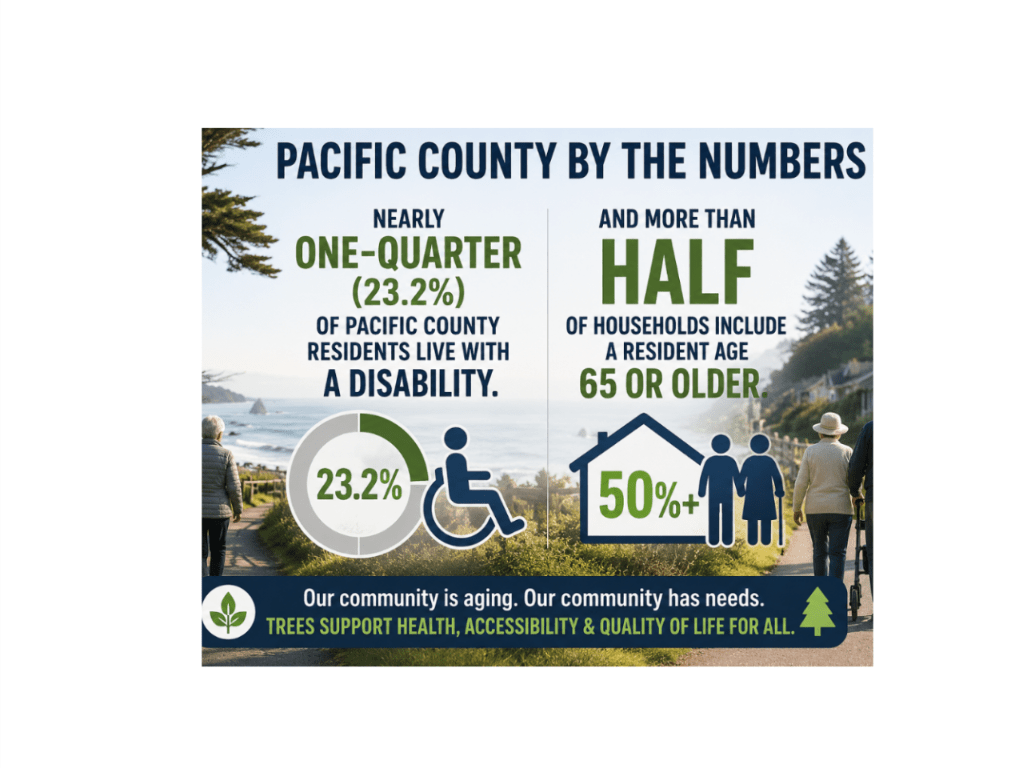
Nearly one-quarter (23.2%) of Pacific County residents live with a disability, and more than half of households include a resident age 65 or older. These statistics make Pacific County one of Washington’s most vulnerable communities when it comes to health challenges, mobility limitations, chronic disease, and climate-related risks.
Pacific County already has a disability rate of nearly one out of four, but Ocean Park’s median age of 63.5 years is nearly a decade older than the county average. As a result, the health, accessibility, and climate-resilience benefits of trees are likely even more important in Ocean Park and Surfside than in most communities in Washington State. As discussed in the article, “Seniors, Chronic Disease, Neurological Symptoms, and the Importance of Trees for Health in Ocean Park and Surfside,” the local population experiences elevated rates of age-related health conditions, including diabetes, cardiovascular disease, obesity, respiratory illness, mobility limitations, and neurological symptoms. Trees help address many of these challenges by reducing heat exposure, improving air quality, encouraging physical activity, lowering stress, and creating more comfortable and accessible outdoor environments. In a community where seniors and individuals with chronic health conditions make up a substantial portion of the population, protecting and expanding tree canopy should be viewed as an investment in public health, healthy aging, and quality of life—not simply an environmental amenity.
As our population ages, protecting and expanding tree canopy should be viewed not simply as an environmental goal, but as a required public health investment.
Trees provide much needed Health Benefits for One of Every Four Residents
Disability includes a wide range of conditions that affect daily life, including mobility limitations, vision and hearing impairments, cognitive disabilities, chronic illnesses, and mental health conditions.
For many residents, everyday activities such as walking, exercising, shopping, or spending time outdoors can be more challenging. Trees help make these activities safer and more comfortable.
With 23.2% of Pacific County residents living with a disability, the benefits of tree canopy extend far beyond aesthetics. Trees directly support the health and well-being of thousands of local residents.
Trees Help Keep People Safe During Heat Waves
People living with disabilities and chronic illnesses are often more vulnerable to extreme heat.
Many medications affect the body’s ability to regulate temperature. Mobility limitations can make it difficult to reach cooling centers or air-conditioned locations during heat emergencies.
Trees naturally cool neighborhoods through shade and evapotranspiration. Studies have shown that tree-covered areas can be significantly cooler than nearby areas lacking canopy.
For individuals with disabilities, this cooling effect can reduce heat stress, lower health risks, and make outdoor spaces safer and more accessible.
Cleaner Air for Vulnerable Residents
Trees act as natural air filters.
They capture particulate pollution and improve air quality, helping reduce respiratory irritation and exposure to airborne contaminants.
This is particularly important for residents living with:
- Asthma
- COPD
- Cardiovascular disease
- Diabetes-related complications
- Other respiratory conditions
For vulnerable populations, cleaner air can mean fewer symptoms, better health outcomes, and improved quality of life.
Trees Support Mental Health and Cognitive Function
Research consistently finds that spending time around trees and green spaces reduces stress and improves emotional well-being.
For individuals experiencing depression, anxiety, PTSD, cognitive decline, dementia, or neurological conditions, access to nature can provide measurable benefits.
Even viewing trees from a window has been associated with reduced stress and improved mental health.
In communities where social isolation is common among seniors and disabled residents, access to green spaces becomes even more valuable.
Trees Make Walking Easier and More Comfortable
One of the most overlooked benefits of trees is their impact on walkability.
Shaded streets and pathways are more comfortable and inviting for walking, especially for individuals with mobility challenges, chronic pain, obesity, diabetes, or cardiovascular disease.
By reducing heat exposure and improving comfort, trees encourage physical activity, which in turn supports both physical and mental health.
Trees Reduce Social Isolation
Many people with disabilities face barriers to social engagement.
Tree-lined neighborhoods, parks, and community gathering spaces encourage outdoor activity and interaction with neighbors.
These social connections are important for emotional well-being and community resilience, particularly among older adults living alone.
An Aging Population Needs Tree Canopy
Pacific County’s demographics make these benefits especially important.
More than half of county households include a resident age 65 or older.
As people age, the likelihood of mobility limitations, chronic disease, hearing loss, vision impairment, and other disabilities increases. Tree canopy helps address many of the challenges associated with aging by providing cooler neighborhoods, cleaner air, safer walking conditions, and opportunities for social interaction.
Communities with large senior populations should view tree protection and tree planting as investments in healthy aging.
Trees Are Public Health Infrastructure
Communities invest millions of dollars in roads, sidewalks, drainage systems, and public facilities because these assets improve safety and quality of life.
Trees deserve to be viewed the same way.
A healthy tree canopy provides:
- Natural cooling.
- Improved air quality.
- Stormwater management.
- Mental health benefits.
- Better walkability.
- Greater accessibility.
- Increased climate resilience.
These are not merely environmental benefits. They are essential public services that improve daily life for residents.
Why This Matters for Pacific County
With nearly one in four residents living with a disability and a majority of households including older adults, Pacific County has a unique responsibility to consider how environmental decisions affect vulnerable populations.
Trees are not simply part of the landscape. They are part of the community’s health infrastructure.
As Pacific County plans for future climate challenges, population aging, and public health needs, protecting existing trees and growing new canopy may be one of the most cost-effective investments available.
For seniors, people with disabilities, and future generations, healthier tree canopy means healthier communities.
In Pacific County, trees are more than an environmental asset—they are an investment in accessibility, dignity, public health, and quality of life for the 23.2% of residents living with disabilities and the thousands of seniors who call the county home.

