
For centuries, trees have been valued for their beauty, shade, and ecological importance. Increasingly, however, scientists are finding that trees may offer something even more profound: longer, healthier lives.
Over the past two decades, researchers from around the world have investigated the relationship between trees, green spaces, and human health. Their findings have consistently pointed in the same direction. People who live in greener environments tend to experience lower rates of disease, better mental health, and reduced mortality compared with those who live in less green surroundings.
While no single study can prove that trees directly extend lifespan, the cumulative evidence has become remarkably compelling.
Trees protect us even before we’re born
Portland Tree Planting Study (2025)
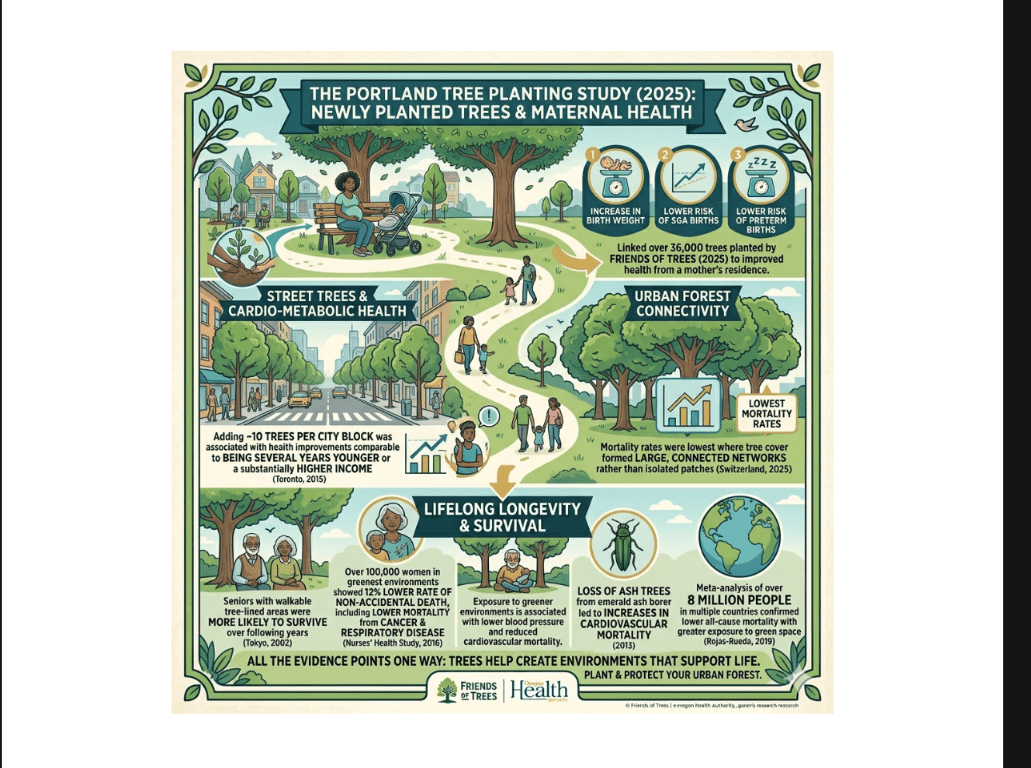
A newer study used records from more than 36,000 trees planted in Portland by Friends of Trees and linked them to Oregon birth records. Researchers found that each tree planted within 100 meters of a mother’s residence was associated with a measurable increase in birth weight, lower risk of small-for-gestational-age births, and lower risk of preterm births. The study is particularly important because it examined newly planted trees, helping address the question of whether trees themselves contribute to improved health outcomes.
The First Clues: Longevity in Japan
One of the earliest and most influential studies was conducted in Tokyo by Takano and colleagues and published in 2002. The researchers followed thousands of older adults to determine whether their surrounding environment influenced survival.
The results were striking. Seniors who lived near walkable green spaces and tree-lined areas were more likely to survive over the following years than those who lacked access to such environments. Importantly, the relationship remained significant even after accounting for factors such as age, marital status, socioeconomic status, and baseline health.
The study provided some of the earliest evidence that access to nature might influence not only quality of life but longevity itself.
Evidence From More Than 100,000 Women
The question gained renewed attention in 2016 when researchers led by Peter James analyzed data from the Nurses’ Health Study, one of the largest and most respected long-term health studies in the United States.
Following more than 100,000 women, the researchers found that those living in the greenest environments experienced approximately a 12 percent lower rate of non-accidental death compared with those living in the least green environments.
The benefits extended across multiple causes of death. Women surrounded by more vegetation showed lower mortality from cancer, respiratory disease, and kidney disease.
Perhaps most interestingly, the researchers found evidence that some of the protective effect was linked to improved mental health, increased physical activity, and stronger social engagement. In other words, trees appeared to support health both directly and indirectly by encouraging healthier lifestyles.
Measuring the Health Value of Street Trees
Around the same time, researchers in Toronto began investigating whether the density of street trees could influence health.
Published in Scientific Reports in 2015, the study by Marc Berman and colleagues examined urban forest inventories alongside public health data. The researchers found that neighborhoods with more street trees reported better overall health and lower rates of cardio-metabolic conditions such as hypertension, obesity, and diabetes.
One of the study’s most widely cited findings was that adding approximately ten trees per city block was associated with health improvements comparable to being several years younger or having a substantially higher household income.
Although the study did not measure mortality directly, it provided a tangible illustration of how urban tree canopy may affect everyday health.
When Trees Disappear
Some of the strongest evidence for a causal relationship between trees and health emerged from an unexpected source: an invasive insect.
In 2013, Geoffrey Donovan and colleagues examined the spread of the emerald ash borer, a beetle that has killed millions of ash trees across the United States. Because the infestation occurred independently of local health conditions, it created a natural experiment that allowed researchers to study the effects of large-scale tree loss.
The findings were sobering. Counties that experienced significant tree loss also experienced increases in cardiovascular and lower-respiratory mortality. Researchers estimated thousands of additional deaths associated with the destruction of tree canopy.
The study suggested that trees may do more than simply mark healthy neighborhoods—they may actively contribute to public health.
The Largest Analysis Yet
In 2019, researchers led by David Rojas-Rueda published a landmark meta-analysis in The Lancet Planetary Health. Rather than examining a single population, they combined data from multiple cohort studies involving more than eight million people across several countries.
The conclusion was clear: greater exposure to green space was consistently associated with lower all-cause mortality.
Because meta-analyses combine findings from numerous independent studies, they are often regarded as among the strongest forms of scientific evidence. The consistency observed across different populations and geographic regions strengthened confidence that the relationship between greenness and longevity is real.
Cardiovascular Health: A Recurring Theme
One pattern appears repeatedly throughout the literature: the strongest benefits are often seen in cardiovascular health.
Numerous reviews published over the past decade have found that exposure to green environments is associated with lower blood pressure, reduced risk of heart disease, lower stroke rates, and decreased cardiovascular mortality.
This is particularly important because cardiovascular disease remains one of the leading causes of death worldwide. Even modest reductions in cardiovascular risk can translate into substantial gains in life expectancy at the population level.
Researchers believe trees may protect cardiovascular health through multiple pathways, including improved air quality, reduced heat exposure, increased physical activity, and lower psychological stress.
New Evidence From Europe
More recent European cohort studies have focused specifically on older adults. These investigations have consistently found that long-term exposure to greener environments is associated with reduced mortality risk, particularly from cardiovascular causes.
A good way to strengthen the article is to replace the brief “New Evidence From Europe” section with a more detailed discussion of the major European studies published in recent years.
Revised Section: New Evidence From Europe
New Evidence From Europe
In recent years, some of the most sophisticated research on trees and longevity has come from Europe, where large population databases and detailed environmental measurements have allowed scientists to examine health outcomes on an unprecedented scale.
A 2023 study published in The Lancet Regional Health – Europe followed more than 35,000 adults across several European countries and found that long-term exposure to greener residential environments was associated with lower mortality risk, particularly from cardiovascular disease. The protective effects remained evident after researchers adjusted for income, education, urbanization, smoking, and other lifestyle factors.
Another major European investigation, conducted in Spain and involving older adults from multiple regions, reported that people living in neighborhoods with greater tree cover and accessible green spaces experienced lower rates of premature death and better cardiovascular health. Researchers concluded that urban vegetation may represent an important public-health resource in aging societies.
European studies have also begun distinguishing between different types of greenery. Rather than treating all vegetation as equal, researchers have found that tree canopy often produces stronger health benefits than lawns or low-growing vegetation. Trees provide shade, reduce urban heat, filter air pollutants, dampen traffic noise, and create more attractive environments for walking and social interaction.
A 2024 multinational European analysis further strengthened the evidence by examining environmental exposures across diverse climates and urban settings. Despite substantial differences among cities and countries, the researchers observed a remarkably consistent pattern: residents of greener neighborhoods generally experienced lower mortality rates than those living in areas with less tree cover.
Together, these studies suggest that the health benefits associated with trees are not confined to North America or East Asia. Across Europe, researchers have repeatedly observed links between greener environments, improved cardiovascular health, and longer life expectancy, reinforcing the idea that urban forests function as an important form of public-health infrastructure.
Six Million Adults and the Importance of Tree Canopy
The most ambitious study to date was published in 2025 and analyzed more than six million adults in Switzerland.
Unlike previous research that focused mainly on the quantity of vegetation, the Swiss investigators examined the structure of tree canopy itself. They found that mortality rates were lowest in neighborhoods where tree cover formed large, connected networks rather than isolated patches.
The study suggested that how trees are distributed may matter nearly as much as how many trees are present. Continuous canopiescomparedto scattered trees provide more effective cooling, better air filtration, and greater opportunities for recreation and active transportation.
For urban planners, the message was clear: creating connected urban forests with higher tree canopy targets may deliver greater health benefits than scattered plantings alone.
Benefits That Begin Before Birth
Research suggests that the health effects of trees may begin even before a child is born.
Several recent studies, including work conducted in Portland, Oregon, have linked residential tree planting and greater tree canopy to healthier birth outcomes and higher birth weights. While these studies do not address longevity directly, they indicate that green environments may influence health across the entire lifespan.
From prenatal development to old age, trees appear to provide measurable benefits that accumulate over time.
Why Trees Matter
Scientists believe trees improve health through a combination of biological, environmental, and social mechanisms.
Trees filter air pollution, reducing exposure to harmful particles linked to heart and lung disease. They cool neighborhoods during heat waves, lowering the risk of heat-related illness and death. They encourage physical activity by making outdoor spaces more inviting. They reduce stress and improve mental health. They foster social interaction and community cohesion.
Each of these factors independently contributes to better health. Together, they may help explain why people living in greener environments consistently experience lower mortality rates.
The Growing Scientific Consensus
The evidence now spans more than two decades, multiple continents, and tens of millions of participants. Studies from Japan, the United States, Canada, Switzerland, and across Europe have arrived at remarkably similar conclusions despite differences in populations and research methods.
Scientists remain careful not to claim that planting a single tree will automatically extend an individual’s life. Yet the consistency of the findings has led many public-health experts to view urban forests as critical health infrastructure.
The emerging picture is both simple and profound: trees do far more than beautify cities. They help create environments that support physical health, mental well-being, and longevity. In an increasingly urbanized world, preserving and expanding tree canopy may be one of the most effective investments societies can make in the health of future generations.
This version integrates the key findings from Takano (2002), Berman (2015), James (2016), Donovan (2013), Rojas-Rueda (2019), European cohort studies (2023), the Swiss cohort study (2025), and recent tree-canopy birth outcome research into a single coherent narrative.

