
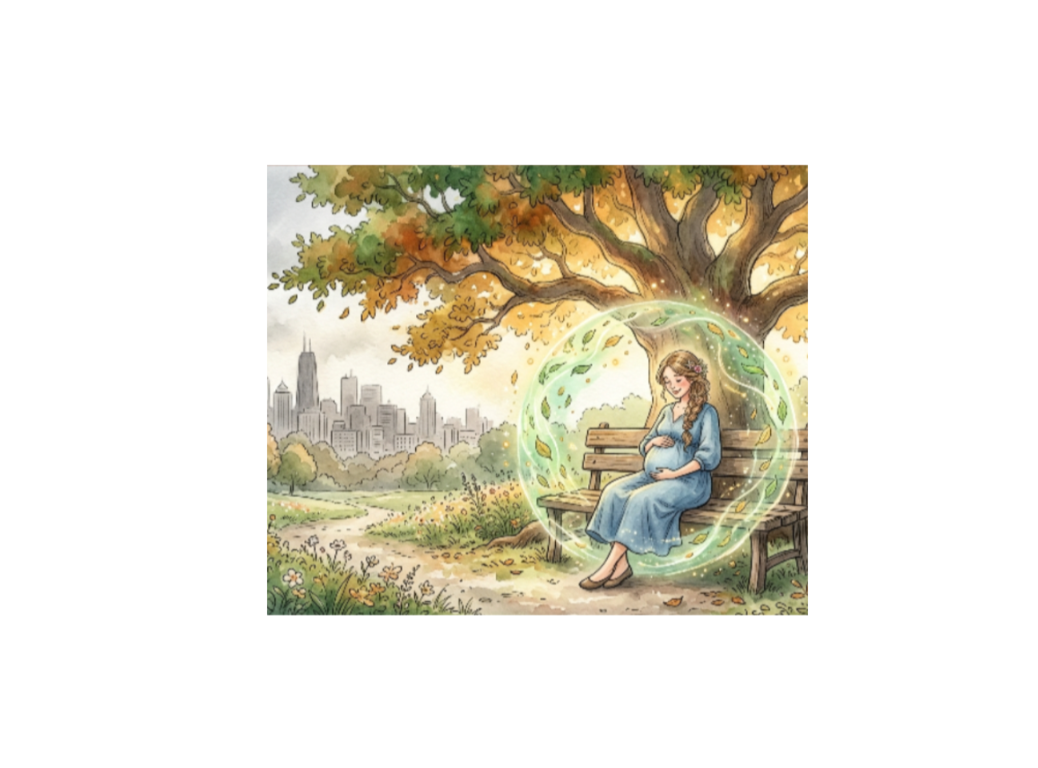
The smell of morning traffic used to be Maya’s alarm clock. Living downtown, she had long made peace with the haze, the noise, and the constant hum of the interstate. But the moment she found out she was pregnant, everything changed. Suddenly, every idling engine felt personal. Every cloud of exhaust felt aimed directly at her.
Like most expectant mothers, Maya went through every checklist she could find. Herbal tea replaced her morning coffee. She scrutinized every label on her skincare products. She started taking prenatal vitamins. But no amount of label-reading could fix the one thing she couldn’t control: the air inside her own apartment.
So she and her partner started spending their weekends at a community park, a shaded little world dense with oak and maple trees. The moment she stepped under that canopy, something shifted. The air smelled different—cooler, cleaner, almost sweet. It felt like stepping into a different neighborhood entirely.
What Maya was experiencing wasn’t just a pleasant change of scenery. It was biology at work. Without knowing it, she was giving her unborn baby one of the most important gifts imaginable: a breath of truly clean air.
The Invisible Threat in the Air
We have always known that trees make our neighborhoods look beautiful. But what researchers have been quietly discovering goes far deeper than curb appeal—trees are actively protecting us on a cellular level, and that protection starts before we even take our first breath.
Our cities are saturated with PM2.5 particles, CO2, microplastics, and toxic gases such as nitrogen dioxide. These pollutants are so microscopic they sail right past our body’s natural defenses, seeping into a mother’s bloodstream and reducing the oxygen flowing to her baby. The result isn’t just discomfort—it’s a genuine health risk for a developing child.
Nature’s Living Air Filters
This is where trees quietly earn their title as the neighborhood’s best defenders. A tree isn’t passive. It’s working around the clock, leaf by leaf, to clean the air around it.
- Trapping particulate matter: Their waxy, textured surfaces trap airborne dust, soot, and smoke particles—think of millions of tiny natural air filters arranged overhead.
- Absorbing toxic gases: Through tiny pores called stomata, trees breathe in harmful gases like nitrogen dioxide and carbon monoxide and lock them away or break them down completely.
The research is consistent: neighborhoods with more trees have measurably cleaner air. A dense row of mature trees between a busy road and a residential street can meaningfully reduce local pollution—creating a living, breathing shield for the families on the other side.
Healthy Canopies, Healthier Babies
This isn’t theoretical. Large peer-reviewed studies tracking thousands of births have found something remarkable: mothers who live near more trees and green space give birth to healthier babies. The data is hard to argue with.
- Lower risk of premature birth: Babies born too early face serious hurdles. The cleaner air provided by nearby trees reduces biological stress on a mother’s body and helps pregnancies reach full term.
- Healthier birth weights: Birth weight is one of the strongest early indicators of a baby’s long-term health. Infants born in tree-rich neighborhoods consistently weigh more than those born in areas paved with concrete.
- Reduced inflammation: By filtering out pollutants, trees help calm a mother’s immune response, keeping inflammation low and oxygen delivery to the baby optimal.
Here’s the remarkable implication: planting a tree isn’t just an act of beautification. It’s a public health intervention. It protects children who haven’t been born yet.
Myth: “Air Quality is the Same Everywhere”
A lot of people assume that air pollution works like a blanket—if you’re in the same zip code, you’re breathing the same air. Science says otherwise. Air quality is hyper-local. Pollution levels can spike dramatically from one block to the next based on traffic and, crucially, how many trees are present.
A street lined with mature oaks can have dramatically lower pollution levels than a parallel street just one block over—paved and bare. That distance matters. Every single tree on your block, in your yard, or in your neighborhood park contributes to a microclimate of safety for nearby families.
How You Can Help Right Now
We don’t have to accept polluted air as the price of modern life. Here are real, practical ways you can be part of the solution:
- Plant for the future: Oaks, maples, and elms—with their large, rough, or fuzzy leaves—are champion air filters. If you have a yard, plant one today.
- Advocate locally: Attend your next council meeting. Push for ordinances that protect mature trees and require new plantings along busy roads and near schools.
- Champion row trees: Row trees serve triple duty: they buffer the wind, absorb carbon dioxide, and protect roads from flooding—benefits that reach every home on the street.
The Lasting Gift
Years later, Maya returned to that same park. This time, she had a toddler walking beside her, weaving between the same oaks that had sheltered them both during those nine crucial months. The trees were doing what trees do—quietly, patiently, generously giving.
When we plant and protect trees, we’re doing something that ripples into the future. We’re offering a gift of health and safety to children who haven’t been born yet. That’s the kind of legacy worth rolling up your sleeves for.

