
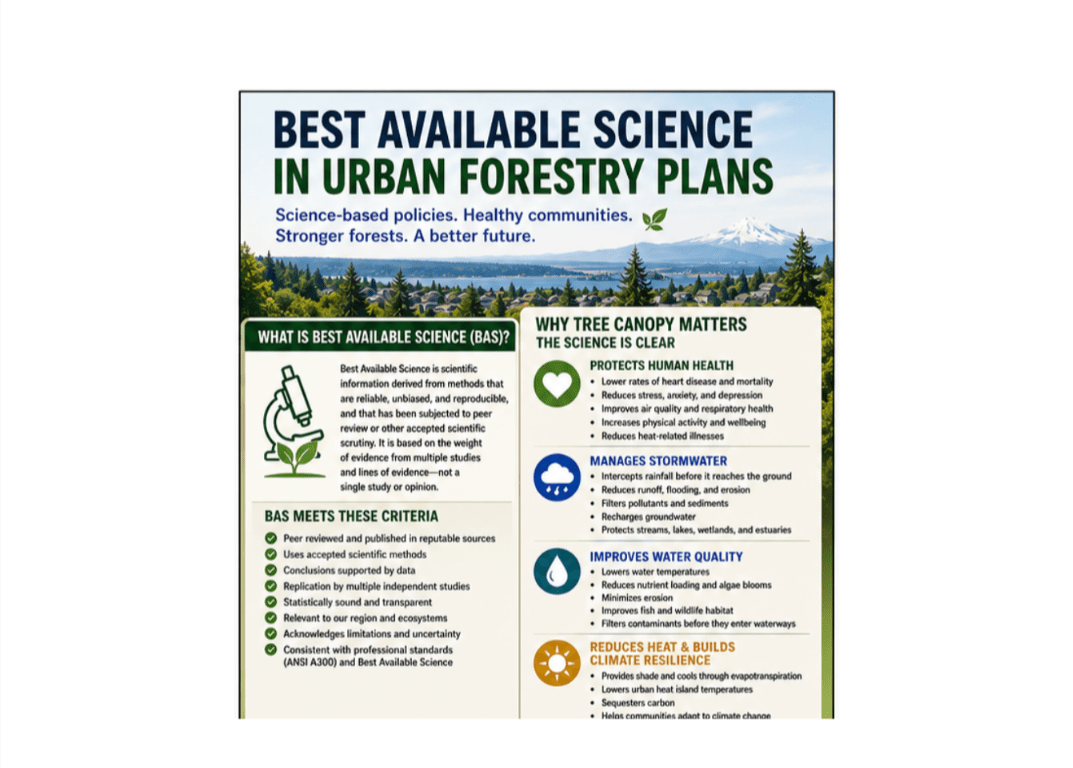
A question in yesterday’s Surfside candidate forum asked about the science and whether it was peer reviewed.
Across the Pacific Northwest, urban forestry plans are increasingly guided by Best Available Science (BAS) rather than aesthetics alone. Scientific research from the U.S. Forest Service, public health institutions, universities, and state agencies demonstrates that trees are not merely landscape features—they are essential green infrastructure that protects human health, manages stormwater, improves water quality, and increases community resilience.
General Definition
Best Available Science is:
Scientific information derived from methods that are reliable, unbiased, and reproducible, and that has been subjected to peer review or other accepted scientific scrutiny. It is not based on a single study or opinion. Rather, it relies on the weight of evidence from multiple studies and lines of evidence.
Urban forestry plans adopted by cities and counties throughout the Northwest cite scientific studies and professional standards when developing urban forestry policies. These scientifically backed recommendations satisfy several criteria including peer review, reproducibility, multiple lines of evidence, and consistency with established biological principles.
Human Health Is a Primary Goal
Modern urban forestry plans recognize that tree canopy is a public health asset. Numerous peer-reviewed studies have found that people living in neighborhoods with greater tree cover experience:
- Lower rates of cardiovascular disease.
- Reduced stress, anxiety, and depression.
- Improved mental health and cognitive function.
- Better air quality and respiratory health.
- Increased physical activity.
- Reduced heat-related illnesses.
- Lower mortality rates and increased longevity.
These benefits are particularly important in communities with older populations and vulnerable residents.
Stormwater Protection Is a Primary Goal
Best Available Science also recognizes that trees are a natural stormwater management system.
Tree canopies and root systems:
- Intercept rainfall before it reaches the ground.
- Reduce runoff and flooding.
- Stabilize soils and shorelines.
- Filter pollutants and sediments.
- Recharge groundwater supplies.
- Protect lakes, wetlands, streams, and estuaries.
For communities surrounded by waterways, maintaining vegetation is often more cost-effective and environmentally beneficial than relying solely on engineered infrastructure.
Water Quality Protection
Scientific studies consistently demonstrate that forests and riparian vegetation:
- Lower water temperatures.
- Reduce nutrient loading.
- Minimize erosion.
- Improve fish and wildlife habitat.
- Reduce algae blooms.
- Filter contaminants before they enter streams and lakes.
Because of these benefits, riparian buffers and healthy tree cover are widely recognized as Best Available Science under Washington’s Growth Management Act.
Climate and Heat Resilience
Tree canopy provides shade and cooling through evapotranspiration. Research shows trees can significantly reduce temperatures and lessen the impacts of heat waves. Trees also sequester carbon and help communities adapt to changing climate conditions.
Examples of Urban Forestry Plans Across the Pacific Northwest
Seattle, Washington
Seattle’s Urban Forest Management Plan established a goal of achieving 30 percent canopy cover by 2037. The plan emphasizes improving public health, reducing heat islands, managing stormwater, increasing climate resilience, and promoting equitable access to tree canopy. Trees are treated as essential infrastructure rather than simply landscaping.
Portland, Oregon
Portland’s Urban Forest Plan serves as a roadmap for preserving, expanding, and caring for the urban forest. Goals include improving community health, managing stormwater, increasing canopy, promoting equity, and protecting watershed health and wildlife habitat. The plan recognizes that trees provide measurable ecosystem services and reduce infrastructure costs.
Tacoma, Washington
Tacoma’s Urban Forest Management Plan focuses on healthy neighborhoods, preserving mature trees, stormwater management, and replacement planting. Trees are recognized as assets providing environmental, economic, and health benefits.
Bellingham, Washington
Bellingham emphasizes watershed protection, biodiversity, erosion reduction, and maintaining healthy canopy to support water quality and ecosystem functions.
Olympia, Washington
Olympia’s urban forestry program focuses on climate resilience, stormwater reduction, habitat protection, and maintaining healthy street trees.
Spokane, Washington
Spokane emphasizes reducing heat islands, improving air quality, increasing tree canopy, and enhancing public health.
Eugene, Oregon
Eugene’s urban forestry program focuses on climate adaptation, carbon sequestration, heat reduction, and maintaining tree canopy as green infrastructure.
Bend, Oregon
Bend’s Community Forestry Program promotes science-based wildfire resilience, species diversity, preservation of mature trees, and increasing shade and cooling.
Vancouver, Washington
Vancouver’s urban forestry program emphasizes stormwater management, wildlife habitat, heat mitigation, and preserving tree canopy. The city has adopted a canopy goal of approximately 28 percent.
King County
King County’s Urban Forest Health Program seeks to enhance, protect, and restore urban tree canopy while promoting tree retention as green stormwater infrastructure. The county’s 30-Year Forest Plan prioritizes maintaining and increasing canopy, especially in underserved communities.
Common Goals of Northwest Urban Forestry Plans
Urban forestry plans throughout Washington and Oregon generally share the following goals:
Primary Goals
- Protect human health and quality of life.
- Manage stormwater and reduce flooding.
- Protect water quality and aquatic ecosystems.
- Increase and maintain tree canopy.
- Reduce urban heat.
- Enhance climate resilience.
Secondary Goals
- Preserve wildlife habitat and biodiversity.
- Remove hazardous and diseased trees.
- Replace trees when removals occur.
- Promote environmental equity.
- Encourage community stewardship.
- Follow ANSI A300 arboricultural standards and Best Available Science.
Notably, these plans generally focus on maintaining or increasing canopy rather than broad canopy reduction.
What Best Available Science Would Suggest for Surfside
A science-based urban forestry plan for Surfside would likely prioritize:
- Protecting the health and well-being of residents, especially seniors.
- Treating tree canopy as essential green infrastructure.
- Using trees to manage stormwater and protect lakes, wetlands, canals, and coastal waters.
- Restoring and maintaining adequate tree canopy.
- Preserving riparian buffers and shoreline vegetation.
- Removing hazardous trees while retaining healthy trees.
- Following ANSI A300 standards and Best Available Science.
- Improving resilience to storms, flooding, heat, and climate change.
Conclusion
Best Available Science increasingly views trees as infrastructure that provides measurable benefits to people and ecosystems. Consequently, urban forestry plans throughout Seattle, Portland, Tacoma, Bellingham, Olympia, Spokane, Eugene, Bend, Vancouver, and King County are designed not simply to preserve trees, but to protect public health, manage stormwater, safeguard water quality, and create healthier and more resilient communities. In this framework, maintaining and restoring tree canopy becomes an investment in both environmental sustainability and human well-being.

