
Across Europe and the American West, a troubling pattern is emerging. Record ocean temperatures, prolonged heat waves, drought, and explosive wildfires are no longer isolated disasters—they are increasingly occurring together. Scientists have warned for decades that climate change would amplify extreme weather. Today, many researchers believe we are entering a period where these changes reinforce one another, creating a dangerous cycle that becomes progressively harder to manage.
Europe provides one of the clearest examples. During the past year, record marine heat waves in the Atlantic and Mediterranean combined with extreme land temperatures to produce one of the most destructive wildfire seasons ever recorded. Tens of thousands of residents have been evacuated in France, Spain, Italy, and Greece, while millions more have endured dangerous heat. The European Union reported that 2025 became its worst wildfire season on record, with more than one million hectares burned within EU countries alone.
Scientists use the phrase “tipping point” to describe a threshold where gradual change gives way to rapid acceleration. While individual wildfire seasons cannot by themselves prove a global tipping point has been crossed, observations show that rising temperatures, drier vegetation, and longer fire seasons are increasing the likelihood of larger and more intense fires in many regions.
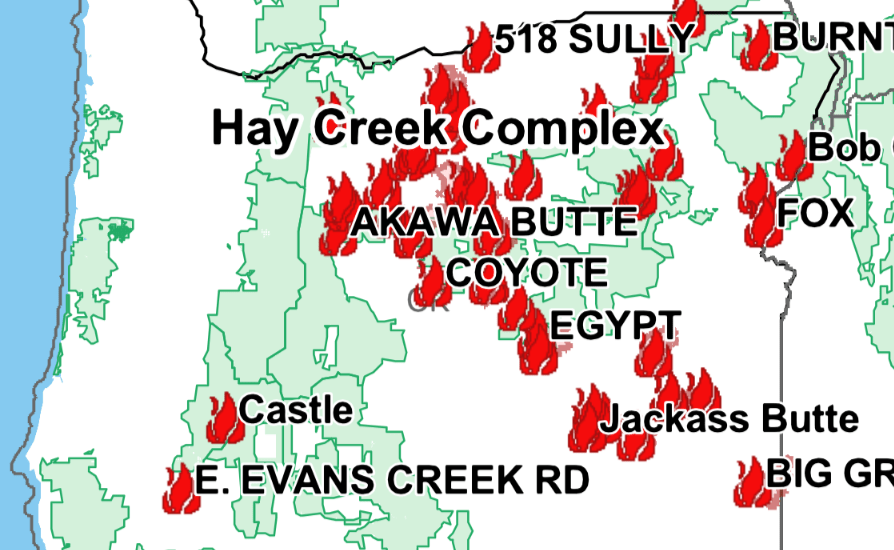
Oregon is now experiencing many of the same warning signs. Western Oregon, once considered relatively protected by its moist forests, has seen increasingly destructive fire seasons. Eastern Oregon continues to experience frequent lightning-caused fires across vast, remote landscapes. When large fires ignite simultaneously across multiple states, firefighting resources—including aircraft, crews, and equipment—are stretched thin. There simply are not enough resources to attack every major fire immediately.
The challenge extends beyond firefighting. A warming climate dries forests, increases evaporation, and lengthens the fire season. Marine heat waves in the Pacific can also influence regional weather patterns that contribute to hotter and drier conditions. Scientists continue to study the precise relationships, but there is broad agreement that warmer oceans and higher global temperatures increase the likelihood of extreme heat and elevated wildfire risk.
Governments traditionally excel at responding to disasters after they occur—sending firefighters, disaster relief, and recovery funding. Prevention, however, is often more difficult because it requires long-term planning, investment, and policies whose benefits may not be fully realized for years.
Many scientists argue that reducing greenhouse gas emissions while protecting and restoring forests can both play important roles. Forests absorb carbon dioxide, moderate local temperatures, improve watershed health, and can reduce some climate impacts when managed sustainably. At the same time, researchers emphasize that forest restoration alone cannot offset continued global emissions; both emissions reductions and ecosystem protection are needed together.
The lesson from Europe and the American West is becoming increasingly clear. Climate change is no longer simply a projection for future generations. It is influencing today’s weather, forests, water supplies, and public safety. Communities that once viewed catastrophic wildfire as a rare event are beginning to experience it as a recurring reality.
Nature ultimately responds to the laws of physics rather than political debate. Scientific evidence continues to show that higher greenhouse gas concentrations increase global temperatures, warmer temperatures dry vegetation, and drier vegetation burns more readily under the right weather conditions. How societies respond to those findings—through energy choices, land management, infrastructure planning, and emergency preparedness—will play a major role in determining whether future wildfire seasons become even more destructive.

