
Executive Summary of phys.org article :
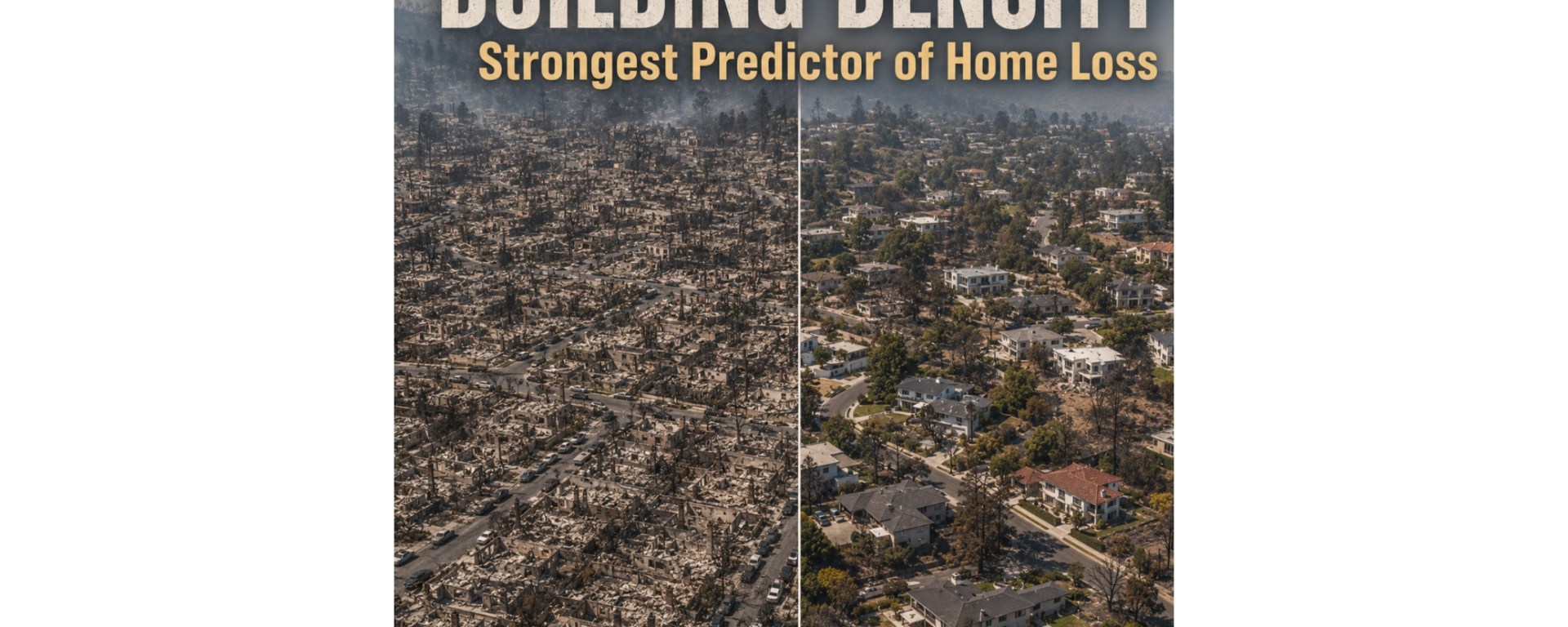
Building Density—not Trees—Was the Strongest Predictor of Home Loss
A peer-reviewed study of the January 2025 Palisades and Eaton fires found that building density was the strongest predictor of whether a home was destroyed. Once the fires entered developed neighborhoods, closely spaced houses became major fuel sources, allowing flames and embers to spread from structure to structure.
Researchers analyzed 15,082 structures and 52,893 tree canopies using CAL FIRE damage inspections, building footprints, LiDAR mapping, satellite imagery and wind modeling. Homes surrounded by more nearby structures were significantly more likely to be destroyed than homes in less densely developed areas.
The study’s principal findings were:
Building density was the strongest predictor of structure loss in both fires.
Homes closer to neighboring buildings faced greater destruction risk.
Tree-canopy effects were comparatively small and inconsistent.
In some locations, tree canopy was associated with lower—not higher—losses.
Simulated removal of all tree canopy within two meters of homes produced only a small reduction in predicted losses.
The study does not conclude that vegetation maintenance is unnecessary. Pruning, removing dead material and clearing leaf litter remain useful precautions. However, it challenges policies that broadly identify healthy trees as a leading cause of urban fire destruction.
The researchers recommend placing greater emphasis on fire-resistant construction, ember-resistant vents and roofs, home hardening, building separation and neighborhood-scale planning.
They caution that widespread canopy removal could eliminate shade, cooling, cleaner air, stormwater control and public-health benefits without substantially reducing losses during extreme urban firestorms.
The central policy conclusion is that communities should prioritize the vulnerability and arrangement of buildings while managing vegetation according to its actual condition. Healthy, maintained trees should not automatically be treated as equivalent to dry grass, dead brush or combustible debris.
Source: Phys.org — Building density, not trees, was strongest predictor of home loss in Los Angeles firestorms
https://phys.org/news/2026-05-density-trees-strongest-predictor-home.html

