
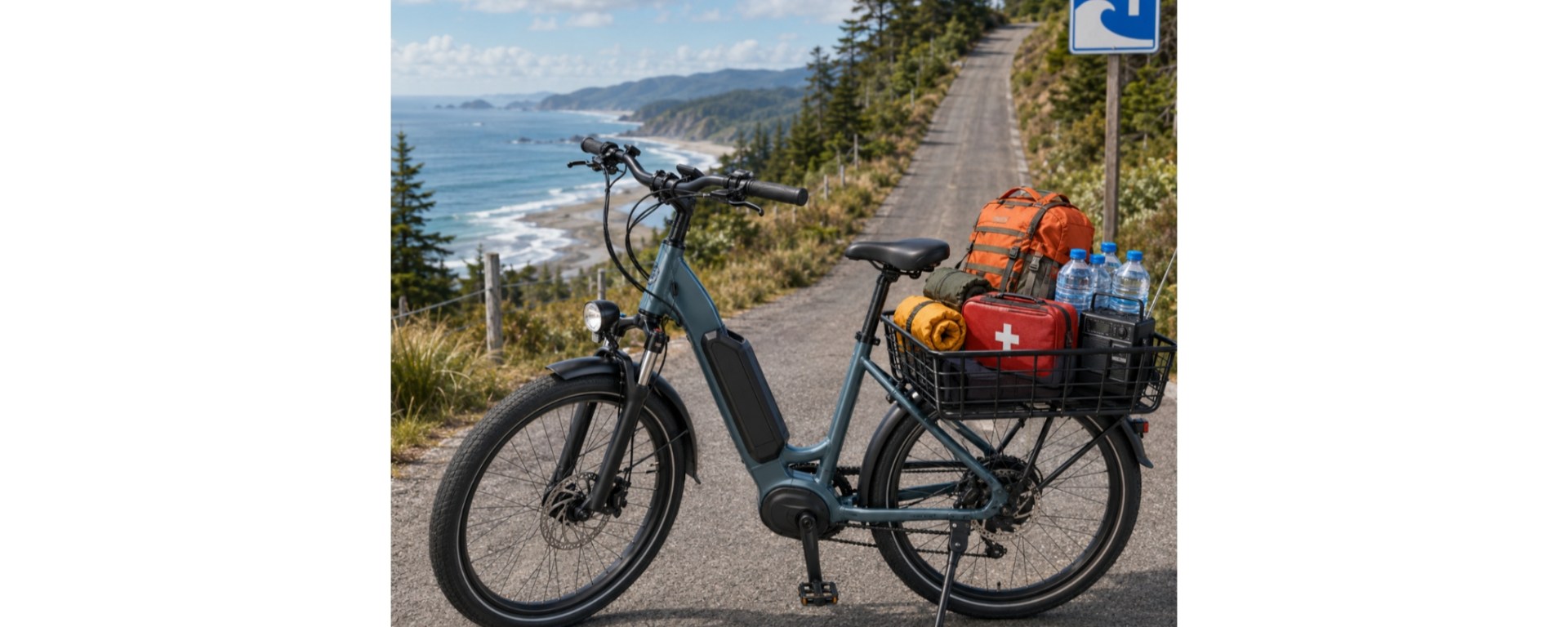
Electric bicycles could become valuable emergency tools in coastal communities threatened by a Cascadia Subduction Zone earthquake and tsunami. An e-bike may help residents evacuate several times faster than walking while also providing transportation for delivering medicine, food, water and communications equipment when roads are blocked and electricity and fuel are unavailable.
An e-bike is not a replacement for official evacuation planning, emergency shelters or accessible transportation. Its effectiveness depends on advance preparation, a safe route and a reliable way to recharge or replace its battery.
There is no data that shows it’s real effectiveness except some limited data from japan. It is dependant on conditions after an earthquake or tsunami that would make use of any bike difficult. So do not rely on an ebike as your only safety evacuation option.
Faster evacuation without automobile gridlock
A locally generated Cascadia tsunami could reach parts of the Washington coast within minutes. There may be no time for an official alert.
If someone near the coast feels a strong or prolonged earthquake, Washington Emergency Management advises them to protect themselves during the shaking and then immediately move inland or toward high ground. The earthquake itself may be the only warning. Washington Emergency Management Division
A person walking at approximately 3 miles per hour can cover about one-half mile in ten minutes. Under favorable conditions, someone riding an e-bike at 10 to 15 miles per hour could travel approximately 1.7 to 2.5 miles during the same period.
Actual speeds after an earthquake would probably be lower because of debris, damaged pavement, fallen trees, disabled vehicles and frightened pedestrians. Nevertheless, even a reduced cycling speed could offer a significant advantage for people who must travel farther than they can comfortably walk.
Lessons from Japan
Research based on the 2011 Great East Japan earthquake and tsunami found that bicycles could be an effective evacuation method. Survey data from 29 municipalities showed a median evacuation starting time of approximately 13 minutes for bicycle users, compared with 18 minutes for motorists and 28 minutes for people walking.
The research primarily examined conventional bicycles, not modern e-bikes. It therefore does not establish how much pedal assistance would improve survival. However, electric assistance could make bicycle evacuation more practical for older adults, people with limited stamina and residents carrying a small emergency pack. Japanese evacuation-mode study
Japan’s experience also demonstrated the risks of relying heavily on cars. Traffic congestion and damaged roads delayed some evacuees, while bicycles required less space and could be walked around certain obstructions.
A potential lifeline after the tsunami
The usefulness of an e-bike may continue long after the immediate evacuation.
A major Cascadia earthquake could damage highways, bridges, fuel stations, electrical systems and communications networks. Some coastal communities might be partially isolated for days or weeks. Cars could become unusable because of blocked roads or gasoline shortages.
E-bikes could help trained volunteers and emergency organizations:
- Deliver prescription medications and first-aid supplies
- Carry food, drinking water and water-purification equipment
- Transport radios, batteries and satellite communication devices
- Check on older or mobility-limited residents
- Carry small tools and repair equipment
- Move laboratory samples or medical information
- Survey damaged roads and report hazards
- Relay written messages when cellular networks are unavailable
- Travel between shelters, supply points and neighborhood gathering areas
Cargo e-bikes and bicycles equipped with trailers can carry much more than an ordinary bicycle. Depending on the model, terrain and rider, a cargo bike might transport several bags of supplies while still using far less road space and energy than a car.
E-bikes may be particularly useful for “last-mile” delivery—the final portion of a supply trip between a central distribution point and homes or shelters that trucks cannot reach.
Use should be organized, not improvised
Immediately after strong coastal shaking, the only priority is reaching a safe location. Riders should not delay evacuation to collect supplies or assist others inside the inundation zone.
Supply deliveries should begin only after people have reached safety, immediate tsunami danger has passed and emergency officials have indicated that travel is appropriate. Tsunami waves can continue for many hours, and the first wave may not be the largest.
Ideally, communities would organize an e-bike response team before a disaster. Riders could be assigned geographic areas, taught basic first aid and communications procedures, and provided with identification, maps and safety equipment.
A coordinated system would also prevent volunteers from unknowingly entering unstable buildings, contaminated water or restricted areas.
Charging batteries without the electrical grid
An e-bike’s greatest limitation during an extended power outage is its battery. Most e-bike batteries store approximately 400 to 750 watt-hours of energy. Larger cargo-bike batteries may hold more.
Because energy is lost during charging, a full recharge may require roughly 500 to 1,000 watt-hours from the power source. Actual requirements depend on battery size, charger efficiency and how deeply the battery was discharged.
Several off-grid charging options could be considered.
Portable power stations
A lithium battery power station with an alternating-current outlet can operate many standard e-bike chargers. However, its usable capacity must be large enough.
For example, a nominal 1,000-watt-hour power station might provide roughly one complete charge for a medium-to-large e-bike battery after conversion losses. A smaller 500-watt-hour unit may provide only a partial charge.
The power station can itself be recharged from solar panels, a generator or an operating vehicle. The manufacturer’s instructions should be checked to ensure the station can handle the charger’s wattage.
Solar charging stations
Portable or permanently installed solar panels could recharge e-bike batteries indirectly through a compatible solar generator or battery-storage system.
A 400-watt solar array operating under good conditions might generate enough energy during the day to recharge one typical e-bike battery, although clouds, shade, temperature and conversion losses can substantially reduce production. Coastal communities should expect slower output during overcast winter conditions.
Solar panels should generally charge a power station or properly designed battery system first. Connecting an e-bike battery directly to an unregulated solar panel can damage the battery or create a fire hazard.
A community-scale system with several panels and a larger storage battery could support multiple e-bikes, radios, lights and small medical devices.
Portable generators
A gasoline, propane or dual-fuel generator can recharge several e-bike batteries while also powering communications equipment and emergency lighting.
Generators must always be operated outdoors, away from doors, windows, tents and occupied shelters. Carbon monoxide is invisible and can kill without warning. Generators should never be used in a garage, even with the door open.
Fuel shortages may limit long-term use. Propane stores longer than gasoline, while solar power does not require recurring fuel deliveries. A combination of generator and solar capacity may therefore provide greater resilience.
Before connecting chargers, operators should confirm that the generator produces stable power suitable for electronic equipment. Inverter generators generally provide cleaner electrical output than many conventional models.
Vehicle-based charging
Some power stations can be charged from a vehicle’s 12-volt outlet. Certain vehicles also have built-in 120-volt outlets capable of powering an e-bike charger.
This process may be slow, and the vehicle should not be left running in an enclosed area. Operators must also avoid draining the starting battery or consuming fuel needed for other emergency purposes.
Spare batteries and battery swapping
A supply of charged, compatible batteries may be more effective than waiting for each bicycle to recharge.
Battery sharing is difficult because e-bike manufacturers use different voltages, connectors, mounting systems and communication protocols. A community program would work best with a limited number of standardized bicycle and battery models.
Batteries should be labeled, inventoried and rotated through charging stations. Damaged, swollen, punctured, submerged or unusually hot batteries must not be charged or used.
Protect batteries from water and damage
Most e-bike electrical systems are designed to tolerate rain but not complete submersion. Saltwater is especially destructive and may cause corrosion, short circuits or delayed battery fires.
Any battery exposed to tsunami water, deep flooding or significant physical damage should be isolated from people and combustible materials. It should not be connected to a charger. Fire officials or the manufacturer should be consulted about safe handling and disposal.
Charging areas should be dry, ventilated and monitored. Batteries should not be charged in sleeping areas, evacuation tents or beside emergency exits. Only the correct manufacturer-approved charger should be used.
Plan for pedal-only operation
An e-bike should still be capable of moving after its battery is depleted, although heavier models can be difficult to pedal without assistance. Riders considering an e-bike for emergency use should test it with the motor turned off.
Communities should also retain conventional bicycles. They require no charging and can perform many of the same delivery and communications functions over shorter distances.
Useful equipment could include:
- Puncture-resistant tires
- Spare tubes, patches and tire plugs
- Portable pump
- Basic bicycle tools
- Headlight and taillight
- High-visibility vest
- Helmet and eye protection
- Waterproof panniers
- Paper evacuation maps
- First-aid kit
- Two-way radio
- Cargo trailer for approved loads
Cargo must be securely attached and should not interfere with steering, pedaling or braking.
Preparation is more important than horsepower
Residents should practice their routes using Washington’s tsunami evacuation maps, including the maps for Ocean Park, Cranberry Road, Leadbetter Point, Long Beach and Seaview. These resources show hazard areas, evacuation routes and estimated pedestrian travel times. Washington tsunami evacuation resources
A community e-bike preparedness program could identify:
- Primary and alternate evacuation routes
- Roads, bridges and trails likely to become unusable
- Safe locations for bicycles above the inundation zone
- Emergency supply distribution points
- Solar and generator-powered charging locations
- Residents needing medication or wellness checks
- Qualified volunteer riders
- Radio channels and reporting procedures
- Compatible batteries, chargers and replacement parts
Charging equipment and supply caches should be located outside the tsunami inundation zone. Equipment stored in a low-lying garage may be destroyed precisely when it is needed most.
A useful tool—but not the entire plan
Electric bicycles could help coastal residents escape more quickly than walking, especially across relatively flat communities such as the Long Beach Peninsula. Following the tsunami, they could also provide low-energy transportation for emergency supplies, communications and neighborhood welfare checks.
Their limitations must be recognized. Roads may be impassable, batteries may fail, charging may be unavailable and some residents cannot safely ride. Every e-bike evacuation plan therefore needs a walking alternative, and every disaster-transportation plan needs options for people with disabilities or serious medical needs.
After strong or prolonged shaking, residents should drop, cover and hold on. When the shaking stops, they should immediately move toward the nearest safe destination. If an e-bike is ready and the route remains rideable, it could save valuable time. If it becomes an obstacle, it should be left behind.
The most important rule remains unchanged: do not wait, do not attempt to save possessions and do not rely on a single transportation method. Get out of the tsunami hazard zone as quickly and safely as conditions allow.

