
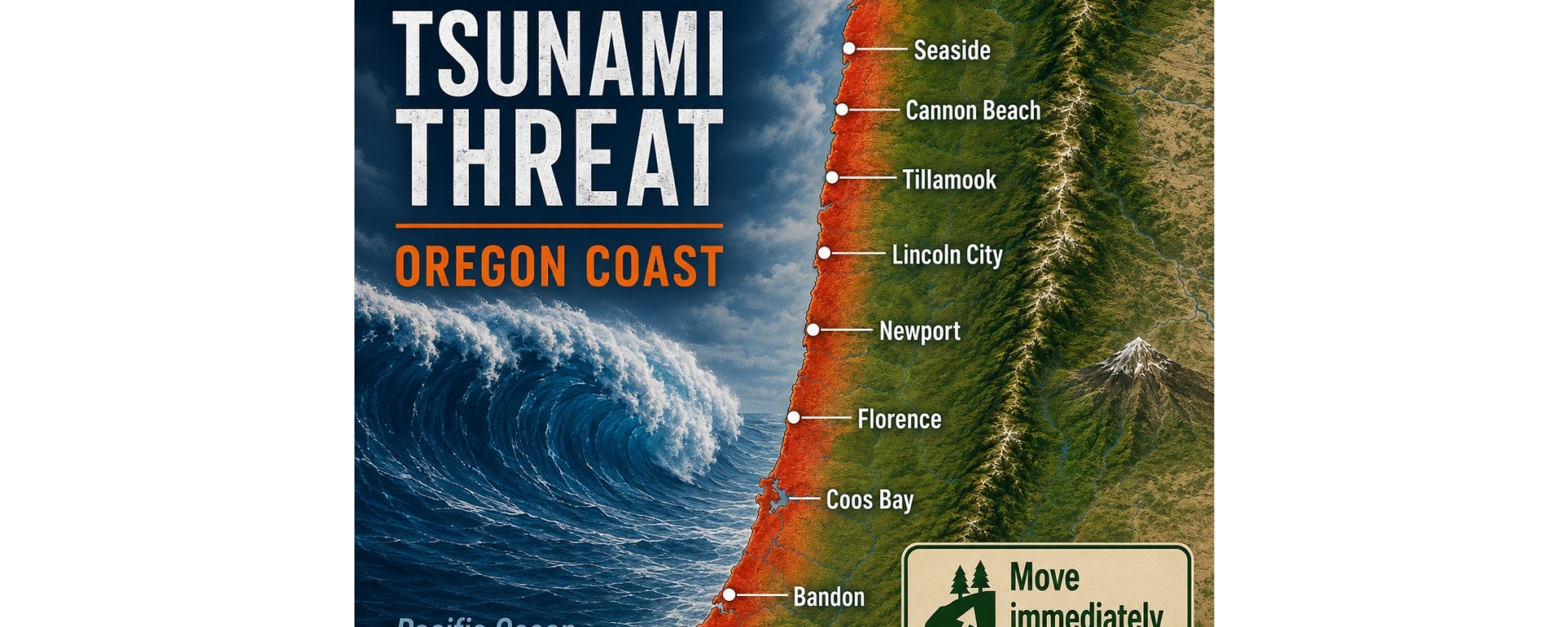
A new Oregon emergency-management study warns that thousands of coastal residents and visitors could die following a major Cascadia Subduction Zone earthquake if they cannot reach high ground before the tsunami arrives.
The danger varies dramatically between communities. Distance from high ground, damaged bridges, walking speed and even a few minutes of hesitation could determine who survives.
The Oregon Department of Emergency Management and the Oregon Department of Geology and Mineral Industries released the 2026 Tsunami Vertical Evacuation Structure Guidance to help coastal communities identify where evacuation towers, reinforced buildings or artificial berms may be needed.
The report’s most alarming example is Seaside. Under current conditions, researchers estimate that only 25% of the people within the city’s tsunami-inundation zone would reach safety during the modeled scenario. That means as many as 75% could be overtaken by the tsunami.
The figure does not apply to Seaside’s entire population or to every tsunami scenario. It applies specifically to people located inside the inundation zone under the assumptions used in the study.
Thousands of deaths projected along the Oregon Coast
For the Oregon Coast as a whole, DOGAMI estimates that approximately 4,550 residents could be killed in a medium tsunami scenario. The projected resident death toll rises to as many as 14,000 in an extra-extra-large tsunami.
Visitors could add another 11,000 to 31,000 deaths, depending on the season, time of day and number of tourists near beaches and other low-lying areas.
The study assumes that people begin evacuating 10 minutes after the earthquake’s shaking starts and travel on foot at approximately four feet per second, or about 2.7 miles per hour.
Under those conditions:
- Only 25% of people in Seaside’s inundation zone are expected to survive with the city’s existing evacuation options.
- One vertical evacuation structure could increase the modeled survival rate to approximately 50%.
- Several strategically located structures could increase survival to approximately 85%.
- Cannon Beach has an estimated survival rate of about 90% because much of its population is closer to natural high ground.
- In an isolated portion of downtown Cannon Beach, however, the present survival estimate is only 2%. Retrofitting the Fir Street Bridge could increase it to approximately 77%.
These numbers demonstrate why coast-wide averages can be misleading. Two communities located only a short distance apart can face very different risks because of their elevation, geography, bridges and access to high ground.
Residents may have only minutes to escape
The report says the first Cascadia tsunami waves could reach some parts of the Oregon Coast approximately 10 to 20 minutes after the earthquake begins.
A Cascadia earthquake itself could produce several minutes of intense shaking. Roads and bridges may be damaged, power lines could fall and debris may block evacuation routes. The time available to escape after the shaking stops could therefore be extremely limited.
The report estimates that a person overtaken by the tsunami would have less than a 1% chance of survival.
That makes immediate evacuation essential. Anyone near the Oregon Coast who experiences prolonged or violent shaking should move toward high ground as soon as it is physically possible. People should not wait for a siren, cellphone alert or official evacuation order.
Cars could make evacuation more dangerous
The safest response in many coastal communities will be to evacuate on foot.
Cars could quickly become trapped in traffic or blocked by damaged roads, fallen trees, collapsed bridges and abandoned vehicles. A traffic jam in a tsunami-inundation zone could prevent hundreds of people from reaching safety.
Visitors face an additional risk because they may not recognize warning signs or know the closest evacuation route. Hotels, vacation rentals, restaurants and other businesses can help by prominently displaying evacuation maps and explaining that strong coastal shaking is the natural warning to leave immediately.
Older adults and people with disabilities face greater danger
The evacuation model assumes a walking speed of approximately 2.7 miles per hour. Many older adults, young children and people with disabilities may not be able to maintain that pace—especially after several minutes of violent shaking.
Communities with large senior populations need evacuation options close enough to be reached by their slowest and most vulnerable residents. Accessible vertical evacuation towers could be particularly important in flat communities where hills are too distant.
Emergency plans should also account for people using wheelchairs, walkers or other mobility devices, as well as residents who may need assistance evacuating.
Vertical evacuation structures could save thousands
Vertical evacuation structures are engineered to withstand earthquakes, tsunami forces and impacts from floating debris. They allow people to escape upward when natural high ground is too far away.
Such structures can include reinforced towers, elevated platforms, specially designed public buildings and artificial hills or berms.
Oregon’s modeling shows that strategically locating these structures could dramatically increase survival in Seaside and other low-lying communities. Reinforcing critical bridges could also prevent neighborhoods from becoming isolated after an earthquake.
The report’s projected death toll is not inevitable. It is a warning about the consequences of existing evacuation limitations—and evidence that investments in evacuation towers, stronger bridges, clearly marked routes and public education could save thousands of lives.
The central message is simple: when the coast shakes, move immediately toward high ground. Every minute matters.
 Surfside Washington News