
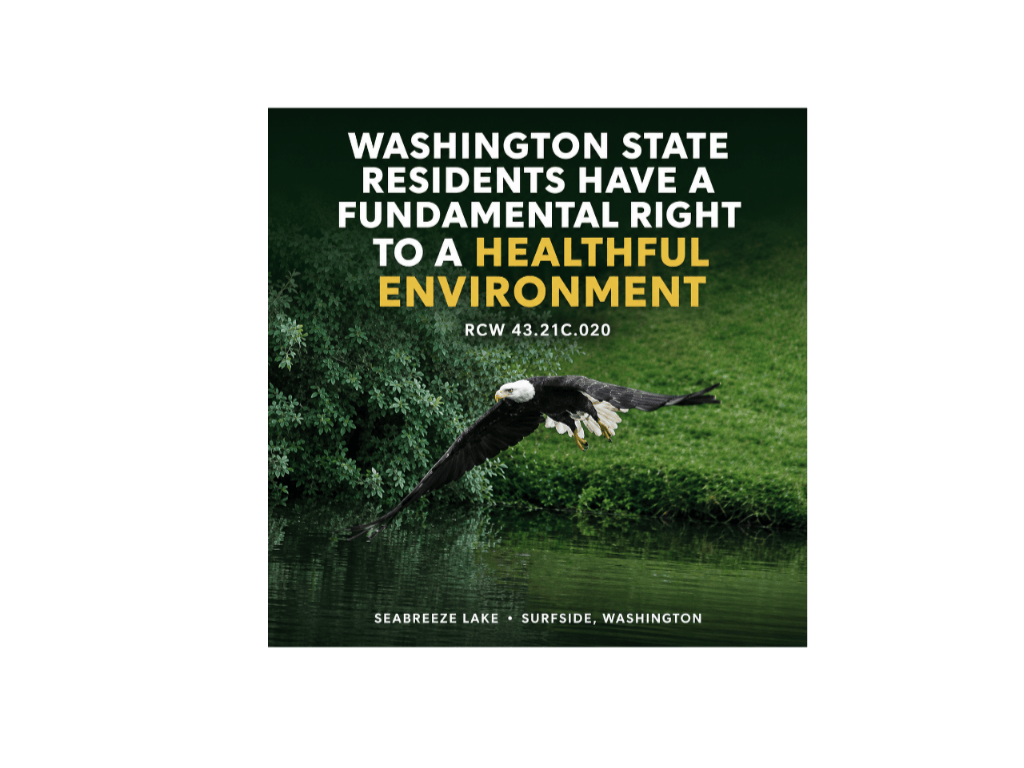
Washington law contains a powerful declaration that environmental protection is not merely a preference—it is a responsibility owed to present and future generations.
Under RCW 43.21C.020, part of the Washington State Environmental Policy Act, commonly known as SEPA, the Legislature recognizes that every person has a “fundamental and inalienable right to a healthful environment.”
The statute also states that every person has a responsibility to help preserve and enhance the environment.
People and nature must exist in harmony
Washington adopted SEPA in 1971 as the state was confronting the environmental consequences of population growth, urban development, industrial expansion and increasing pressure on natural resources.
The law recognizes that people depend on their biological and physical surroundings for food, shelter, health and cultural enrichment. It establishes a continuing state policy to create and maintain conditions in which people and nature can exist in “productive harmony.”
RCW 43.21C.020 directs the state and its agencies to use all practicable means to:
- Act as trustees of the environment for future generations.
- Provide safe, healthful, productive and aesthetically pleasing surroundings.
- Obtain beneficial uses of the environment without degradation or unacceptable risks to health and safety.
- Preserve important historic, cultural and natural resources.
- Maintain environmental diversity.
- Improve the quality of renewable resources.
These principles recognize that clean water, healthy trees, wetlands, wildlife habitat and functioning shorelines are essential parts of a healthy community.
More than an environmental slogan
SEPA primarily applies to decisions made or approved by state and local government agencies. It provides a process for identifying and considering environmental consequences before an agency approves certain projects, plans, regulations or other governmental actions.
Under RCW 43.21C.030, government agencies must consider environmental values alongside economic and technical considerations. When an action could significantly affect the environment, the responsible agency may be required to evaluate its effects, unavoidable harm, reasonable alternatives, long-term consequences and irreversible commitments of natural resources.
Environmental review does not necessarily prevent a project from moving forward. It is intended to ensure that environmental consequences are disclosed and considered before decisions are made—not after damage has occurred.
What this means for local communities
The principles in RCW 43.21C.020 are particularly important when counties consider changes affecting wetlands, lakes, streams, drainage systems, shorelines, riparian buffers, mature trees or wildlife habitat.
A proposal to reduce a protective buffer, change the classification of a water body or weaken environmental regulations may have consequences extending far beyond a single property. Vegetation along waterways can filter pollutants, stabilize soil, provide shade, moderate water temperatures, absorb stormwater and support birds and other wildlife.
Trees also provide community-wide benefits. They reduce heat, capture carbon, improve air quality, slow runoff and contribute to physical and mental well-being. Removing or repeatedly damaging trees can gradually weaken the environmental systems on which the larger community depends.
SEPA requires applicable government decisions to consider these connected and cumulative effects when the law’s review requirements are triggered.
Other Washington laws strengthen these protections
RCW 43.21C.020 works alongside several other state environmental laws.
RCW 36.70A.172 requires counties and cities to use the best available science when developing regulations protecting critical areas. These areas include wetlands, fish and wildlife habitat conservation areas, frequently flooded areas, critical aquifer-recharge areas and geologically hazardous areas.
RCW 90.58.020, part of the Shoreline Management Act, establishes state policy for protecting shoreline resources while allowing carefully planned uses.
RCW 90.48.010 declares that Washington should maintain the highest possible water-quality standards to protect public health, recreation, fish, birds, wildlife and aquatic life.
RCW 90.48.080 prohibits allowing organic or inorganic material to enter state waters when it causes or tends to cause pollution.
Together, these laws establish a broader legal framework for protecting environmental functions, not simply the outward appearance of a landscape.
A responsibility shared across generations
One of the most significant parts of RCW 43.21C.020 is its recognition that each generation serves as a trustee of the environment for those who come afterward.
That principle asks public officials, organizations, property owners and residents to consider more than immediate convenience. Decisions made today about trees, waterways, wetlands and development can shape water quality, wildlife habitat, public health and quality of life for decades.
Washington law does not promise that the environment will never change. It does, however, establish that environmental health must be taken seriously, that government agencies must consider environmental consequences and that everyone shares responsibility for protecting the natural systems on which communities depend.
The Legislature’s message is clear: a healthful environment is both a fundamental right and a shared obligation.

