
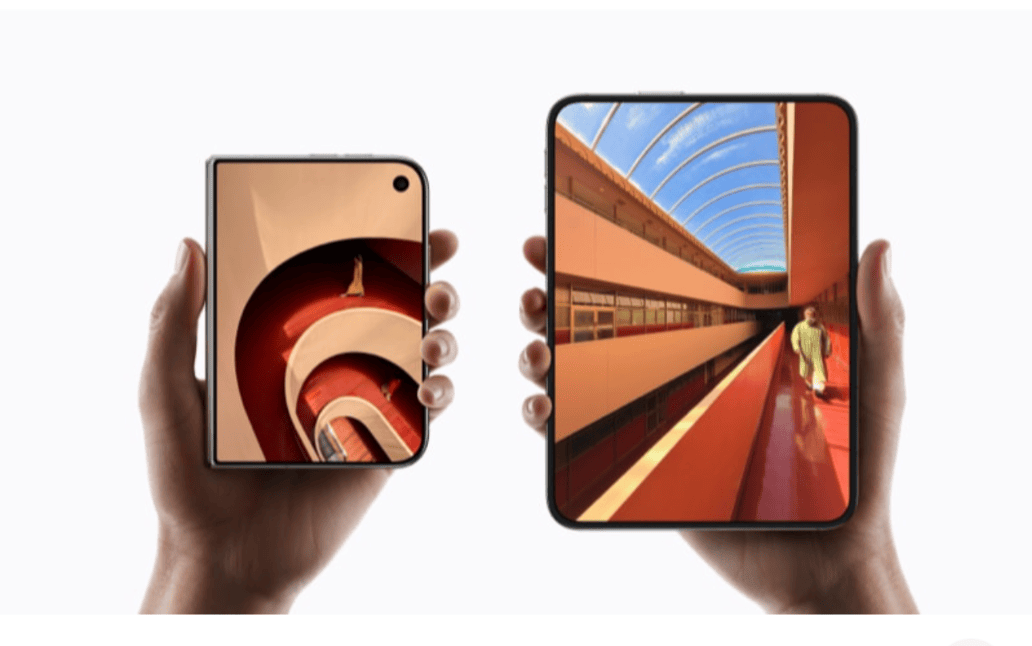
Apple has officially entered the foldable-phone market with the iPhone Duo, a premium device that combines the portability of an iPhone with a 7.6-inch interior display approaching the size of a small tablet.
The new phone opens like a book, allowing owners to use a conventional outer screen while it is closed or unfold it for reading, entertainment, photography and multitasking. It is one of the most significant changes to the iPhone’s physical design since Apple introduced the original model nearly two decades ago.
Preorders begin at 5 a.m. Pacific time on October 16, with availability starting October 23. Prices range from $1,999 for 256GB of storage to $3,199 for the 2TB version. The phone will be offered in Night Sky and Star White. “Apple”
A phone that unfolds into a small tablet
When closed, the iPhone Duo has a 5.4-inch Super Retina XDR outer display designed for calls, messages, navigation, photography and other everyday tasks.
Opening the phone reveals a 7.6-inch folding Super Retina XDR display. Apple says it is the largest screen ever offered on an iPhone and provides 50 percent more display area than the iPhone 18 Pro Max.
Both displays support ProMotion, an always-on mode and brightness of up to 3,000 nits. The inner screen is constructed from 10 ultrathin layers and uses a nano-texture finish intended to reduce glare.
The larger display could be especially useful for older adults and people who find small text, keyboards and controls difficult to use. It provides more room for enlarged text, maps, photographs, websites and video calls without requiring a separate tablet.
Apple also placed the interior FaceTime camera beneath the display, keeping it hidden until needed and producing a more continuous viewing surface.
Several ways to position the phone
The hinge allows the iPhone Duo to be used in several positions rather than simply opened or closed.
In landscape orientation, users can watch videos or operate two applications side by side. Portrait orientation provides a wider keyboard and more vertical space for reading and browsing.
The phone can also be partially folded and placed on a table. In its seated position, the upper screen can display a movie, exercise program or FaceTime call while the lower screen holds the controls.
Standing the device in a tent-like position allows the outer display to show videos, photographs, weather information, a clock or calendar. This self-supporting design could also make hands-free video calls and group photographs easier.
The phone runs iOS 27, which Apple redesigned to work across the two displays and different folding positions. Split View allows two applications to appear side by side, potentially making it easier to compare information, copy material between applications or watch a video while reading or writing.
Titanium construction and water resistance
Durability has been one of the largest concerns surrounding foldable phones. Their flexible screens and complex hinges introduce potential points of failure that do not exist on conventional smartphones.
Apple says the iPhone Duo uses a Grade 5 titanium frame and titanium hinge cover. Ceramic Shield protects the front and back, while the flexible interior display receives a scratch-resistant coating.
The phone carries an IP68 water- and dust-resistance rating. However, water resistance is not permanent and may decline as a device ages. Buyers should also remember that the folding interior display cannot use the same rigid protective glass found on a conventional iPhone.
Apple describes the screen as smooth and flat, but independent testing will be needed to determine how visible the fold becomes during regular use and how well the hinge and flexible display withstand years of opening, closing, drops and exposure to sand.
That could be an especially important consideration along the Washington coast, where windblown sand, moisture and salt air are common.
A20 Pro processor and expanded artificial intelligence
The iPhone Duo uses Apple’s new A20 Pro chip with a six-core processor, seven-core graphics system and Dual 16-core Neural Engine.
Apple says its central processor is up to 20 percent faster than the previous A19 Pro, while memory bandwidth has increased by as much as 50 percent. A vapor chamber helps remove heat during gaming, video editing and artificial-intelligence workloads.
The phone supports Apple Intelligence and the new Siri AI. Apple says the updated assistant can hold more natural conversations, answer open-ended questions, help brainstorm ideas and use personal information stored on the phone to locate messages, photographs, notes and email.
Siri AI can also perform actions within applications, help draft or revise writing and respond to questions about objects viewed through the camera. Apple says the new Siri features are beginning to roll out in English, meaning some capabilities may not be immediately available in every country, language or application.
Apple’s artificial-intelligence tools also include enhanced photo editing, image generation, writing assistance and automatic organization of Safari tabs. Some features may be subject to availability or usage limits.
Dual 48-megapixel cameras
The iPhone Duo includes a 48-megapixel Fusion Main camera and a 48-megapixel Fusion Ultra Wide camera. It supports 0.5x, 1x and 2x viewing options, macro photography and video recording in Dolby Vision at up to 4K resolution and 120 frames per second.
The outer display creates several unusual photography options.
Duo Preview lets the person being photographed see a live preview, helping people adjust their position before the picture is taken. Kid Cue displays animations intended to encourage children to look toward the camera.
Smart Take can recognize when everyone is ready and capture the photograph automatically, allowing the person who would normally take the picture to join the group.
The device also includes a 12-megapixel Center Stage front camera and an under-display FaceTime camera. The phone can stand on its own during video calls, eliminating the need to hold it or find something against which to prop it.
Although the camera system is capable, serious photographers should note that it does not include the dedicated telephoto camera or variable-aperture main camera offered on the iPhone 18 Pro models. Optical-quality zoom is limited to 2x, compared with up to 8x on the iPhone 18 Pro.
Dual batteries provide all-day power
Apple divided the battery system between the two halves of the phone. The company estimates up to 31 hours of video playback using the interior screen and as much as 44 hours using the smaller outer display.
Fast wired charging can replenish the battery to approximately 50 percent in about 20 minutes when used with a sufficiently powerful charging adapter.
Actual battery life will depend heavily on how the phone is used. Operating the large folding display, playing games, editing video or running AI applications is likely to consume considerably more power than using the outer screen for calls and messages.
Satellite features may help coastal residents
The iPhone Duo supports 5G, Wi-Fi 7, Bluetooth 6 and eSIM. It does not require—or support—a removable physical SIM card in the United States, so owners must use a compatible carrier and activate service digitally.
Its satellite features could be valuable for residents and visitors in rural Pacific County, where cellular coverage can be inconsistent.
Emergency SOS via satellite allows a user to contact emergency services when cellular and Wi-Fi connections are unavailable. Messages via satellite can maintain limited contact while outside normal coverage, while Roadside Assistance via satellite can help connect motorists with a participating service provider.
Satellite connectivity should not replace an emergency radio or personal locator beacon for boating, hiking or disaster preparedness, but it can provide another communication option when normal networks fail.
Environmental claims require a broader view
Apple says recycled materials account for 35 percent of the iPhone Duo’s total weight, including 85 percent recycled titanium in its enclosure. The company also says the device is manufactured using 60 percent renewable electricity and ships in entirely fiber-based packaging.
Those improvements can reduce some of the environmental effects associated with mining, manufacturing and packaging. However, producing a complex foldable device still requires substantial energy, water and raw materials.
The most environmentally responsible approach for many consumers is to keep an existing phone as long as it remains functional. A durable phone that receives years of software updates can have a lower lifetime impact than repeatedly replacing devices for incremental improvements.
Consumers purchasing the Duo should consider using Apple’s trade-in or recycling program rather than allowing an older phone to sit unused or enter the waste stream.
Storage options and prices
The iPhone Duo is among the most expensive phones Apple has ever sold:
256GB: $1,999
512GB: $2,199
1TB: $2,599
2TB: $3,199
These prices do not necessarily include sales tax, an AppleCare protection plan, a case, charging accessories or cellular service. Buyers may be able to reduce the cost through trade-in credits, carrier promotions or installment plans.
Because the phone starts at almost $2,000, Apple is positioning it as a specialized premium device rather than a replacement for every iPhone.
Who should consider the iPhone Duo?
The Duo may appeal to people who regularly carry both a phone and a small tablet. Its larger screen could be useful for reading, viewing maps, editing photographs, conducting video calls, watching movies and using two applications simultaneously.
It may also benefit users who need larger text and controls, although prospective buyers should try the device in person to evaluate its weight, thickness, grip and accessibility.
The iPhone 18 Pro may remain the better choice for customers who prioritize advanced cameras, long-term durability or a lower price. People satisfied with their current phones may have little reason to upgrade immediately.
First-generation products also involve uncertainty. Independent reviews will be important for evaluating the screen crease, hinge durability, repair costs, battery performance and how well existing applications use the larger folding display.
Apple’s biggest iPhone experiment in years
The iPhone Duo represents more than a new screen size. It changes how an iPhone can be held, positioned and used.
Apple waited years after competing manufacturers introduced foldable devices, apparently seeking to address concerns about screen quality, software, battery life and durability. Whether it has solved those problems will become clearer only after consumers and independent reviewers spend time with the finished product.
At $1,999 and above, the Duo will not be affordable for everyone. But it marks a significant new direction for Apple—one in which a single pocket-sized device can serve as a phone, camera, entertainment screen, digital assistant and compact tablet.
Complete specifications, purchasing information and availability are available on the official Apple iPhone Duo website.
 Surfside Washington News