
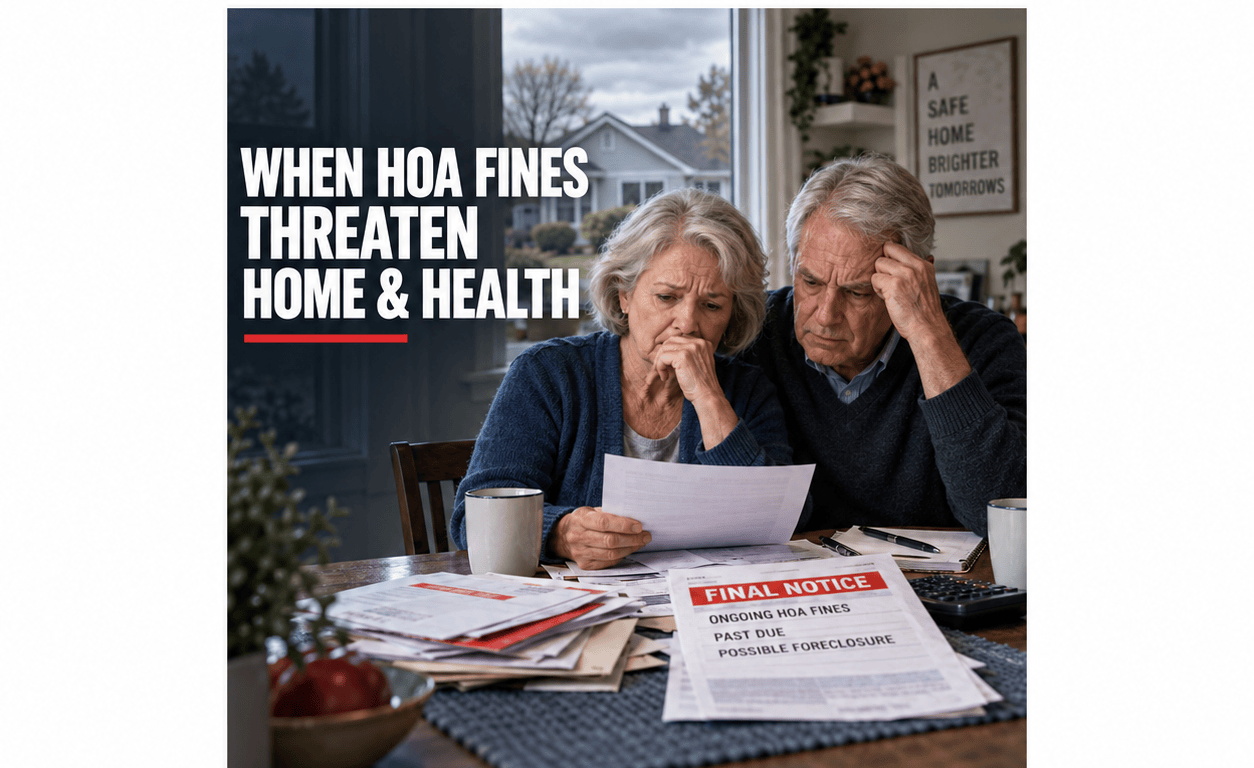
An Arizona couple’s story has become a national warning about what can happen when a relatively small homeowners association debt grows into a life-changing financial and health crisis.
Toby Newton and his longtime partner, Sherrie Patten, were already coping with serious medical and financial challenges when their homeowners association foreclosed on Newton’s Mesa, Arizona, home. The original unpaid HOA assessments reportedly totaled just $977.
Newton had purchased the four-bedroom home in 2022 for approximately $450,000, hoping it would become a place where the couple could eventually retire. Two years later, he was diagnosed with diabetes and lost his job. Without his regular income, the couple struggled to keep up with medical expenses, household bills and HOA assessments.
Newton told reporters that he contacted the Superstition Springs Community Master Association and attempted to arrange a payment plan. He initially offered to pay $50 a month in addition to keeping up with current assessments. He later increased the offer to $200 a month plus the regular quarterly payments.
According to Newton and Patten, those proposals were rejected.
What began as $977 in unpaid assessments quickly grew after collection costs, interest and attorney fees were added. Court records cited in national reports showed that the claimed debt eventually included approximately $1,311 in assessments and late charges, $1,042 in collection expenses and $3,345 in attorney fees.
By the time of the foreclosure auction, the total claimed obligation had reached approximately $6,579.
In October 2025, the HOA purchased the approximately $450,000 home at a public auction for just $8,172. Newton said he did not learn that the auction was imminent until two days beforehand, leaving him insufficient time to obtain legal representation. The HOA maintained that proper notice had been provided.
Regardless of how the legal dispute is ultimately resolved, the enormous imbalance is difficult to ignore: a homeowner’s original $977 debt led to the loss of a home worth hundreds of thousands of dollars.
Illness, Job Loss and an Escalating Crisis
This was not simply a dispute between an association and a homeowner who refused to meet his obligations. It unfolded while both members of the household were facing serious health problems.
Newton’s diabetes diagnosis coincided with unemployment and declining financial security. Patten was subsequently diagnosed with breast cancer, forcing the couple to divide their attention and resources between medical care and the legal battle over their home.
The couple said the experience has taken an enormous emotional and financial toll. They have sought public assistance to continue fighting for their home.
Their ordeal illustrates how quickly people can become vulnerable when illness, job loss and aggressive debt collection occur at the same time. A person dealing with diabetes may already be managing medications, dietary needs, medical appointments and the physical effects of the disease. A breast cancer diagnosis can bring surgery, radiation, chemotherapy, repeated testing and months or years of uncertainty.
Adding the possible loss of one’s home to those burdens can turn financial distress into a genuine health threat.
Foreclosure Is More Than a Financial Transaction
For an HOA or collection attorney, foreclosure may appear to be a procedure for collecting a debt. For the homeowner, it can mean losing shelter, security, accumulated equity and the place where a family expected to grow older.
Medical research has repeatedly connected housing insecurity and foreclosure with poorer physical and mental health. A systematic review found that 32 of 35 studies examining foreclosure and health reported harmful physical or mental-health effects. Researchers have associated foreclosure with depression, anxiety, hypertension, heart disease and reduced access to medical care. “National Institutes of Health” (https://pmc.ncbi.nlm.nih.gov/articles/PMC4388711/)
Another study found that people undergoing foreclosure were significantly more likely to report hypertension, heart disease, depression, anxiety or other psychiatric conditions. Financially distressed homeowners may also postpone medical appointments, ration medications or avoid treatment because every available dollar is being directed toward legal fees and housing costs. “American Journal of Public Health” (https://pmc.ncbi.nlm.nih.gov/articles/PMC2741520/)
Chronic stress can disrupt sleep, increase blood pressure, worsen blood-sugar control and contribute to unhealthy coping behaviors. For someone already living with diabetes, cancer, cardiovascular disease or another chronic illness, the threat of foreclosure may intensify an already difficult medical situation.
A home is therefore more than property. It is part of the foundation upon which physical health, emotional stability and personal dignity depend.
When a Small Debt Becomes a Weapon
Homeowners should pay legitimate assessments needed to maintain their communities. Associations also need reasonable collection tools when members refuse to pay.
But foreclosure is the most extreme collection tool available. It should be a last resort, particularly when a homeowner is experiencing serious illness or unemployment and is making a good-faith effort to repay the debt.
The Newton case raises important questions for HOA communities throughout the country:
- Should a family lose hundreds of thousands of dollars in home equity over an original debt of less than $1,000?
- Should attorney and collection fees be allowed to multiply far beyond the unpaid assessments?
- Should an HOA be required to accept a reasonable payment plan before initiating foreclosure?
- Should health problems, disability and temporary unemployment trigger additional protections?
- Should associations be allowed to purchase homes at foreclosure auctions for a tiny fraction of their market value?
Arizona lawmakers have since increased protections for homeowners in planned communities. Senate Bill 1494 raised the assessment threshold permitting foreclosure from $1,200 to $10,000 and extended the delinquency period from one year to 18 months. The law also requires reasonable efforts to communicate with the homeowner and offer a reasonable payment plan before foreclosure. Newton’s case began under the previous standards. “Arizona Legislature” (https://www.azleg.gov/legtext/57leg/1R/summary/S.1494GOV_ASPASSEDHOUSE.DOCX.htm)
Communities Must Put People First
An HOA exists to serve its community—not to destroy a household over a manageable debt.
Responsible enforcement should begin with direct communication, clear accounting and affordable repayment options. Foreclosure should require meaningful independent review, substantial debt thresholds and strong protections for seniors, people with disabilities and homeowners experiencing medical or financial emergencies.
Boards should also consider the proportionality of their actions. Recovering $977 in assessments does not justify inflicting hundreds of thousands of dollars in losses when less destructive collection methods are available.
Newton and Patten’s experience is about much more than one Arizona property. It demonstrates what can happen when an administrative system loses sight of the human beings affected by its decisions.
Behind every fine, lien and foreclosure filing is a person who may be managing cancer, diabetes, disability, grief, unemployment or another private crisis. A community governed without compassion may still enforce its rules—but it cannot honestly claim to be serving its residents.
The true cost of HOA foreclosure is not measured only in unpaid assessments or attorney fees. It is measured in lost homes, damaged health, depleted retirement savings, sleepless nights and the destruction of a family’s sense of security.
No homeowner should face that punishment over a debt of $977.
 Surfside Washington News