
Oregon’s high-ground survival caches offer a practical lesson for Washington’s Long Beach Peninsula
When a major earthquake strikes the Pacific Northwest coast, families may have only minutes to leave low-lying areas. That creates a problem many emergency plans overlook: a well-stocked disaster kit inside a home, garage or vehicle is of little use if the building is damaged, roads are blocked or the supplies are left behind during an urgent evacuation.
One practical answer is to store part of a household’s emergency supply on high ground, outside the mapped tsunami inundation zone.
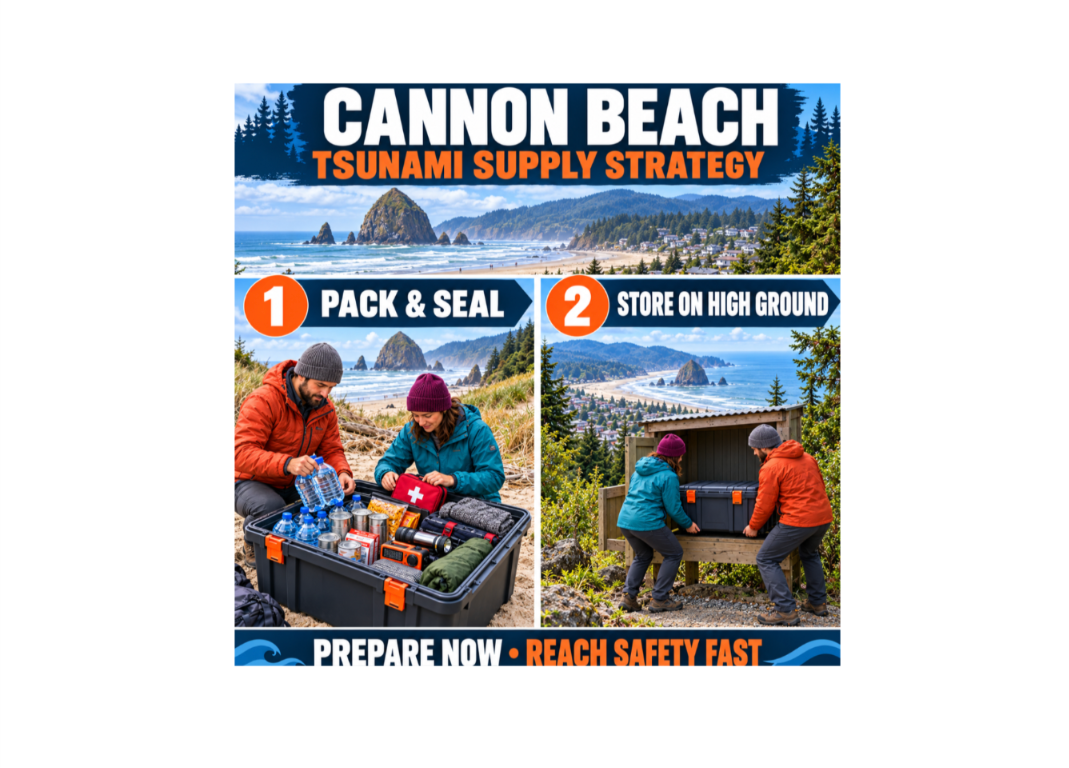
In 2012, residents of Cannon Beach, Oregon, began preparing individual barrels and buckets of survival equipment for placement inside a shipping container on elevated ground. The community project was designed to give evacuees access to shelter, food, clothing, first-aid supplies and other essentials after they had reached safety. The idea remains relevant today—and may be especially important for isolated coastal communities in southwest Washington.
First survive the evacuation
Supplies are important, but they must never delay evacuation. If you are near the coast and feel a strong earthquake, experience shaking that lasts a long time, hear the ocean roar or see the water suddenly rise or recede, move inland and uphill immediately. Do not wait for a siren, phone alert or official instruction.
For a Cascadia Subduction Zone earthquake, roads may be damaged or congested, so evacuation may have to be completed on foot. Oregon’s tsunami planning warns that some coastal residents and visitors may have only 10 to 30 minutes to reach safety. Washington’s official Long Beach Peninsula evacuation map likewise directs people to the nearest high ground—preferably at least 50 feet above sea level—and warns that dangerous waves can continue for many hours.
The first priority is therefore speed. Every household should know its evacuation route, identify a meeting location and practice walking the route before an emergency.
Use a two-part supply plan
A sensible coastal plan separates emergency supplies into two layers.
1. A lightweight evacuation bag
Keep a portable bag where it can be grabbed without losing valuable time. It should be light enough to carry while walking quickly and should include:
Essential prescription medications and a current medication list
Water and a small amount of high-energy food
First-aid supplies
Flashlight or headlamp with spare batteries
Battery-powered or hand-crank radio
Whistle
Warm, waterproof clothing and sturdy gloves
Emergency blanket
Phone power bank and charging cable
Copies of identification, insurance information and emergency contacts in a waterproof pouch
Cash in small bills
Glasses, hearing-aid batteries and other personal medical necessities
Basic supplies for children, older adults, pets and service animals
Keep sturdy shoes beside the bed. After a major earthquake, broken glass and debris may make bare-foot evacuation dangerous.
2. A larger cache outside the hazard zone
A secured high-ground cache can hold supplies that are too bulky or heavy to carry during evacuation, including:
Tent, tarp or other weatherproof shelter
Sleeping bags, blankets and dry clothing
Additional food and water containers
Water filter or purification supplies
Sanitation items, toilet paper and heavy-duty bags
Expanded first-aid and medical supplies
Cooking equipment intended for safe outdoor use
Work gloves, protective eyewear and simple hand tools
Extra pet food and pet-care supplies
Copies of local maps and household contact information
Washington and Oregon now recommend working toward at least two weeks of food, water, medication, sanitation materials and other essential supplies. A high-ground cache does not have to contain everything at once. Families can start with the items they already own and add supplies gradually.
A storage container must not become another hazard
The Cannon Beach program placed family containers inside a larger community-managed shipping container. That approach offers security and weather protection, but it requires professional planning.
Any community cache should be located outside the modeled inundation area and away from landslide, falling-tree and flooding hazards. A large container also must be properly engineered, anchored and maintained for local wind and seismic conditions. An unsecured shipping container, trailer or shed could shift, overturn or become windborne debris during an extreme coastal storm.
Access must also be planned in advance. Residents should know who controls the keys, how the cache will be opened after a disaster and how supplies will be identified. Food, water, batteries and medications need scheduled inspection and replacement. Moisture, corrosion, rodents and temperature changes can ruin poorly packed supplies.
Waterproof, food-grade buckets or barrels with clear household identification can protect individual supplies within a shared structure. Batteries should be stored separately from devices when appropriate, and an inventory with expiration dates should be placed inside each container.
Why community caches deserve consideration
On the Long Beach Peninsula, many homes, businesses and visitor destinations lie within low-elevation tsunami hazard areas. A major Cascadia earthquake could damage bridges, roads, utilities, water systems and communication networks, potentially isolating survivors for days or weeks.
Strategically located survival caches could support neighborhoods after evacuation, particularly where reaching natural high ground takes time. Possible locations might include established evacuation assembly areas, engineered vertical-evacuation structures or other sites approved by emergency managers and confirmed to be outside the hazard zone.
Such a program should not be improvised by simply parking old trailers or shipping containers on vacant land. It would need cooperation among residents, property owners, fire districts, Pacific County Emergency Management and geological or structural experts. Location, anchoring, drainage, security, disability access, inventory control and long-term maintenance would all need to be addressed.
Community planning must also include people who cannot easily walk long distances. Older residents, people with disabilities, those who use oxygen or powered medical equipment, and households without vehicles need realistic evacuation assistance—not just a line on a map. Neighborhood teams can identify who may need help, while still recognizing that a tsunami may require everyone to move immediately.
Preparation should begin before the ground shakes
The Cannon Beach project carried a simple message: survival equipment should be waiting where survivors are expected to gather, not only inside homes they may be forced to abandon.
For coastal families, the most effective approach is to prepare in layers: keep a small bag ready for immediate evacuation, maintain a larger two-week supply, and consider whether some durable supplies should be stored at a properly selected and secured location outside the inundation zone.
https://www.ci.cannon-beach.or.us/emergencymgmt/page/emergency-cache-barrel-program
Most importantly, walk the route. A cache on high ground can make the difficult days after a tsunami safer, but it only helps those who reach it in time.
Sources and preparedness resources
Original 2012 report, KCBY:
https://kcby.com/outdoors/oregon-coast-residents-stash-tsunami-survival-kits-on-high-ground
Washington tsunami information and evacuation maps:
https://dnr.wa.gov/washington-geological-survey/geologic-hazards-and-environment/tsunamis
Long Beach Peninsula tsunami evacuation map: https://dnr.wa.gov/Publications/ger_tsunami_evac_longbeach.pdf
Washington emergency-kit guidance: https://mil.wa.gov/kits
Oregon “Be 2 Weeks Ready” guidance: https://www.oregon.gov/oem/hazardsprep/pages/2-weeks-ready.aspx
Oregon tsunami evacuation maps: https://www.oregon.gov/dogami/tsuclearinghouse/pages/tsunami-evacuation-maps.aspx
Federal emergency supply-kit guidance: https://www.ready.gov/kit

