
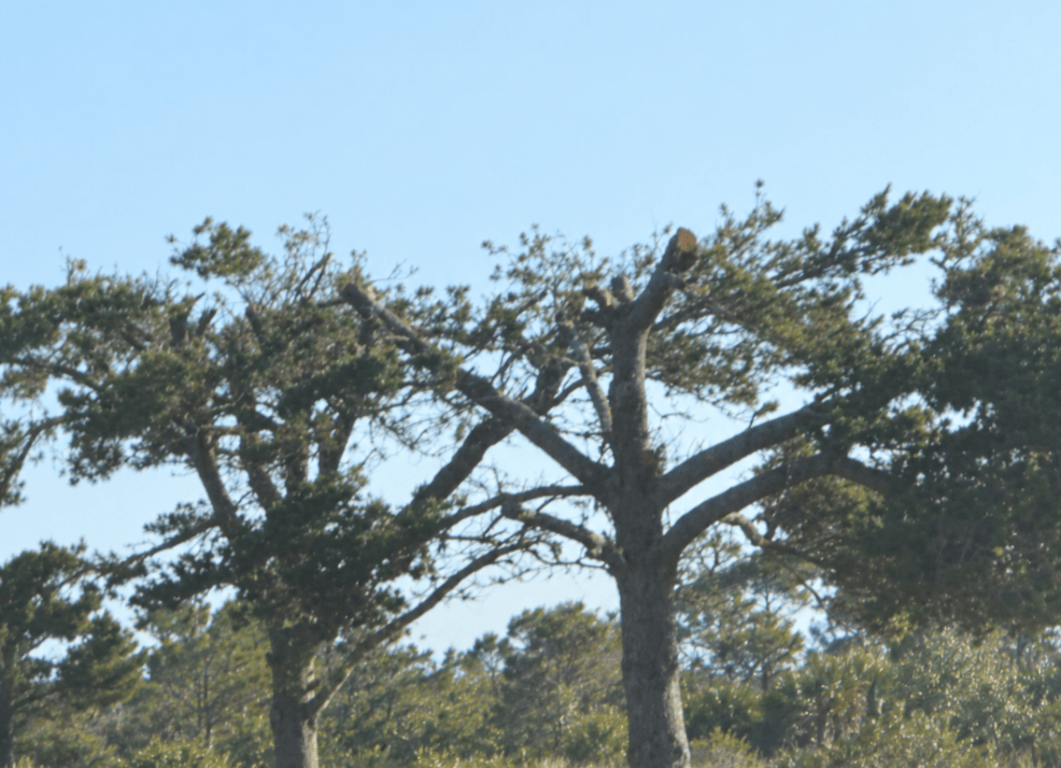
Topping, lower-limb removal and widespread tree loss can weaken an entire coastal neighborhood
Cutting a mature tree back to an arbitrary height of 16 feet or 24 feet may make it look smaller, but smaller does not necessarily mean safer. When the work requires cutting through the trunk or major limbs and leaving stubs, it is topping—a practice that the Washington State Department of Natural Resources and professional arborists warn can make trees unhealthy and unsafe.
This distinction matters in coastal communities such as Surfside, where trees grow in sandy or seasonally wet soils and face strong winds, salt exposure and winter storms. A mature coastal tree cannot simply be shortened like a hedge without changing its biology and structure.
Topping creates large wounds that invite decay
A proper pruning cut is made at a suitable branch junction, where a tree has the best chance to seal the wound and contain decay. Topping cuts are commonly made through large limbs or the main stem between branches. These large exposed surfaces may be too extensive for the tree to close effectively.
The result can be:
Entry points for decay organisms and some pests
Internal wood decay that may spread below the visible cut
Loss of stored energy and food-producing foliage
Stress that reduces the tree’s natural defenses
Gradual death of branches, roots or the entire tree
Decay is not always visible from the ground. A topped tree may remain green and produce abundant new foliage while the wood beneath the old cuts is deteriorating.
Fast regrowth is not strong regrowth
After severe topping, a stressed tree often responds by producing clusters of fast-growing shoots below each cut. This can give the misleading appearance that the tree has recovered.
Unlike a naturally formed branch with strong connective wood, many of these shoots arise from tissue near the outer surface of the older limb. Their attachment can be weak. As the shoots become taller and heavier, they act as long levers attached near a decaying cut. Wind, wet foliage, snow or ice can then cause them to split away.
Topping can therefore begin a costly cycle: cut the tree severely, allow weak shoots to grow, cut those shoots again and repeat. Each round can add wounds and decay while never restoring the tree’s original structure.
Removing lower and interior branches can make the remaining crown end-heavy
The damage can be compounded when crews also remove too many lower or interior branches. Arborists call an extreme version of this practice lion-tailing: long, bare limbs are left with most of their foliage concentrated near the tips.
Lower and interior branches are not useless clutter. They help distribute foliage and weight along the stem and branches, contribute food to the tree and help dampen movement during wind. Excessive removal can shift weight outward, lengthen the lever acting on a branch attachment and leave the remaining crown more prone to whipping and breakage.
When the upper crown has also been topped, the tree can be damaged at both ends: its natural leader and upper framework have been cut apart, while supporting lower and interior foliage has been stripped away. The resulting crown may be sparse, poorly balanced and dependent on weak new sprouts.
This does not mean that every lower branch must remain. Proper crown raising can provide clearance, and carefully targeted crown reduction can reduce risk. The danger comes from removing too much live crown, making indiscriminate cuts or combining heavy lower-limb removal with topping.
Shore Pines are resistant to high winds and coastal storms
Shore pines are among the toughest trees on the Washington coast. They naturally withstand salt spray, nutrient-poor sandy soils, heavy winter rain and powerful Pacific winds by developing flexible trunks, wind-shaped crowns and root systems adapted to local conditions. That natural strength, however, depends on preserving the tree’s living crown and structural form. Repeatedly cutting a mature shore pine to an artificial height of 16 feet removes much of its food-producing foliage, creates large wounds vulnerable to decay and forces clusters of weakly attached shoots to replace the natural crown. Instead of making the tree safer, severe topping can turn a naturally resilient coastal tree into a stressed, unbalanced and increasingly hazardous one.
Coastal conditions increase the consequences
Coastal trees are repeatedly exposed to strong winds and prolonged winter rain. The U.S. Forest Service notes that shallow rooting and saturated soil increase the chance of windthrow because wet soil provides less secure anchorage. A damaged or decaying tree in saturated soil may therefore face several stresses at once.
Trees that developed together also shelter one another. When neighboring trees are removed, the remaining trees can be abruptly exposed to wind loads they did not experience while growing. Research on coastal forests has found that newly exposed edges and retained trees can suffer increased wind damage.
This is why removing one tree can affect more than one property. Wind does not stop at a lot line, and tree roots, drainage patterns and sheltering can extend across property boundaries.
Tree removal can also change soil moisture
Trees influence local water conditions in several ways. Their crowns intercept some rainfall, their roots create pathways through soil, and they move water from the soil to the atmosphere through transpiration. Forest hydrology research identifies canopy interception and tree transpiration as major parts of the water cycle.
When many trees are removed, less water is intercepted and transpired. Depending on rainfall, soil, drainage and the number and size of trees removed, groundwater or soil moisture can rise and runoff or deep percolation can increase. On an already wet coastal site, that change may contribute to longer periods of saturated soil.
It would be too broad to claim that removing any single tree will always saturate nearby soil. But widespread removal can materially change site hydrology, and saturation is a recognized windthrow risk. The combined effects—more water in the soil, reduced root reinforcement and greater wind exposure—deserve evaluation before additional trees are removed.
Diseased-looking and structurally unsound trees require diagnosis
Residents may already see trees with dead tops, sparse crowns, fungal growth, cracked trunks, large cavities or clusters of weak sprouts. These can be warning signs, but appearance alone cannot establish whether topping caused a particular tree’s condition or whether it presents an immediate hazard. Drought, salt, root damage, insects, pathogens, poor drainage and earlier pruning may all contribute.
Each tree of concern should be assessed by a qualified arborist using its history, species, roots, trunk, crown, surrounding targets and exposure. Where failure could injure people or damage property, a formal tree-risk assessment is more reliable than judging safety by height alone.
A 16-foot limit is not a tree-risk assessment
A naturally small tree that matures near 16 feet is not the same as a tall species repeatedly cut back to 16 feet. Risk depends on species, trunk and branch condition, root health, soil, wind exposure, defects and what could be struck—not on one universal height.
The safer goal is sound structure—not forced uniform height
A sound tree policy should therefore emphasize:
- Let trees to grow to full mature height.
- Preserving healthy, wind-firm groups of trees where possible
- Using proper structural pruning instead of topping
- Avoiding excessive removal of lower and interior branches
- Assessing drainage and wind exposure before removing multiple trees
- Inspecting previously topped trees for decay and weak attachments
- Obtaining an ISA Certified Arborist or qualified tree-risk assessment when safety is in question
Topping may create an immediate visual impression of compliance, but it can transfer risk into the future. Large wounds decay, stressed trees produce weak shoots, over-pruned limbs become end-heavy, roots receive less energy, and neighboring trees lose shelter. In wet coastal soils and high winds, these effects can combine.
If the objective is public safety, the better approach is science-based tree care: let trees grow to mature height , retain healthy canopy, prune selectively at appropriate branch unions and evaluate actual defects and targets. A healthy tree with sound roots and natural structure may be far safer than a damaged tree repeatedly forced to remain at 16 feet or 24 feet
Sources and further reading
Washington State Department of Natural Resources, “Anti-Tree Topping”:
https://dnr.wa.gov/forest-resilience-division/urban-and-community-forestry/anti-tree-topping
International Society of Arboriculture, “Why Topping Hurts Trees”:
https://www.treesaregood.org/Portals/0/TreesAreGood_Why%20Topping%20Hurts_0321.pdf
Washington State University Extension, “Pruning Woody Landscape Plants”:
https://extension.wsu.edu/pnw-gardeners-handbook/chapter-23-pruning-woody-landscape-plants/
Penn State Extension, “Pruning Landscape Trees”:
https://extension.psu.edu/pruning-landscape-trees
Oregon State University Extension, “Should I top tall, slender oak trees next to my house?”:
https://extension.oregonstate.edu/ask-extension/featured/should-i-top-tall-slender-oak-trees-next-my-house
University of Florida, “Thinning”:
https://hos.ifas.ufl.edu/woody/thinning.shtml
University of Florida, “Pruning to Reduce Subsequent Storm Damage”:
https://hos.ifas.ufl.edu/woody/prune.shtml
U.S. Forest Service, “Windthrow”:
https://www.fs.usda.gov/r10/natural-resources/forest-health/windthrow
U.S. Forest Service, “Forest Evapotranspiration: Processes and Quantification”:
https://research.fs.usda.gov/treesearch/69971

