
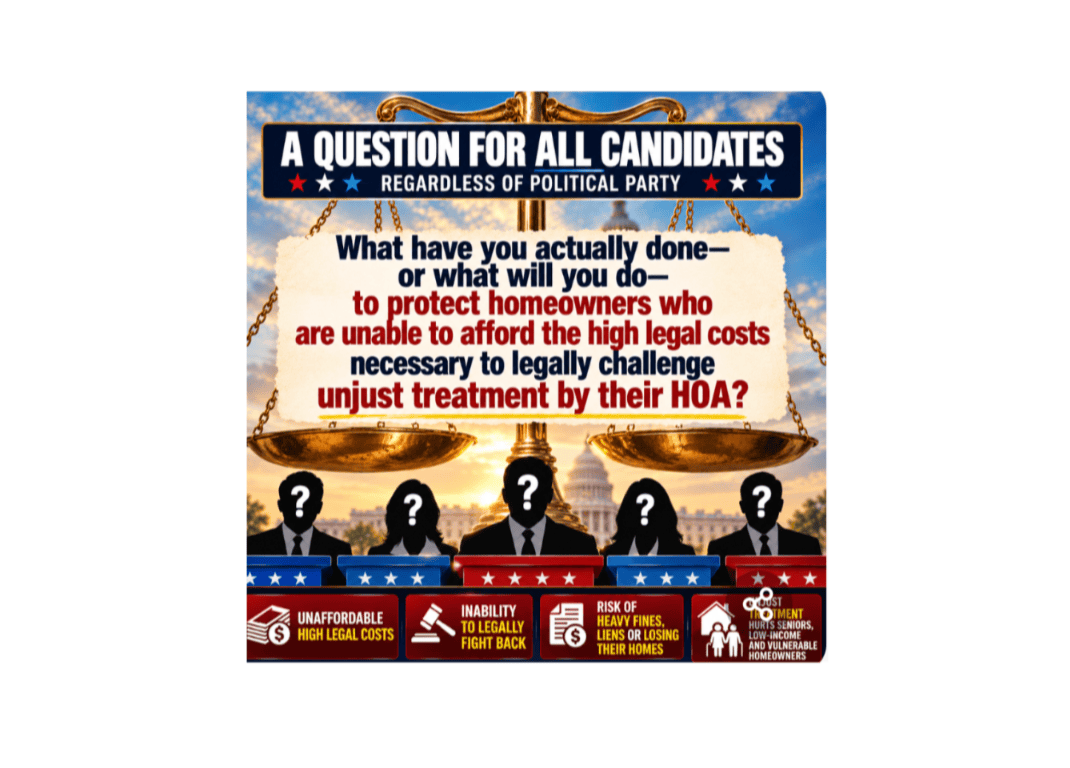
The most devastating consequence of Washington’s unequal HOA legal system is the burden placed on homeowners who cannot afford to challenge their associations.
When a cohesive faction controls a board, dissenting homeowners may lose influence as decisions increasingly reflect a small group’s interests. If that faction also controls meetings, communications, committees, and enforcement priorities, meaningful opposition can become difficult. This does not by itself establish unlawful conduct, but it can encourage selective enforcement, poor transparency, resistance to reform, and fear of retaliation.
Homeowners may face aggressive covenant enforcement, escalating fines, legal threats, and other penalties totaling thousands of dollars. For a wealthy homeowner, a $5,000 fine may be an inconvenience. For a retired senior receiving $1,800 or $2,000 per month in Social Security benefits, it may equal several months of income, forcing a choice among association demands, medication, property maintenance, health, food insecurity and basic living expenses. Politician campaign on affordability but ignore the financial impacts of HOA fines on poor residents.
The Financial Consequences Can Be Devastating
Homeowners who cannot afford to challenge their associations may face:
- Thousands of dollars in fines: Repeated or escalating penalties can overwhelm people living on fixed incomes.
- Loss of retirement savings: Attorney retainers, legal correspondence, expert witnesses, and court proceedings can consume savings.
- Threats to homeownership: Unpaid assessments and qualifying association liens may lead to foreclosure under Washington law, subject to statutory restrictions and procedural safeguards.
- Forced compliance: Homeowners may accept disputed or unreasonable demands because they cannot afford to contest them.
- Reduced property values: Restrictions, costly compliance demands, or unresolved infrastructure problems can harm a homeowner’s investment.
- Emotional and physical stress: Financial insecurity and fear of losing a home can worsen health and undermine independence.
The central injustice is that a homeowner may suffer substantial financial harm without an affordable, independent determination of whether the HOA acted lawfully.
When challenging an HOA costs more than the penalty itself, the association gains power from the homeowner’s inability to pay.
Covenants That Become Difficult to Change
Restrictive covenants adopted decades ago may no longer reflect current housing needs, environmental conditions, property values, or homeowners’ preferences. Yet changing them may require substantial voting thresholds, formal procedures, and legal review.
When an organized board majority opposes reform, outdated restrictions can remain despite significant opposition. Even if a covenant is unenforceable, proving that fact may require legal assistance. Questionable restrictions can therefore remain influential simply because challenging them is too expensive.
Where Are the State, County, and Elected Officials?
Washington counties generally do not serve as appeals courts for private HOA disputes, and state agencies have limited authority to resolve many disagreements between associations and homeowners. Residents are often referred to private attorneys and civil litigation—the very options they cannot afford.
Washington lawmakers have adopted HOA legislation, but affordable access to independent representation and dispute resolution remains unresolved. The governor, legislators, and county officials have different legal responsibilities, and none should be assumed to have direct authority over every private dispute.
Still, the broader policy question deserves attention: Who is responsible for ensuring that ordinary homeowners can afford to exercise the rights established by Washington law?
The lack of a comprehensive, affordable homeowner dispute-resolution system is a legitimate subject for legislative scrutiny. Claims about particular campaigns or officials should be evaluated against their actual platforms and public statements, but the underlying access-to-justice problem remains.
Federal Government Responsibility: Fair Housing and Discrimination
The unequal treatment of homeowners raises another important question: What responsibility does the federal government have when HOA enforcement disproportionately harms seniors, low-income residents, people with disabilities, and minority homeowners?
The federal Fair Housing Act, enforced by the U.S. Department of Housing and Urban Development (HUD) and through federal courts, prohibits housing discrimination based on race, color, national origin, religion, sex, familial status, and disability.
These protections can apply to homeowners associations, including discriminatory covenant enforcement, harassment, and refusals to provide legally required reasonable accommodations for residents with disabilities.
Washington’s Law Against Discrimination, RCW 49.60, provides additional housing protections, including protections involving certain other characteristics.
However, an important gap remains: Age and low income, by themselves, are not generally protected classifications under the federal Fair Housing Act. Washington’s fair housing provisions also do not provide a blanket prohibition on every form of discrimination based solely on older age or poverty.
This means that a retired homeowner surviving on Social Security may experience devastating financial consequences from HOA enforcement without necessarily having a discrimination claim under existing fair housing laws.
A disabled senior may have additional legal protections, but asserting those rights can still require navigating administrative complaints, gathering evidence, and sometimes pursuing litigation.
The distinction between unlawful discrimination and economic inequality is legally important, but it does not make the economic consequences any less serious.
When Neutral HOA Rules Have Unequal Consequences
An HOA may apply the same monetary fine to every homeowner, regardless of income.
On paper, the rule appears equal.
In practice, a $5,000 penalty has dramatically different consequences for a household earning $250,000 annually and a senior living on $24,000 in Social Security benefits.
The first household may pay without significant hardship. The second may lose savings needed for housing, food, medical treatment, or utilities.
Likewise, an HOA rule that imposes expensive physical modifications may create particular hardships for disabled homeowners who need reasonable accommodations.
A facially neutral rule can sometimes violate fair housing law if it causes a legally significant discriminatory effect on a protected group and the applicable legal requirements are satisfied. However, unequal financial hardship alone does not automatically establish such a violation.
This distinction reveals a larger policy problem: housing laws prohibit many forms of intentional and discriminatory treatment, but they do not guarantee that financially vulnerable homeowners can afford to defend themselves against HOA enforcement.
The Federal Fair Housing System Must Be Accessible
HUD and the U.S. Department of Justice have authority to address certain violations of federal fair housing law.
Homeowners who believe an HOA has discriminated against them because of a protected characteristic may file a complaint with HUD. Washington residents may also seek assistance from the Washington State Human Rights Commission when their circumstances fall within state law.
But these agencies are not general appeals bodies for every HOA fine, covenant dispute, or disagreement with a board.
That leaves a substantial gap between discrimination enforcement and ordinary homeowner protection.
Federal housing policy should be evaluated not only by whether discrimination is prohibited, but also by whether people with limited financial resources can realistically access the protections available to them.
The Human Cost of an Unequal System
Behind every disputed fine or enforcement letter is a real person: a widow, disabled veteran, working family, or retired couple whose home represents a lifetime of savings. These homeowners may have followed community rules, paid assessments, and maintained their properties for decades, yet still face demands and legal expenses they cannot meet.
For seniors and people with serious health conditions, repeated notices, financial uncertainty, and fear of losing their homes can worsen illness, disrupt treatment, and interfere with medications and daily care. Some pay fines they believe are unjustified; others exhaust their savings defending themselves or sell their homes because the burden becomes intolerable and leave a neighborhood they lived in for decades.
Not every dispute leads to foreclosure, and Washington law limits when an association may pursue that remedy. But the potential for substantial financial harm is real. For homeowners without resources, even the threat of litigation can force compliance.
Currently serving — not up for election in 2026
A System That Needs Accountability, Not Absolute Authority
HOAs should maintain common property, administer shared obligations, and enforce lawful standards fairly. They should not wield nearly unlimited practical power simply because individual members cannot afford to challenge them.
Washington needs stronger safeguards against selective enforcement, disproportionate penalties, inaccessible records, and the use of association resources to overwhelm individual homeowners.
Federal and state policymakers should also examine whether existing housing protections adequately address the cumulative effects of HOA enforcement on seniors, disabled residents, minority homeowners, and low-income families.
Potential reforms include expanded legal assistance, accessible administrative hearings, financial hardship safeguards, stronger fair housing enforcement, and independent study of enforcement disparities.
Most importantly, homeowners need an affordable, independent process for challenging association decisions without risking their retirement savings or financial security.
A homeowner should never have to surrender legitimate property rights simply because an HOA has more money, better legal representation, or greater political influence.
When the cost of defending oneself silences homeowners, the problem extends beyond HOA governance. It becomes a failure of equal access to justice—serious enough that federal, state, and local governments should not treat it as merely a private neighborhood disagreement.
Where Are Washington’s Political Leaders on HOA Reform?
The news media and both major political parties give little attention to the financial and legal inequities facing homeowners living under HOA governance.
Ask any candidate running for office in Pacific County what they have done to reform Washington’s HOA laws, protect seniors from excessive fines, or provide affordable legal representation to homeowners fighting powerful associations.
Can any candidate identify a meaningful reform they have supported?
HOAs can spend homeowners’ money on attorneys, enforcement, and lobbying, while individual residents may face thousands of dollars in fines, legal expenses, and threats to their homes.
For seniors living on Social Security and low-income homeowners, fighting back may be financially impossible.
Yet HOA reform rarely receives the same political attention as other housing issues.
Every candidate, regardless of political party, should be asked one question: What have you actually done—or what will you do—to protect senior and minority homeowners who cannot afford to fight their HOA?
Until candidates provide specific answers, the public has little reason to believe this inequality is being adequately addressed. For the most part, they are unaware of the problem. Existing candidates running for reelection have no answers because they did little on the record to address the problem.
Pacific County — 2026 Candidates and Elected Officials
Running November 3, 2026
- U.S. Congress, District 3: Marie Gluesenkamp Perez (D), John Braun (R)
- State House, District 19, Position 1: Jim Walsh (R), Kevin Moynihan (D)
- State House, District 19, Position 2: Joel McEntire (R), Terry Carlson (D)
- Pacific County Commissioner, District 3: Pattie Gray (R), Jerry Doyle (Independent)
- County Assessor: Bruce Walker, Jeffrey Phelan
- County Auditor: Dotsi Graves, Nicole Deskins
- U.S. Senator: Patty Murray (D)
- U.S. Senator: Maria Cantwell (D)
- U.S. Congress, District 3: Marie Gluesenkamp Perez (D) up for reelection
- Washington State Senator, District 19: Jeff Wilson (R)
- Washington Governor: Bob Ferguson (D)

