
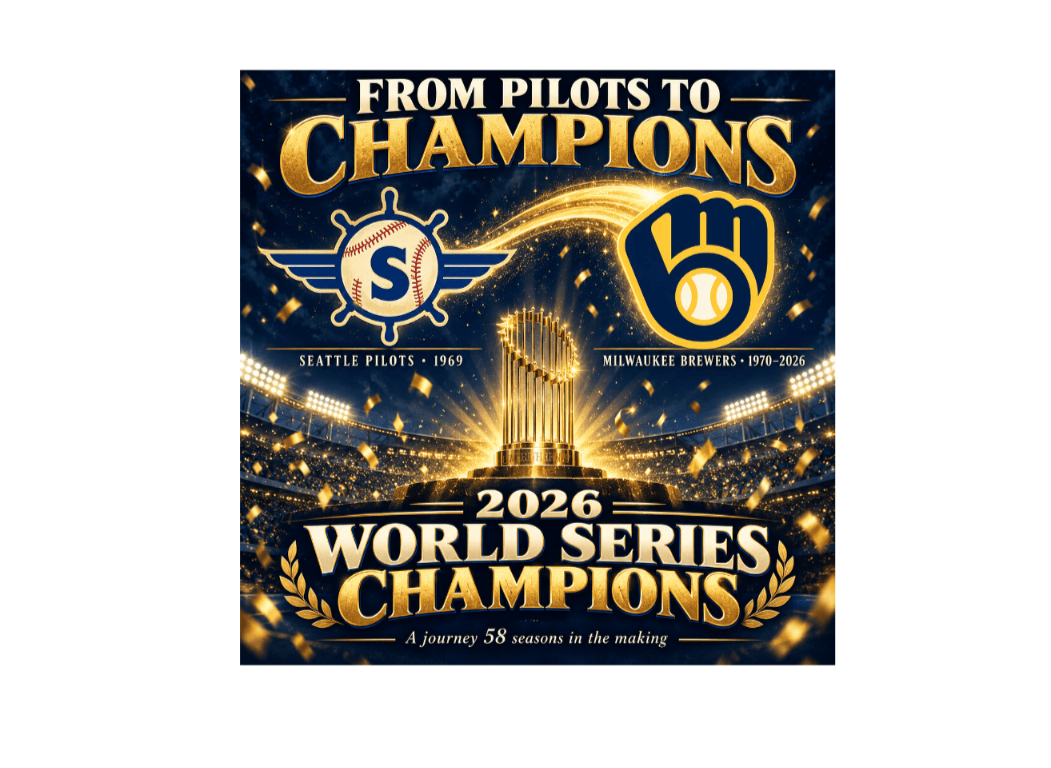
The franchise that spent just one season in Seattle has finally won baseball’s biggest prize—a celebration connected to two cities and one of the game’s greatest players. They were my favorite baseball team when I was a child. In addition, Henry Aaron was my favorite player who was a Brewer from 1954 to 1962 before they moved to Atlanta. As a kid I just was a Henry Aaron fan when he was an Atlanta Brave.
The original brewers won. World series in 1957 defeating the New York Yankees. Yesterday was about the second brewers team.
For anyone who remembers the original Seattle Pilots, Milwaukee’s World Series championship carries an unusual Northwest connection. Before the Brewers belonged to Wisconsin, they belonged to Seattle—for one brief, troubled season.
On October 28, 2026, Milwaukee defeated the Tampa Bay Rays 4–1 in Game 5, capturing the first World Series championship in franchise history. The organization that began as the Pilots in 1969 had finally reached the top in its 58th season. For generations of Brewers fans, the wait really had lasted a lifetime.
For me, that history also brings back my favorite baseball player: Henry Aaron. His connection to Milwaukee links the city’s earlier baseball glory with the franchise that started in Seattle.
Aaron never played for the Seattle Pilots. He joined the Brewers several years after their move. But his place in Milwaukee’s heart—and his extraordinary achievement in breaking Babe Ruth’s career home run record—makes him an essential part of this story.
Seattle’s One-Season Team
Major League Baseball arrived in Seattle in 1969 with the expansion Pilots. For a city with a long minor league tradition, it was an exciting step onto the national stage.
The Pilots played at Sicks’ Stadium, an aging ballpark being expanded for its new role. Construction fell behind, and some opening-day spectators waited while their seats were still being installed. The team won its home opener against the Chicago White Sox, 7–0, on April 11, offering a promising beginning.
The excitement soon met difficult realities. Stadium shortcomings, financial instability and disappointing attendance undermined the operation. On the field, Seattle finished 64–98, last in the American League West. What fans expected to be the beginning of a permanent major league presence instead became a single summer of baseball.
The end came abruptly. A bankruptcy court cleared the sale to a Milwaukee ownership group led by Bud Selig, and the Pilots became the Milwaukee Brewers as April 1970 began. Players who had prepared for another Seattle season suddenly needed homes in Wisconsin.
Seattle eventually received another team. The Mariners debuted in 1977 following litigation and a settlement associated with the Pilots’ departure. They were a new franchise; the original Pilots’ history continued in Milwaukee.
Milwaukee Gets Baseball Back—and Welcomes Henry Home
Milwaukee understood the pain of losing a team. The Braves had played there before departing for Atlanta for the 1966 season. Henry Aaron had been their defining star, helping deliver a World Series championship in 1957.
That season, Aaron batted .322, hit 44 home runs, drove in 132 runs and won the National League’s Most Valuable Player Award. Long before his pursuit of Ruth became a national drama, Milwaukee fans already knew they were watching someone special.
The arrival of the former Pilots restored major league baseball in 1970. Aaron’s return for the 1975 season restored something more personal.
After 21 seasons with the Braves, he came back to Milwaukee to finish his career with the Brewers, primarily as a designated hitter. His return connected two separate franchises through a player the city had never stopped loving.
At the Brewers’ 1975 home opener, 48,160 fans filled County Stadium. Businesses displayed “Welcome Home, Henry” signs. For Milwaukee, this was much more than acquiring a famous veteran. A beloved part of the city’s history had come home.
The Swing That Passed Babe Ruth
The achievement that made Aaron an enduring figure in American history came on April 8, 1974, while he was still an Atlanta Brave.
Facing Los Angeles Dodgers pitcher Al Downing, Aaron hit his 715th career home run, passing Babe Ruth’s record of 714.
It was the career record—not the single-season record—and it represented an extraordinary accumulation of excellence. Aaron had surpassed a number that generations of baseball fans had treated almost as a permanent landmark.
His accomplishment also carried a burden that no athlete should have faced. As a Black man approaching Ruth’s record, Aaron endured racist hatred and threats. He continued playing through that hostility, giving the achievement a significance far beyond the distance of one baseball hit into the stands.
That is part of why Henry Aaron remains my favorite player. The home runs were remarkable. The perseverance and dignity behind them made the player even more memorable.
Aaron finished with 755 career home runs. His greatness extended well beyond power: he collected 3,771 hits and finished with a .305 batting average. Remove all 755 home runs from his hit total, and he would still have more than 3,000 hits—an astonishing measure of his complete offensive ability.
Barry Bonds eventually surpassed Aaron’s home run total in 2007. But another player taking the statistical lead could never erase what Aaron accomplished when he passed Ruth.
Finally, a Championship
The Brewers’ long wait included a painful near miss. In 1982, Milwaukee reached the World Series but lost to the St. Louis Cardinals in seven games. Decades followed before the franchise returned to the Series and finally won it in 2026.
There is a distinction worth preserving: Milwaukee had celebrated a World Series winner before, with Aaron and the 1957 Braves. This championship belongs to the Brewers—the franchise born in Seattle.
For Milwaukee fans, it rewards years of loyalty. For Northwest baseball fans, it offers a reminder that the Pilots’ story continued after their uniforms and equipment left town.
And for those of us who admired Henry Aaron, it brings his name back into a celebration he helped make meaningful. He connected Milwaukee’s baseball generations simply by returning to the city where his major league career began.
The Pilots had only one season in Seattle. Aaron had only two seasons with the Brewers. Neither connection was long, but both remain woven into the history of a franchise that can finally call itself a World Series champion. Do we get to claim a world series for Seattle?
We won’t mention the Oklahoma City Thunder or the Seattle SuperSonics—apparently, one stolen Seattle team per article is enough.

