
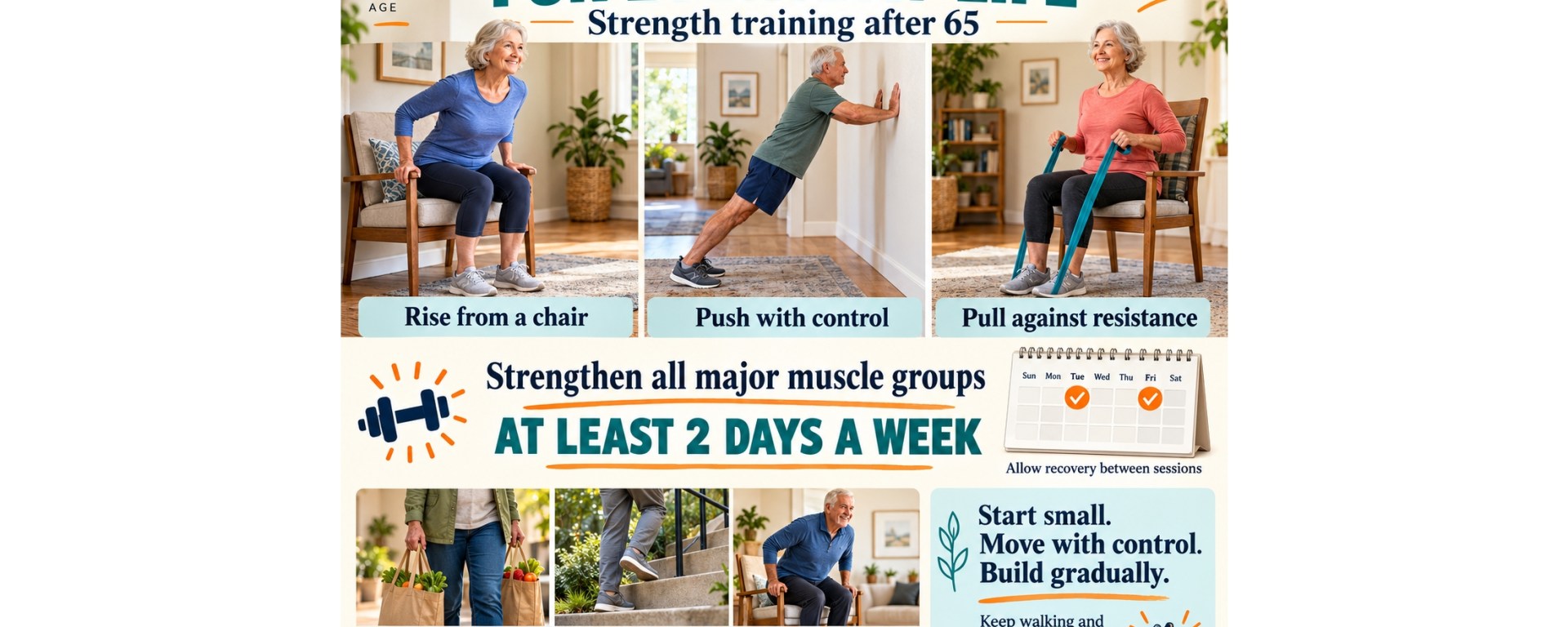
Walking is valuable, but it does not fully replace strength training. After 65, the ability to rise from a chair, carry groceries, climb steps, recover from a stumble and keep doing household tasks depends partly on muscle strength and power. Those abilities can change with age, illness and inactivity—but age alone does not make improvement impossible.
For older adults in Surfside, Ocean Park and elsewhere on the Long Beach Peninsula, strength work has a practical advantage: it can be done indoors when rain, wind or slippery pavement make outdoor exercise less appealing. The goal is not bodybuilding. It is maintaining enough capacity for everyday life.
What the federal recommendation actually says
The current Physical Activity Guidelines for Americans recommend muscle-strengthening activities involving all major muscle groups on at least two days each week. The major groups include the legs, hips, back, abdomen, chest, shoulders and arms. The days do not have to be consecutive.
The same guidelines recommend 150 to 300 minutes of moderate-intensity aerobic activity weekly, or 75 to 150 minutes at vigorous intensity, plus balance activity for older adults. Strength work is therefore one part of a complete plan—not a substitute for walking, cycling, swimming or other aerobic movement. If health conditions prevent meeting the full target, the guidance says to be as active as abilities and conditions allow.
In 2024, only 15.5% of U.S. adults age 65 or older reported meeting both the aerobic and muscle-strengthening guidelines, according to Healthy People 2030 data. That is a national self-reported estimate, not a measure of Pacific County residents.
What counts as strength training
Strengthening means making muscles work harder than they normally do. Free weights and gym machines count, but they are not required. Resistance bands, body-weight movements, climbing stairs, carrying loads and some forms of heavy gardening can qualify. A home session might include sitting down and standing up from a sturdy chair, wall push-ups, resistance-band rows, heel raises while holding a counter and lifting a light object overhead if shoulder mobility permits.
Federal guidance says one set of 8 to 12 repetitions can improve strength, while two or three sets may provide more benefit. The resistance should make another repetition difficult while still allowing controlled movement and good form. That is a general benchmark, not a prescription for everyone. Someone beginning after a long inactive period may need fewer repetitions, less resistance, a smaller range of motion or supervised instruction.
Progression is the essential idea. When an exercise becomes easy with steady technique, a person might add a repetition, slightly increase resistance or choose a more challenging version. Increasing several variables at once makes it harder to tell what caused pain or excessive fatigue.
What the research can—and cannot—promise
A 2023 systematic review and meta-analysis included 21 studies with 1,610 adults age 60 or older. It reported improvements in several measures of upper-body, lower-body and handgrip strength, along with some quality-of-life and depression measures. However, studies used different programs and outcome tests, and the authors described the evidence as preliminary. The review supports the general value of resistance exercise; it does not identify one perfect routine or guarantee that every participant will obtain the same result. The study record is available through PubMed.
A separate 2023 evidence synthesis focused on older adults with sarcopenia—clinically important loss of muscle mass and function. It found that resistance exercise, alone or combined with aerobic, balance or nutritional interventions, ranked among the most effective approaches for several outcomes. Some average changes did not reach the review’s stated threshold for a meaningful difference, which is an important reminder that statistical improvement is not always the same as a noticeable change in daily life. See the published review.
Balance needs its own practice
Stronger legs may help with stability, but strength training and balance training are not identical. The CDC recommends aerobic, strengthening and balance activities each week. Balance work can include heel-to-toe walking, controlled weight shifts or standing from a chair. Anyone at substantial fall risk should practice near a stable support or with appropriate supervision rather than testing balance alone beside hard furniture.
Start safely, especially with chronic conditions
Most older adults can benefit from activity, but the starting point should reflect current health and function. CDC advises people with chronic conditions or disabilities to consult a health professional or physical-activity specialist about suitable types and amounts. That is especially useful after surgery or hospitalization, with unstable heart or lung symptoms, significant neuropathy, severe joint pain, recurrent falls or a condition that changes safe lifting technique.
Do not hold your breath while straining; breathe continuously and use controlled motion. Stop the activity and seek medical guidance if it causes chest pain or pressure, fainting, marked dizziness, unusual shortness of breath, or a new irregular or racing heartbeat. Sudden neurological symptoms or severe chest symptoms require emergency evaluation. Ordinary muscle effort is expected, but sharp joint pain is not a goal.
Medication effects also matter. Drugs that affect blood pressure, heart rate, blood sugar, alertness or balance can change exercise tolerance. Do not stop a medicine to exercise. Ask a clinician or pharmacist how timing, hydration, meals and monitoring should be handled for your situation.
A realistic two-day starting plan
Choose five or six movements covering the major muscle groups, with a sturdy chair or counter available. Begin with one controlled set per movement on two nonconsecutive days. Allow recovery, record resistance and repetitions, and increase only when the current level feels manageable without loss of form. Add balance practice and aerobic movement on other days or in short portions of the same session.
Consistency matters more than expensive equipment. Bands and household items can work, but equipment must be intact and the exercise area should be dry, uncluttered and well lit. On wet coastal days, an indoor routine can preserve momentum without taking unnecessary risks on slick steps or pavement.
Practical takeaways
Aim to strengthen every major muscle group at least twice weekly, but scale the starting point to your current abilities. Include aerobic and balance activities because each serves a different purpose. Build resistance gradually, favor good form over heavier weight, and seek individualized advice when medical conditions, pain, dizziness or fall risk complicate exercise.
The useful question is not whether someone can train like a younger athlete. It is whether a safe, repeatable program can make tomorrow’s chair rise, grocery trip or walk across uneven ground a little easier. For many older adults, the evidence says that is a realistic goal.
Sources
U.S. Department of Health and Human Services. Physical Activity Guidelines for Americans, 2nd edition. 2018. https://health.gov/sites/default/files/2019-09/Physical_Activity_Guidelines_2nd_edition.pdf
Centers for Disease Control and Prevention. “Older Adult Activity: An Overview.” Updated December 4, 2025. https://www.cdc.gov/physical-activity-basics/guidelines/older-adults.html
National Institute on Aging. “Three Types of Exercise Can Improve Your Health and Physical Ability.” Updated January 14, 2025. https://www.nia.nih.gov/health/exercise-and-physical-activity/three-types-exercise-can-improve-your-health-and-physical
Kashi, Sholeh Khodadad, Zahra Sadat Mirzazadeh and Vahid Saatchian. “A Systematic Review and Meta-Analysis of Resistance Training on Quality of Life, Depression, Muscle Strength, and Functional Exercise Capacity in Older Adults Aged 60 Years or More.” Biological Research for Nursing, 2023. https://pubmed.ncbi.nlm.nih.gov/35968662/
Shen, Yanan, et al. “Exercise for Sarcopenia in Older People: A Systematic Review and Network Meta-Analysis.” Journal of Cachexia, Sarcopenia and Muscle, 2023. https://pubmed.ncbi.nlm.nih.gov/37057640/
Office of Disease Prevention and Health Promotion. “Increase the Proportion of Adults Who Do Enough Aerobic and Muscle-Strengthening Activity.” 2024 data. https://odphp.health.gov/healthypeople/objectives-and-data/browse-objectives/physical-activity/increase-proportion-adults-who-do-enough-aerobic-and-muscle-strengthening-activity-pa-05/infographic

