
Technology
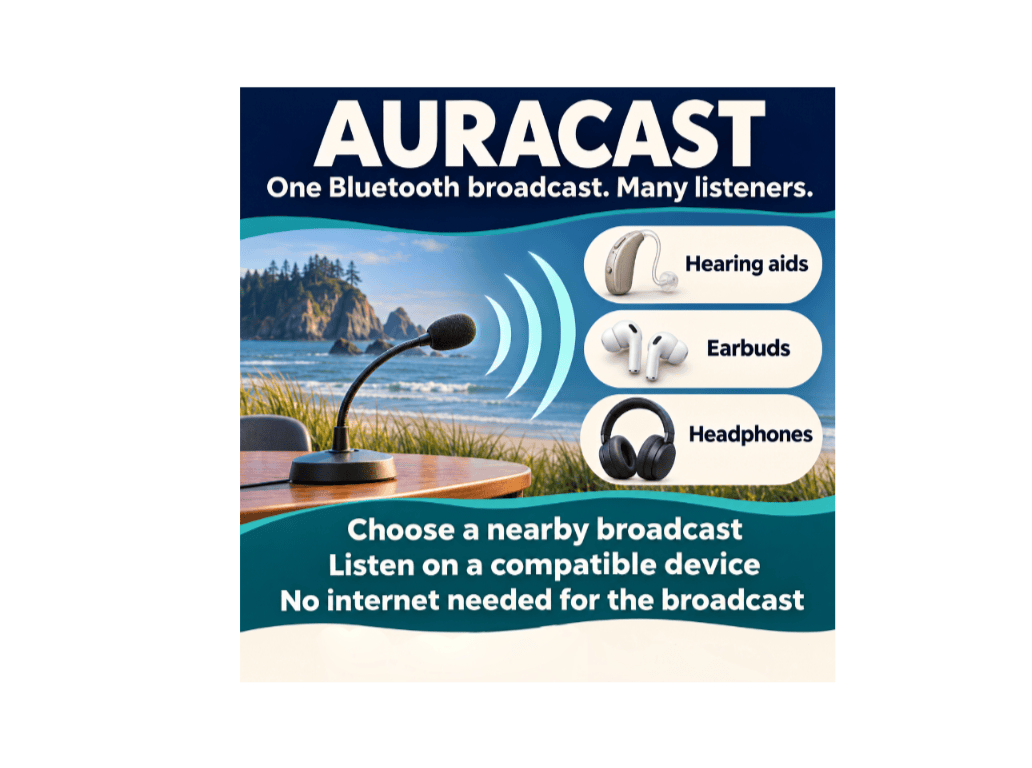
At a crowded meeting, airport gate or television waiting area, the loudspeaker is often the weakest link. Distance, echoes and background conversation can make speech difficult even for people with normal hearing—and much harder for those using hearing aids. Auracast, a feature built on Bluetooth LE Audio, is intended to send the same audio directly to many nearby compatible hearing aids, earbuds or headphones.
The promise is appealing: choose an audio broadcast from a phone menu much as you choose a Wi-Fi network. Yet the transition is incomplete. Compatibility depends on the phone, operating system and listening device, and a familiar Bluetooth logo does not establish that Auracast will work.
Auracast is a way to stream audio over Bluetooth to everyone nearby who chooses to listen.
When you stream a podcast, the audio usually comes over the internet to your phone, which can then send it to your earbuds. With Auracast, a source like a TV or a meeting-room microphone broadcasts directly to nearby compatible earbuds or hearing aids. You might use your phone to select the broadcast, but the phone doesn’t have to relay the sound, and the Bluetooth broadcast itself doesn’t need internet access over WiFi or 5g.
How one broadcast reaches many listeners
Ordinary Bluetooth audio usually creates a private one-to-one connection. Auracast uses Bluetooth broadcast audio. A transmitter advertises a named stream; an “assistant,” often a phone, helps a receiver find and join it. The Bluetooth Special Interest Group says an unlimited number of in-range receivers can theoretically join the same broadcast. That does not mean range or capacity is unlimited: walls, antennas, radio interference and transmitter power still matter.
A public meeting room could transmit its microphone feed, a gym could offer several television channels, or a museum could broadcast a tour. A password can protect a private stream. Public streams may be open, but open audio should never carry confidential health, financial or personnel information. Bluetooth signals can pass through walls, and the SIG’s transmitter guidance recommends encryption when content is personal or confidential.
Why this could matter on the peninsula
For residents of Surfside, Ocean Park and the Long Beach Peninsula, useful settings could include community meetings, emergency-preparedness presentations, museums, houses of worship and televisions in public waiting rooms. Direct audio may improve the signal-to-noise ratio because speech reaches the listener without first traveling through a reverberant room.
That is an engineering advantage, not a medical treatment. Auracast does not diagnose hearing loss, correct an improperly fitted hearing aid or guarantee that every listener will understand speech. Room microphones, the public-address mix and the receiver’s fitting still influence the result.
The technology may also help people without hearing loss. Compatible earbuds could receive a silent television, tour narration or translated audio. The Bluetooth SIG describes all of these uses, although that organization promotes the standard and its projected benefits should not be confused with independent evidence that every installation produces the same experience.
Compatibility is the difficult part
As of November 4, 2026, Android support is real but uneven. Google says Auracast support has expanded to the Pixel 8 series and newer, several Samsung flagships released since 2023 and selected Xiaomi and POCO models. Google’s help pages also explain how a compatible Android phone can scan for public broadcasts or share audio with multiple LE Audio accessories.
Samsung documents broadcasting from supported Galaxy phones and receiving with compatible Galaxy Buds, including Buds2 Pro and later supported models. Exact availability can depend on model, software version and region.
Apple’s current support pages document Made for iPhone hearing aids, telecoil compatibility and other hearing features, but the Apple material reviewed for this article did not document a general iPhone interface for finding public Auracast broadcasts. That is an inference from Apple’s published support information—not proof that no Apple device or accessory can participate. Buyers should verify a specific phone, operating-system version and hearing device before spending money.
The safest purchasing rule is to require the word Auracast in the manufacturer’s specifications and then confirm the device’s role. A product may transmit, receive or merely act as an assistant. “Bluetooth 5.3,” “LE Audio capable” or “hearing-aid compatible” alone is not enough.
It supplements—not automatically replaces—existing access systems
Federal accessibility rules already require assistive listening systems in certain assembly areas. The 2010 ADA Standards specify where systems and receivers are required, while a 2024 Federal Communications Commission order recognizes Bluetooth LE Audio and Auracast as nonproprietary wireless coupling technologies.
Installing an Auracast transmitter does not by itself prove that a venue satisfies every ADA scoping and technical requirement. Venues should evaluate receiver availability, hearing-aid compatibility, signage, staff training, backup arrangements and the needs of visitors who do not own compatible devices. During the transition, maintaining an induction loop, FM or infrared option may be necessary.
Practical takeaways
- Before buying: check the exact phone, operating system and hearing-aid or earbud model—not just the Bluetooth version.
- Before a meeting: update device software and test the complete system in the actual room.
- For venues: pilot the technology with people who use different hearing devices, and keep loaner receivers or an established assistive-listening option available.
- For privacy: treat an open broadcast like a public loudspeaker. Encrypt confidential streams and distribute the code separately.
- For emergencies: do not make Auracast the only warning channel. Preserve visual alerts, captions, public-address audio and written information.
A promising standard, not yet a universal experience
Auracast addresses a genuine accessibility problem: sound from a distant loudspeaker must compete with the room before it reaches a listener. Sending the source directly to personal hearing devices could make meetings, announcements and public media easier to follow.
Its usefulness today depends on careful compatibility checks and inclusive venue planning. For peninsula organizations, the sensible approach is a small, well-tested pilot—not an assumption that every resident already owns the right equipment.
Sources
- Bluetooth SIG, “Auracast—How It Works”: https://www.bluetooth.com/auracast/how-it-works/
- Bluetooth SIG, “Auracast for Public Locations”: https://www.bluetooth.com/auracast/public-locations/
- Google, “LE Audio Auracast Support Expands to More Android Devices,” 2025: https://blog.google/products-and-platforms/platforms/android/le-audio-auracast-support/
- Google Android Help, “Use Multiple Bluetooth Audio Accessories at Once”: https://support.google.com/android/answer/16550669
- Samsung, “Broadcast Audio From Your Galaxy Phone”: https://www.samsung.com/us/support/answer/ANS10001042/
- U.S. Department of Justice, 2010 ADA Standards for Accessible Design: https://www.ada.gov/law-and-regs/design-standards/2010-stds/
- Federal Communications Commission, FCC 24-112, 2024: https://docs.fcc.gov/public/attachments/FCC-24-112A1_Rcd.pdf

