
Now comes what some may view as a startling revelation.
The chair of the Surfside Tree Committee has raised concerns that Western Gall Rust may prove catastrophic to Surfside’s shore pine population. They are now going to bring an arborist to consult. I can save them some money. We have a lot of dead and diseased trees as a result of the tree height restrictions. And hundreds of dead-tree violations and fines against residents. This raises an unavoidable question
Could years of tree topping and chronic canopy reduction lead by the chair of the tree committee have weakened the very trees the community is now being warned may be in danger?
This is a direct result of the Surfside HOA board and tree policy they enforced. A policy that punished residents for violations.
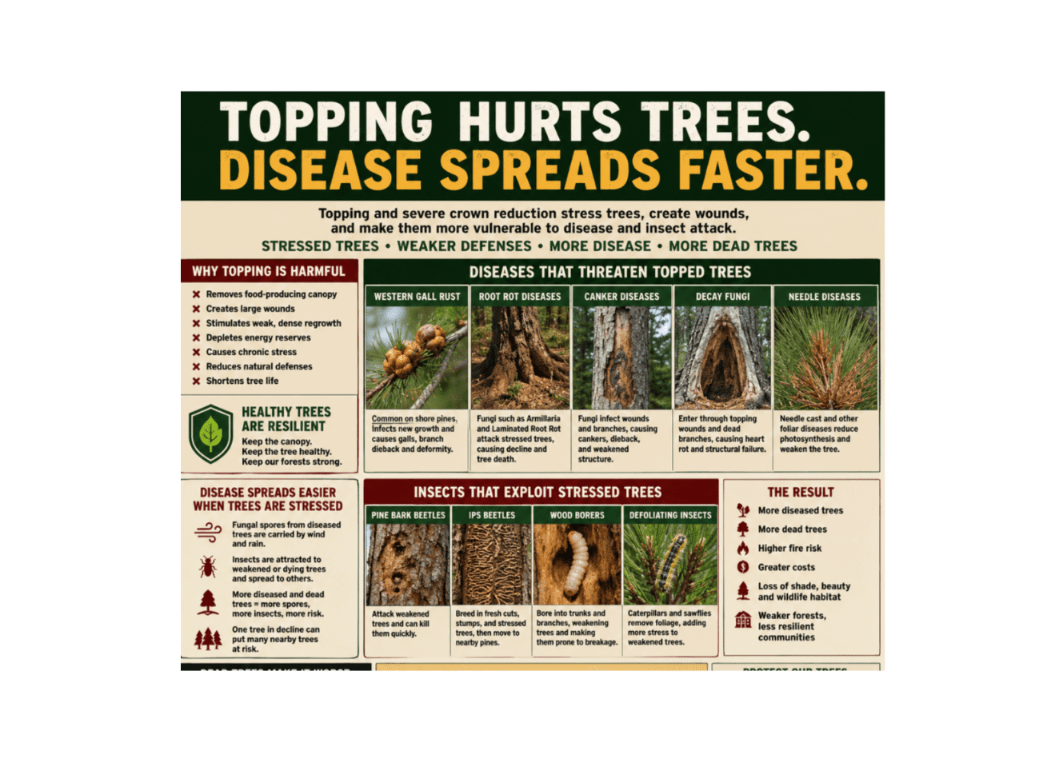
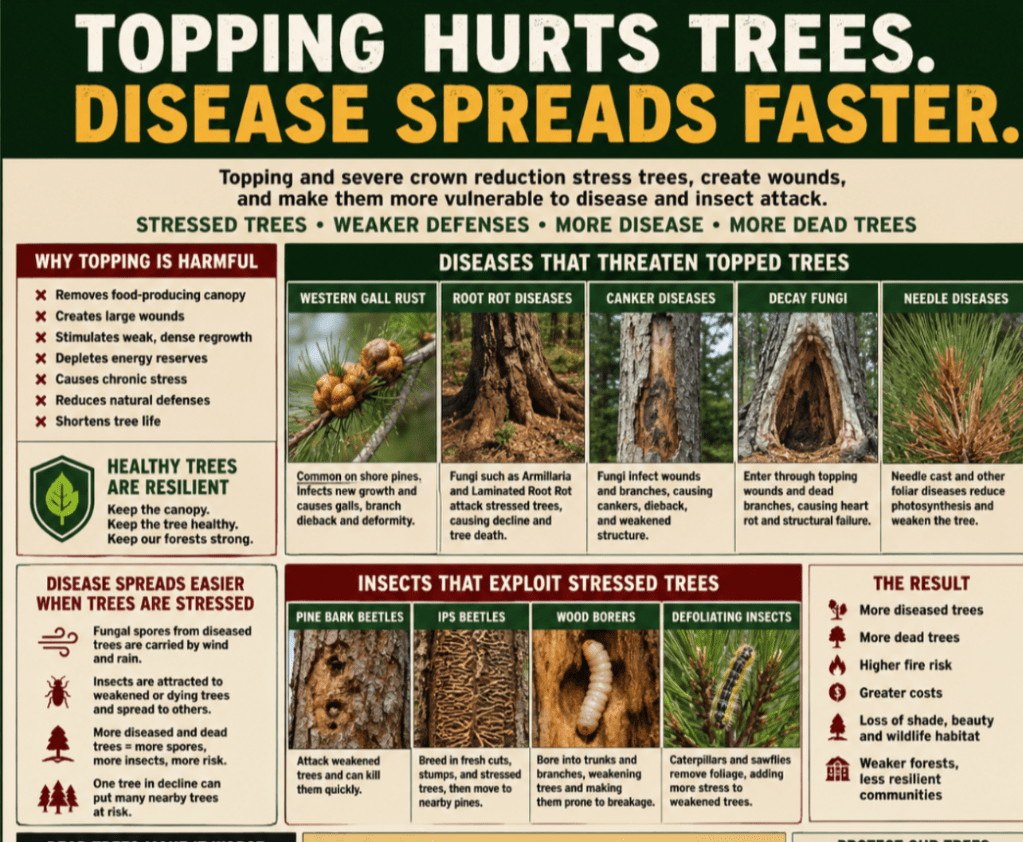
Western gall rust is not a new disease. It has existed throughout the Pacific Northwest for generations. Forestry experts recognize that healthy trees possess natural defenses against disease and insects, while stressed trees become increasingly vulnerable. Arboricultural standards have long warned that topping creates wounds, stimulates susceptible juvenile growth, and subjects trees to chronic stress.
The Surfside HOA has spent the last four years enforcing tree heigh restrictions and a budget entry related to fines on the ordee of 311000 in the 2024 budget.
The resulting drop in tree canopy from around 20% to 14% is the result on the west side of aggressive enforcement.
So too are the recurring algae blooms and fish kills in Seabreeze Lake. Meanwhile, the chipper site—filled with dead and diseased trees—has become a graveyard of tree debris. And that does not even account for the many standing dead and declining trees throughout Surfside, the legacy of years of widespread tree topping and canopy reduction that have left trees more vulnerable to disease, insects, and premature mortality.
Yet for years, Surfside’s policies emphasized height enforcement rather than tree health.
Throughout Surfside, residents have witnessed:
- Dead and declining shore pines.
- Repeated topping of mature trees.
- Loss of natural canopy.
- Increased exposure to wind.
- Less tree canopy means more flooding
- Stressed regrowth from previously cut trees.
- Progressive fragmentation of the trees
And now, after years of these practices, homeowners are being warned that Western Gall Rust may threaten the remaining shore pines.
If that warning proves justified, then perhaps the greatest irony is this:
The catastrophe being feared today may have been unintentionally encouraged by decades of policies that weakened the Surfside’s trees natural defenses.
Diseases rarely act alone.
Western gall rust is only one of many threats facing stressed trees. Root rot fungi, canker diseases, decay fungi, bark beetles, Ips beetles, and needle diseases frequently exploit weakened trees. Dead and dying trees can become reservoirs for insects and fungal pathogens, serving as breeding sites and sources of spores that increase disease and pest pressure on surrounding healthy trees.
The first line of defense against these threats has always been healthy trees.
Not topped trees.
For years, Surfside homeowners have watched as countless shore pines slowly decline. Dead tops, repeated height reductions, excessive pruning, and the gradual disappearance of mature trees became a familiar sight. Hundreds of trees have died or been removed. Yet, despite years of visible decline, little public discussion focused on whether the policies themselves might be contributing to the problem.
Not chronically stressed trees.
Not fragmented canopies.
Healthy trees.
For years, homeowners questioned whether repeated height reductions were harming shore pines. Those concerns were often dismissed. Today, with warnings of potentially widespread disease, those questions deserve answers.
Perhaps the issue is not simply Western Gall Rust.
Perhaps the real issue is whether Surfside’s tree committee and board has been managed according to modern arboricultural science and best available science—or whether decades of height-driven management unintentionally transformed one of Surfside’s greatest assets into one of its greatest vulnerabilities. They are calling in an arborist now for consultation.
If Western Gall Rust truly poses a catastrophic threat, then the community deserves a board and tree committee chair that understands trees cut.repeatanly to height kills them. They have hundreds of examples of diseases trees as an example. They tout their defense of Surfside against wild fires with their dead tree policy. Pointing out the threat of western gall rust is the ultimate hypocrisy.
Their blind adherence to the covenants demonstrates a failure to recognize when policies are producing harmful and unintended consequences. They now need an arborist to confirm what everyone already knows.
Members deserves a board who ignores science to be held accountable.
They need to explain how their practices contributed to current conditions.
And it deserves a new vision—one based not on fear of trees, but on understanding how healthy trees function.
Because if there is one lesson nature repeatedly teaches, it is this:
Healthy trees are resilient. ll
The question Surfside must ask itself is not merely whether Western Gall Rust threatens the trees
The harder question will be the board taking responsibility and the head of the tree committee very policies intended to control it.
The consequences are clear.
For the health and well being of members best available science recommends the following tree policies :
- Review Tree Regulations: Update local codes using best available science and encourage tree preservation and mature canopy growth.
- Adopt Canopy Targets: Establish a 30% canopy goal with ongoing monitoring and integration into land-use planning.
- Promote Healthy Tree Growth: Remove restrictive height limits, prohibit topping, and encourage practices that support mature trees.
- Address Social Equity: Prioritize tree planting and preservation in low-canopy and underserved areas to improve health and quality of life.
The board has failed to meet any of these goals for years. The health benefits of trees for many health conditions are well known
The result is a senior population with low tree canopy and threat of even more dead trees being more vulnerable to disease, impacting their health and well-being for years to come.

