
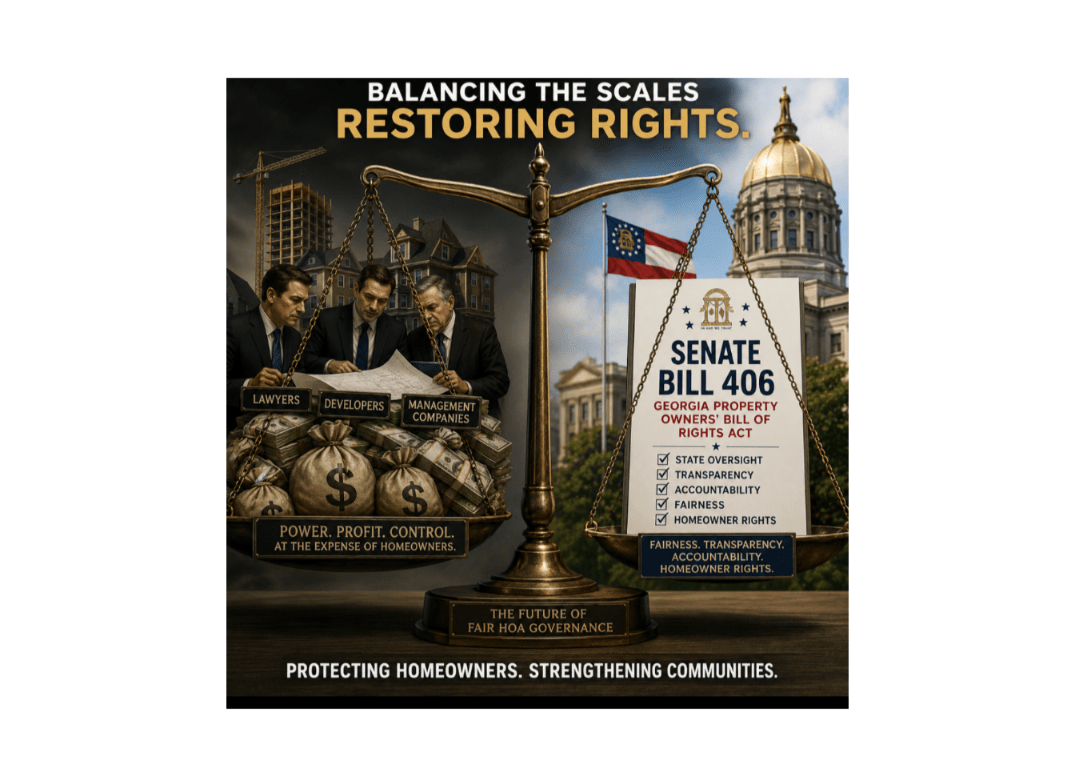
In a move that could reshape homeowner association governance across the United States, the state of Georgia has enacted Senate Bill 406, widely known as the Georgia Property Owners’ Bill of Rights Act. The legislation establishes one of the most comprehensive systems of state oversight for homeowner associations ever adopted and is already being viewed as a potential model for other states.
For years, many homeowners have argued that HOA boards often operated with little practical oversight, leaving owners with few affordable options other than lengthy and expensive court battles. SB 406 fundamentally changes that equation by placing homeowner associations under the authority of the Georgia Secretary of State and creating a formal enforcement process.
Georgia’s landmark HOA accountability law is a triumph of vision, perseverance, and grassroots homeowners’ power. It shows that ordinary citizens can challenge powerful interests and change the law. While many critics believe organizations such as the Community Associations Institute (CAI) and the broader HOA industry have shaped laws that favor associations over homeowners, Patrick Johansen and the volunteers of the HOA Reform Leaders National Group (HRLNG) spent years advocating for greater transparency, accountability, and homeowner rights. As part of its legacy, Patrick’s legacy is helping build a national movement that restores power to homeowners. Georgia’s SB 406 demonstrates that meaningful HOA reform is possible, and it may be only the beginning.
The movement that ultimately contributed to today’s HOA reform efforts traces part of its roots to homeowner frustrations in communities such as Surfside, Washington, where residents raised concerns about limited oversight, escalating fines, and the lack of an effective state-level mechanism to hold HOA boards accountable.
Those experiences helped inspire broader advocacy through HOA Reform Leaders National Group (HRLNG), co-founded by Patrick Johansen, which has promoted model legislation calling for independent state oversight and meaningful enforcement authority. And that movement includes members like Candace, who, like many homeowners, are victimized by HOAs with expensive lawsuits.
While Georgia’s SB 406 was developed through the state’s legislative process, advocates note that many of its accountability provisions reflect principles long championed by HRLNG, making the law an important milestone in the growing national movement for HOA reform.
Years before Georgia passed its landmark SB 406, Mike Chevalier, Candace Carteen, and Patrick Johansen spent months writing the book Legislative Strategies: Combating HOA Corruption, a blueprint for strengthening homeowner rights and bringing meaningful accountability to homeowner associations. The book mirrors Patrick Johansen’s work with the HOA Reform Leaders National Group (HRLNG), a volunteer organization committed to advancing legislative reforms that protect homeowners through greater transparency, independent oversight, and fair governance. Many of the reforms championed by HRLNG—including expanded homeowner protections, stronger state oversight, and increased accountability for HOA boards—closely align with key provisions of Georgia’s new law, highlighting the growing momentum of the national HOA reform movement.
For all of Patrick Johansen’s critics on the Surfside HOA Board and among Surfside Preservation supporters, Georgia’s landmark legislation is a reminder that meaningful reform often begins with those willing to challenge the status quo. What was once dismissed as unrealistic has now become state law. The principles Patrick and other reform advocates championed—independent oversight, real accountability, and consequences for boards that violate the law—are no longer just ideas; they are setting the standard for HOA reform. Sometimes being on the right side of history means enduring criticism today to achieve meaningful change tomorrow.
Georgia’s landmark HOA reform demonstrates that meaningful change is driven by those willing to put forward solutions, not merely criticize them. In the end, lasting accomplishments speak louder than name-calling, and history remembers those who devote their lives to improving the lives of others—not those driven primarily by money, power, sticking to outdated covenants or control. Lasting legacies are built through service, vision, and the courage to stand up for what is right especially for vulnerable homeowners. Patrick Johansen will not be remembered for the immature, childish criticism of his detractors. He will be remembered for helping build a national grassroots movement that is changing HOA laws and strengthening homeowner rights.
Today, I am very proud of both Patrick Johansen and Candace Carteen in advancing the HOA reform movement. Inspired by the need for change, they helped promote ideas that are now being reflected in landmark legislation like Georgia’s SB 406.
What began as a Surfside HOA resistance has now helped spark a nationwide movement aimed at empowering homeowners, making it easier for Georgians to stand up to their HOAs today, and laying the groundwork for similar reforms in states like Washington in the future.
So to Patrick and Candace who lifts human spirits with her chicken soup for the soul books – well done.
.
A New Era of State Oversight
One of the most significant changes is the requirement that homeowner associations register annually with the Georgia Secretary of State. Associations that fail to comply may lose important enforcement powers, including the ability to collect fines, impose certain fees, record liens, or initiate foreclosure proceedings.
The law also creates a formal state complaint process, giving homeowners an alternative to costly litigation when disputes arise.
Stronger Accountability for HOA Boards
Perhaps the most groundbreaking aspect of SB 406 is the disciplinary authority granted to the Secretary of State. Under the law, state officials may take enforcement action against HOA board members who:
- File false or misleading information with the state.
- Willfully violate Georgia HOA law.
- Fail to comply with subpoenas.
- Ignore lawful state orders.
- Fail to correct registration deficiencies.
Supporters view this as a historic shift because it creates meaningful consequences for serious violations of state law rather than relying solely on private lawsuits. The legislation also authorizes the state to suspend or revoke an HOA’s registration under specified circumstances.
Expanded Protections for Homeowners
SB 406 contains numerous additional consumer protections designed to improve transparency and reduce abusive collection practices.
Among its provisions, the law:
- Requires long-term retention of HOA records and expands homeowner access to documents.
- Increases the foreclosure threshold from $2,000 to $4,000.
- Excludes fines from counting toward that foreclosure threshold.
- Requires at least 90 days’ notice before foreclosure proceedings may begin.
- Establishes a state review process for homeowner complaints.
Together, these provisions are intended to increase transparency while ensuring that foreclosure is used only as a last resort.
Why This Matters Nationally
Georgia now joins a group of states that provide meaningful state-level oversight of homeowner associations. The legislation demonstrates that comprehensive HOA accountability reforms can receive bipartisan legislative support and move beyond discussion into law.
For lawmakers considering HOA reform elsewhere, SB 406 provides a working legislative framework that balances homeowner protections with continued operation of community associations.
How It Compares to HOA Reform Leaders’ Proposal
Advocates with HOA Reform Leaders have noted that many of SB 406’s enforcement concepts closely resemble elements of their proposed model legislation, particularly the creation of state oversight, disciplinary authority, and meaningful enforcement mechanisms.
They also point out that their proposed legislation includes a more detailed enforcement process that outlines how complaints should be investigated, hearings conducted, and disciplinary actions implemented. Supporters argue that adding those procedural elements could provide additional due process protections while making future enforcement even more consistent.
Looking Ahead
Georgia’s new law is likely to become one of the most closely watched HOA reform efforts in the country. Other legislatures now have a modern example demonstrating that stronger oversight, greater transparency, and increased homeowner protections can be enacted through state law.
Whether other states adopt similar measures remains to be seen, but SB 406 has undoubtedly changed the national conversation about HOA accountability. For millions of homeowners living in association-governed communities, Georgia has established a significant new precedent that could influence HOA legislation across the United States for years to come.
What began as a fight with the Surfside HOA ultimately helped inspire a nationwide effort to strengthen homeowner rights and accountability.

