
August 3, 2026
Washington and Oregon are experiencing one of the most destructive wildfire seasons in recent memory, with millions of acres burning across the Pacific Northwest, thousands of firefighters deployed, and wildfire smoke degrading air quality across much of the western United States.
The most devastating impacts have occurred in eastern Washington, where multiple fast-moving fires in the Spokane area have destroyed more than 700 homes and other structures, forced the evacuation of more than 60,000 residents, and become the nation’s highest wildfire suppression priority. Entire neighborhoods have been reduced to ashes as firefighters continue battling rapidly spreading fires fueled by drought, extreme heat, and gusty winds. Despite an enormous response involving more than 1,000 firefighters, several of the fires remain largely uncontained.
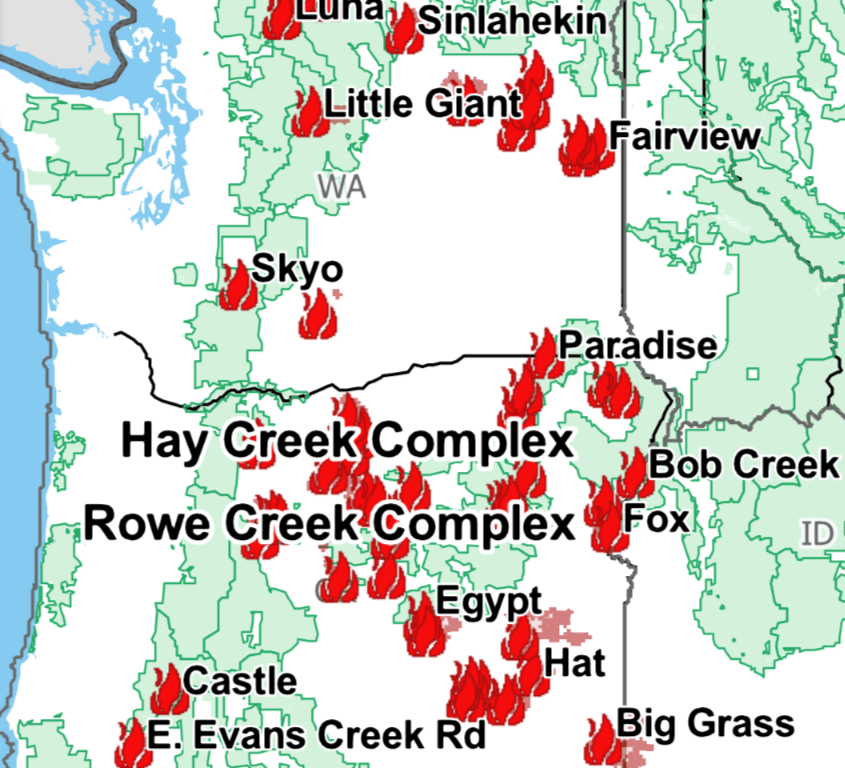
The wildfire crisis extends well beyond Spokane. More than 100 large wildfires are burning across 15 states, with Washington and Oregon among the hardest hit. Combined, the two states now have more than 2 million acres burning, with numerous fires exhibiting extreme fire behavior. Large incidents near Mount Hood, the Lake Chelan region, central Oregon, and other parts of eastern Washington continue to generate massive smoke plumes visible from space.
In Oregon, firefighters continue making progress on several major incidents, including the Rowe Creek Complex and the Hay Creek Complex. However, these fires remain large enough to produce significant amounts of smoke that are affecting communities hundreds of miles away.
Smoke from the fires has spread far beyond the burn areas. Satellite imagery shows a vast smoke plume stretching across Washington, Oregon, Idaho, Montana, and into parts of California and the northern Rockies. Forecasts indicate shifting winds will continue transporting smoke westward, periodically reducing air quality throughout western Washington and northwest Oregon, including the Seattle and Portland metropolitan areas.
For many residents, the greatest threat may not be the flames themselves but the microscopic PM2.5 particles carried in wildfire smoke. These fine particles can penetrate deep into the lungs and bloodstream, increasing the risk of respiratory and cardiovascular illness. Health officials recommend limiting strenuous outdoor activities during periods of unhealthy air quality, keeping windows closed, using HEPA air filtration when possible, and wearing a properly fitted N95 respirator if prolonged outdoor exposure cannot be avoided.
Scientists warn that hotter summers, prolonged drought, and more frequent extreme weather are contributing to longer and more intense wildfire seasons across the Pacific Northwest. As fires continue to burn across Washington and Oregon, communities throughout the region are being reminded that wildfire smoke has become an increasingly widespread health hazard, often affecting areas hundreds of miles from the flames themselves.
 Surfside Washington News