
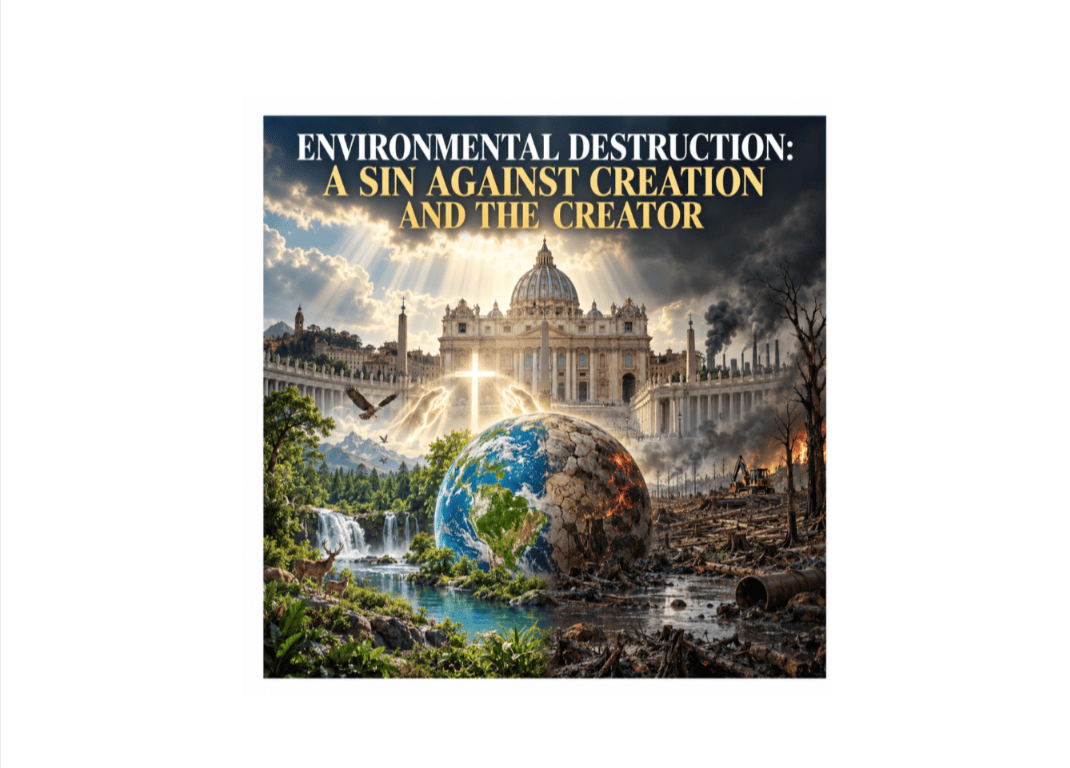
The Vatican’s International Theological Commission has issued a major document declaring that serious harm to the natural world should be understood as a “sin against creation and against the Creator.”
Published on September 2, 2026, with the authorization of Pope Leo XIV, the more than 29,000-word document is titled Caring for Our Common Home: A Responsible and Fraternal Response to the Triune God.
The document presents environmental protection as more than a political, economic or scientific concern. It says caring for creation is a moral and spiritual responsibility arising directly from humanity’s relationship with God.
“We propose understanding this sin against our Common Home as a ‘sin against creation and against the Creator,’ insofar as it violates the meaning of creation intended by God the Creator,” the commission states.
Environmental Destruction Becomes a Matter of Faith
The commission explains that human life is defined by three essential relationships: our relationship with God, our relationships with other people and our relationship with creation.
Environmental destruction damages all three.
Polluting water, destroying natural habitats, exploiting resources irresponsibly and degrading the land do more than harm plants and wildlife. These actions can also injure neighboring communities, threaten public health and leave future generations with environmental damage they did not cause.
The document emphasizes that poor and vulnerable populations frequently suffer the greatest consequences, even though they often contribute the least to pollution and environmental destruction.
By failing to protect our common home with wisdom and long-term vision, humanity not only mistreats creation but also disregards God’s plan and harms its neighbors.
Building on the Teachings of Pope Francis
The new document continues the environmental teachings of Pope Francis, particularly those expressed in his 2015 encyclical Laudato Si’ and his 2023 apostolic exhortation Laudate Deum.
Pope Francis frequently used the term “ecological sin.” The International Theological Commission now proposes the more direct description “sin against creation and against the Creator.”
The new wording makes the theological meaning clearer. Nature is not simply a collection of resources available for unlimited human consumption. Creation is a gift from God, and humanity has been entrusted with its stewardship and protection.
The document was developed between 2022 and 2025, spanning the final years of Pope Francis’ papacy and the beginning of Pope Leo XIV’s leadership. It was approved by a majority of the International Theological Commission, presented to Pope Leo XIV and authorized for publication through Cardinal Víctor Manuel Fernández, prefect of the Dicastery for the Doctrine of the Faith.
What the Vatican Document Actually Does
The document is an authoritative theological study published by a Vatican commission with papal authorization. However, it is not a new papal encyclical, an infallible declaration or an amendment to Catholic canon law.
It does not create a new Church crime or establish a formal punishment for damaging the environment. Instead, it provides theological guidance that could influence Catholic teaching, preaching, education and pastoral practice.
The commission “proposes” that ecological wrongdoing be understood as a sin against creation and its Creator. Although that language is not equivalent to a new law, it carries considerable moral and theological importance.
A Call for Ecological Conversion
The commission says technology, government regulations and scientific advances will not be enough to solve the ecological crisis. Humanity also needs an “ecological conversion”—a transformation in how people understand creation and their responsibility toward it.
Such a conversion can include:
- Protecting forests, wetlands, shorelines and wildlife habitats.
- Preventing pollution of lakes, rivers and groundwater.
- Using natural resources responsibly.
- Reducing wasteful consumption.
- Considering the effects of decisions on vulnerable communities.
- Protecting the rights and well-being of future generations.
These responsibilities do not apply only to individuals. Governments, corporations, churches, property associations and community organizations can make decisions that cause environmental harm on a much greater scale.
When an institution knowingly destroys habitat, contaminates water or places short-term financial interests above public and environmental health, the resulting harm is not merely a technical or regulatory matter. Under the commission’s reasoning, it can also become a moral failure.
Creation Is Not Disposable
The Vatican commission’s message is direct: creation is not disposable.
Humanity may use the Earth’s resources, but it does not possess an unrestricted right to destroy the natural systems that sustain life. People are called to act as stewards and caretakers—not as absolute masters of the Earth.
Protecting clean water, healthy forests, fertile soil, wildlife habitat and a stable climate can therefore be understood as an expression of faith and love for one’s neighbors.
Laudate Deum—On the Climate Crisis:
https://www.vatican.va/content/francesco/en/apost_exhortations/documents/20231004-laudate-deum.html
This teaching has implications for decisions made at every level—from international climate policy to local choices involving tree removal, waterways, wetlands, pollution and development. Environmental decisions become especially serious when the consequences fall upon children, older adults, low-income households and generations that have no voice in today’s decisions.
The warning echoes one of the Bible’s most powerful passages concerning humanity’s treatment of the Earth. Revelation 11:18 speaks of the time when God will judge humanity and bring to ruin “those who destroy the earth.”
The Vatican commission’s document brings that biblical warning into the modern environmental crisis: those who knowingly destroy creation must recognize that their actions are not hidden, morally neutral or without consequence. They will ultimately be judged for the damage they inflict upon the Earth, upon their neighbors and upon the Creator whose world was entrusted to their care.
Full sources:
Laudato Si’—On Care for Our Common Home:
https://www.vatican.va/content/francesco/en/encyclicals/documents/papa-francesco_20150524_enciclica-laudato-si.html
Revelation 11:18:
https://www.biblegateway.com/passage/?search=Revelation%2011%3A18
 Surfside Washington News