
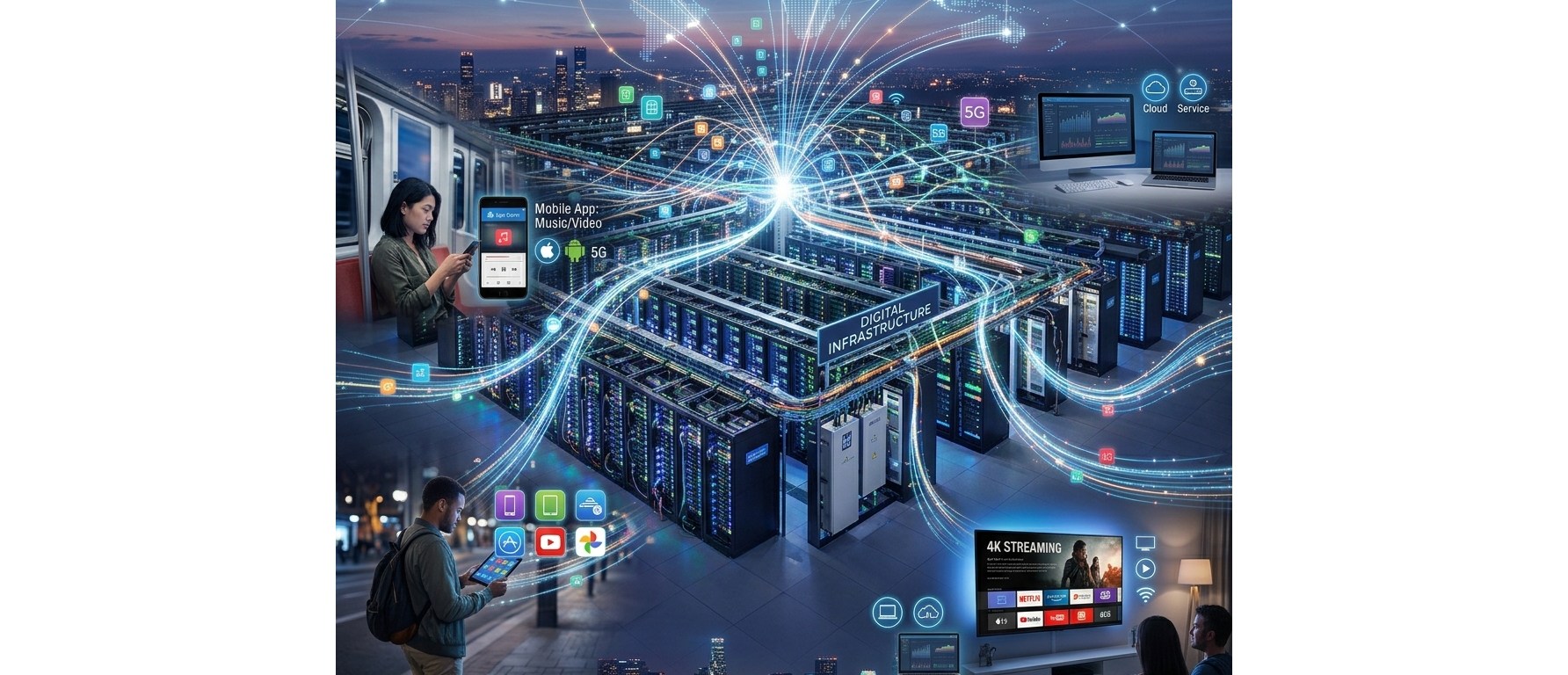
I spent a large part of my years working on data center technology at Intel. I was a storage, networking and server expert. But data centers are not just about AI. They are the. Infrastructure that delivers your Netflix video, facebook posts, your Instagram photos and videos. The current pushback on data centers and AI may impact the digital economy that has driven economic growth for decades.
Data Centers: The Infrastructure Behind Almost Every App We Use
When people open an app on a phone or computer, they usually think about the software they see on the screen. Behind that simple interface, however, is a vast infrastructure of servers, networks, storage systems, cooling equipment, and electricity.
Much of that infrastructure is housed in data centers.
Data centers are the physical foundation of modern digital services. They host websites, mobile applications, databases, cloud platforms, streaming services, online stores, games, business software, and many other services. Artificial intelligence is creating a rapidly growing category of workloads, but data centers are not primarily an AI invention. They have powered the internet and software applications for decades.
What Is a Data Center?
A data center is a facility designed to house computing equipment and the systems required to operate it reliably.
Inside a data center are thousands—or, in very large facilities, hundreds of thousands—of servers. These machines process requests, run software, store information, and communicate with other computers over high-speed networks.
A typical data center also requires:
- Servers and processors
- Storage systems
- Networking equipment
- Backup power
- Cooling systems
- Physical and cybersecurity
- Monitoring and management systems
- High-capacity internet connections
The goal is simple: keep digital services available and responsive, often 24 hours a day, 365 days a year.
How Data Centers Deliver Apps
Most modern apps are not running entirely on the user’s phone.
For example, when someone opens a social-media application, the phone may display the interface and handle certain tasks locally. But the app can also communicate with servers in a data center to retrieve posts, messages, account information, photos, videos, and other data.
The process might look like this:
Phone or computer → Internet → Data center → Application servers → Database/storage → Internet → User
The data center may perform the computation, retrieve information from storage, authenticate the user, and send the requested information back to the device.
This happens extremely quickly, often in fractions of a second.
Data Centers Power Much More Than AI
The recent growth of artificial intelligence has put enormous attention on data centers, particularly facilities containing specialized processors such as GPUs.
But AI is only one category of computing performed in data centers.
Traditional workloads include:
- Web search
- Social media
- Video streaming
- Online banking
- E-commerce
- Cloud storage
- Enterprise software
- Multiplayer gaming
- Telecommunications
- Content delivery
- Databases
- Websites
- Mobile applications
- Software development platforms
These services existed long before today’s large-scale generative AI systems.
Many everyday applications depend on conventional computing infrastructure that has nothing to do with generating AI responses.
The Enormous Amount of Photo and Video Storage
Photos and videos are among the largest consumers of data-center storage.
A modern smartphone photo might be around 2–10 MB, although high-resolution, ProRAW, and other professional formats can be substantially larger. Video requires even more space. A minute of 4K video can consume hundreds of megabytes or several gigabytes depending on resolution, frame rate, codec, and compression.
To illustrate the scale:
- 1,000 photos at 10 MB each: about 10 GB
- 10,000 photos: about 100 GB
- 1 million photos: about 10 TB
- 1 billion photos: about 10 PB
- 1 trillion photos: about 10 EB
Video can increase these numbers dramatically. For example, a collection of 1,000 five-minute 4K videos could require hundreds of gigabytes or several terabytes, depending on the video format and compression.
And the original file is not necessarily the only copy a data center needs to maintain.
Large digital services may create additional copies for redundancy, backups, disaster recovery, thumbnails, previews, different video resolutions, and geographic distribution. Consequently, the physical storage infrastructure required can be considerably larger than the amount of data users initially upload.
This is why some large technology platforms and cloud-storage services operate infrastructure measured in petabytes and exabytes.
The growth of smartphone cameras has made this issue even more important. People take more photographs, record longer videos, and increasingly capture content in higher resolutions. Every photograph and video ultimately has to be stored somewhere if users want to access it later.
Even without AI, the global digital economy therefore requires enormous amounts of storage simply to preserve people’s memories, documents, messages, photographs, and videos.
The Cloud Is Really Data Centers
The term cloud computing can make digital infrastructure sound abstract. In reality, the cloud ultimately depends on physical machines.
When someone stores a photo in a cloud service, the information has to exist somewhere. When a company runs its website on a cloud platform, physical servers execute the software. When someone watches a movie through a streaming service, computers and storage systems somewhere in the network deliver that content.
Cloud providers operate enormous networks of data centers and make their computing resources available to businesses and consumers.
Instead of buying and maintaining their own servers, a company can rent computing, storage, and networking capacity from a cloud provider.
This model has transformed how software is built and delivered.
Why Data Centers Matter for Apps
Modern applications increasingly require substantial infrastructure.
Consider a simple messaging application. It may need to:
- Authenticate users.
- Store accounts and contacts.
- Deliver messages.
- Store photos and videos.
- Synchronize conversations across devices.
- Maintain backups.
- Detect abuse and security threats.
- Handle millions of simultaneous connections.
The application itself may look simple to the user, but supporting millions of users requires a large technical infrastructure.
Data centers provide the computing and storage capacity needed to operate that infrastructure.
Not All Data Centers Are the Same
Different applications require different types of infrastructure.
A company running a database-heavy business application may need large amounts of conventional CPU computing and fast storage.
A video-streaming company may require enormous storage capacity and high-speed networks.
A gaming company may prioritize low latency and geographically distributed servers.
An AI company may require large clusters of specialized accelerators and extremely high-speed connections between them.
Consequently, the physical design of data centers can vary considerably depending on their workloads.
Electricity and Cooling
Computing equipment consumes electricity and produces heat.
As a result, data centers require sophisticated electrical and cooling systems. Facilities can use different combinations of air cooling, liquid cooling, chillers, heat exchangers, and other technologies depending on their equipment and climate.
Power reliability is also critical. Many facilities use redundant electrical systems, backup generators, batteries, and multiple power feeds.
For services that people expect to be available continuously, losing power to a data center can mean losing access to important applications.
The Growing Role of AI
AI is changing the economics and design of some data centers.
Training large AI models can require huge numbers of specialized processors operating together. Running AI models for users—known as inference—also requires substantial computing resources.
These workloads can have different requirements from traditional web applications. They may need more accelerator hardware, higher-density computing, greater power capacity, and faster connections between servers.
This does not mean that every application is becoming an AI application. Rather, AI is becoming an additional major workload alongside the traditional computing workloads that already occupy data centers.
A Foundation of the Digital Economy
Data centers are easy to overlook because users rarely see them.
When someone sends a message, purchases something online, watches a video, checks a bank account, stores a photograph, or opens a business application, the physical infrastructure behind that action is usually invisible.
But the pattern is consistent: software requires computers, computers require physical infrastructure, and that infrastructure increasingly lives in data centers.
AI is bringing a new wave of demand for computing capacity, but the broader data-center industry supports a much larger digital ecosystem.
From ordinary websites and mobile apps to cloud storage, video streaming, online services, and artificial intelligence, data centers provide the physical foundation that allows digital services to operate at global scale.

