
October 16, 2026 | Homeowners Association Governance
Homeowners associations (HOAs) play an important role in maintaining community standards, protecting shared property, and resolving neighborhood disputes. However, when enforcement policies rely heavily on escalating fines, homeowners can face substantial financial penalties for violations that may be relatively minor or difficult to correct quickly.
Across the country, questions about HOA fines, homeowner rights, transparency, and due process are prompting discussions about whether traditional enforcement systems strike the right balance between community interests and individual property rights.
The central question is simple: Should HOA enforcement focus primarily on punishment, or should it emphasize helping homeowners achieve compliance?
A fair system can accomplish both accountability and cooperation without creating unnecessary financial hardship.
When HOA Fines Become a Financial Burden
Many homeowners associations impose daily fines for unresolved covenant violations. These may involve landscaping, property maintenance, parking, recreational vehicles, exterior modifications, or other community rules.
Although fines are intended to encourage compliance, accumulating daily penalties can quickly become disproportionate to the original violation.
Consider a hypothetical HOA fine schedule:
- $20 per day for the first 30 days.
- $30 per day beginning on day 31.
- Continued penalties until the violation is corrected.
Under this example, a homeowner could accumulate: Duration Total fines 30 days $600 60 days $1,500 90 days $2,400 180 days $5,100
These calculations assume continuous daily penalties, with no pauses or maximum cap.
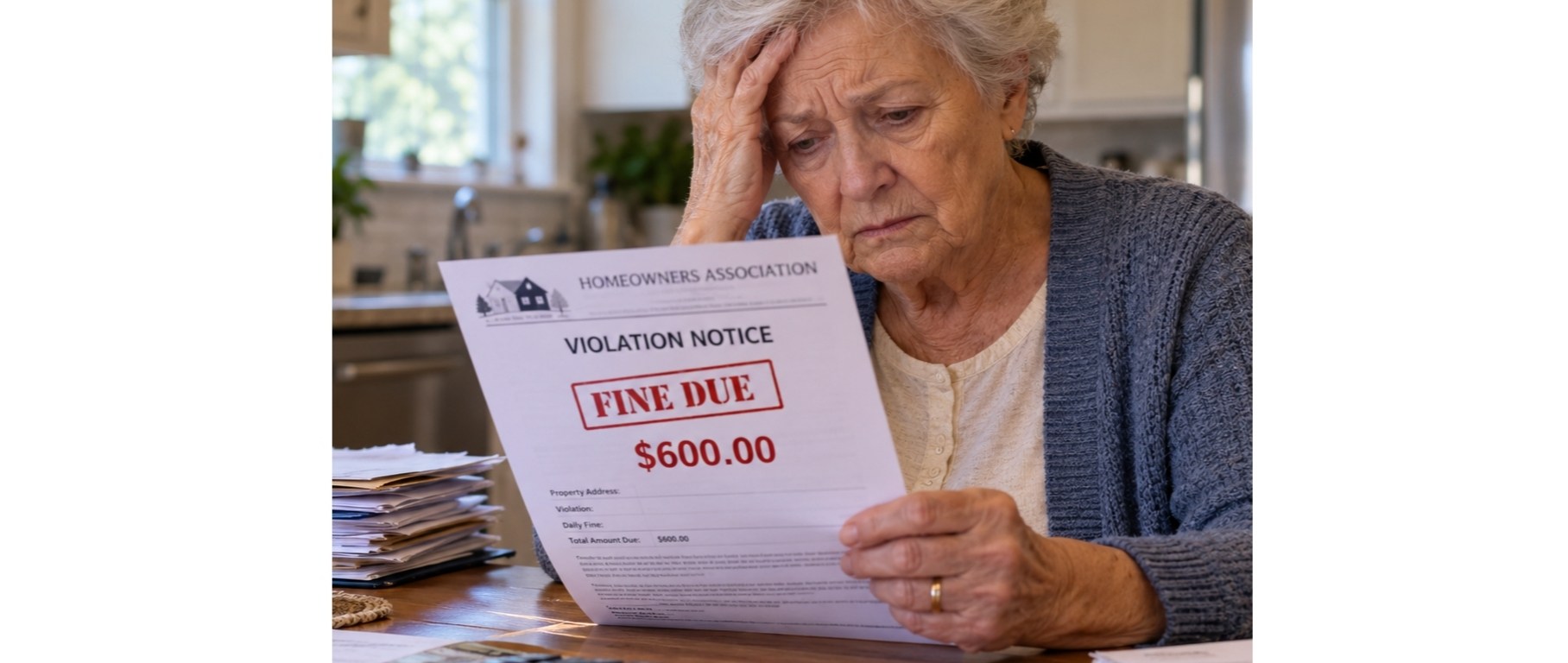
For retirees living on fixed incomes, people with disabilities, or homeowners facing unexpected financial difficulties, such penalties can create serious hardship. Especially with higher costs for prescriptions, medical, taxes, food and basic needs. Imagine being hit with a 600 dollar bill while barely getting by on social security.
Even homeowners willing to comply may encounter delays obtaining contractors, securing permits, resolving disputes, or addressing weather-related obstacles.
An effective enforcement system should distinguish between homeowners who deliberately refuse to comply and those making reasonable efforts to correct a problem.
What Rights Do Homeowners Have?
HOA enforcement authority varies by state, association governing documents, and the laws applicable to each community.
Many states require some combination of written notice, reasonable fines, an opportunity to respond, and procedures for challenging alleged violations.
Washington provides one example of these protections.
Under RCW 64.38.020, covered homeowners associations may impose reasonable fines after providing notice and an opportunity to be heard. Fines must follow a previously established schedule furnished to homeowners.
Washington’s Uniform Common Interest Ownership Act (WUCIOA) provides additional requirements concerning association rules and enforcement. Beginning January 1, 2028, the law generally extends to older common-interest communities, subject to statutory exceptions.
Other states have different requirements, making it important for homeowners to understand their own state’s laws and association governing documents.
Legal compliance, however, should be the minimum standard—not necessarily the highest level of fairness an HOA can achieve.
Seven Reforms That Could Make HOA Enforcement Fairer
1. Give Homeowners a Reasonable Opportunity to Correct Violations
The first response to most nonemergency violations should be education and voluntary compliance.
A written notice should identify the specific rule, explain the alleged violation, provide supporting evidence, and establish a reasonable correction deadline.
Immediate enforcement may be appropriate when health, safety, or significant property damage is involved. Minor violations should generally receive a reasonable opportunity for correction before fines begin.
2. Require Transparency and Access to Evidence
Homeowners should receive the evidence supporting an alleged violation before being required to defend themselves.
This may include photographs, inspection reports, dates, relevant governing provisions, and an explanation of how proposed fines were calculated.
Providing evidence early reduces misunderstandings and allows disputes to be resolved before escalating into formal hearings or litigation.
3. Establish Reasonable Fines and Maximum Limits
A minor landscaping violation should not necessarily carry the same financial consequences as a serious safety hazard.
HOAs should consider graduated penalties based on the seriousness of the violation, whether it is repeated, and the homeowner’s efforts to comply.
Maximum daily fines and overall caps for continuing violations can help prevent penalties from becoming excessive.
Exceptions for serious or ongoing safety risks could require written justification from the board.
4. Suspend Fines During Good-Faith Compliance
Homeowners who demonstrate reasonable progress toward correcting a violation should have an opportunity to request a temporary suspension of penalties.
Examples include obtaining contractor estimates, applying for permits, scheduling professional work, or submitting a written compliance plan.
Fines could resume if agreed milestones are missed without a reasonable explanation.
This approach encourages corrective action rather than allowing penalties to grow while homeowners are actively trying to resolve problems.
5. Create an Independent Appeals Process
One of the most important elements of fair enforcement is impartial review.
Homeowners should have an opportunity to challenge alleged violations before individuals who were not directly responsible for investigating or prosecuting the complaint.
For significant penalties, associations could establish an independent appeals committee or use an outside neutral reviewer.
Appeal decisions should be based on evidence, governing documents, and consistent standards rather than personal disagreements or selective enforcement.
6. Require Written Decisions
Every formal enforcement decision should clearly explain the outcome.
Written decisions should identify the governing rule, relevant evidence, findings, penalty calculations, correction requirements, and available appeal options.
Documentation protects both homeowners and associations by establishing a transparent record of how decisions were reached.
7. Provide Hardship and Accessibility Protections
HOAs should recognize that homeowners have different financial and physical circumstances.
Reasonable accommodations may include payment plans, additional correction time, remote hearings, accessible notices, and disability-related accommodations where required.
These safeguards are particularly important for older adults, people with disabilities, and households experiencing temporary financial difficulties.
Fairness does not require eliminating responsibility. It requires ensuring that enforcement procedures are accessible and proportional.
Should HOA Fines Put Homeownership at Risk?
One of the most serious concerns involving HOA enforcement is the possibility that unpaid obligations may lead to collection actions, liens, legal expenses, or foreclosure.
The legal treatment of fines differs among states, and fines should not automatically be treated as equivalent to unpaid regular assessments.
For example, Washington’s WUCIOA establishes assessment-related foreclosure thresholds that exclude fines, late charges, interest, attorney fees, and collection costs from the threshold calculation.
See RCW 64.90.485.
These provisions do not eliminate every possible collection risk, but they illustrate the importance of distinguishing between regular assessments and penalties.
Associations should consider policies requiring board review before referring disputed fines to collections, offering reasonable payment arrangements, and ensuring homeowners have access to meaningful hearings.
The loss of a home should never be treated as a routine enforcement tool for a minor, correctable violation.
Transparency Can Improve Community Trust
HOA boards can strengthen confidence in enforcement by regularly reviewing how rules are applied.
An annual enforcement report could disclose aggregate information without identifying individual homeowners, including:
- Number and types of violations issued.
- Average time allowed for correction.
- Total fines assessed and collected.
- Number of penalties reduced or waived.
- Number of appeals filed and granted.
- Number of cases referred to collections.
Such reporting can help reveal inconsistent enforcement practices and identify rules that generate recurring disputes.
Boards should also periodically review fine schedules and invite homeowner participation before adopting major changes.
A Better Approach to HOA Governance
Homeowners associations exist to serve their communities. Enforcement is necessary to protect shared interests, but it should not become an end in itself.
Excessively punitive systems can generate resentment, legal disputes, financial hardship, and declining confidence in HOA leadership.
A cooperative system emphasizes early communication, clear expectations, reasonable deadlines, consistent enforcement, and independent review.
Homeowners remain responsible for complying with legitimate community rules. In return, associations should be accountable for administering those rules fairly.
The most successful enforcement policy is not necessarily the one that generates the largest amount of fine revenue. It is the one that resolves problems efficiently while preserving trust between homeowners and their association.
Conclusion: Compliance Should Be the Goal, Not Punishment
HOAs have legitimate responsibilities to maintain community standards, protect common property, and address violations that affect neighbors.
But enforcement should be measured by whether problems are corrected—not by how much money is collected in penalties.
Reasonable fines, meaningful appeal rights, transparent procedures, and accommodations for good-faith compliance can help create communities where homeowners understand the rules and trust the enforcement process.
A fair HOA does not have to choose between protecting community standards and protecting homeowner rights. Effective governance should accomplish both.
Sources and Further Reading
- Washington State Legislature — RCW 64.38.020: Association Powers
- Washington State Legislature — RCW 64.90.405: Association Powers and Duties
- Washington State Legislature — RCW 64.90.485: Liens and Enforcement
- Washington State Legislature — RCW 64.90.505: Association Rules and Notice
- Washington State Legislature — RCW 64.90.360: Applicability
Editor’s note: This article discusses general HOA governance principles and uses Washington law as an illustrative example. HOA laws differ by state, community type, and governing documents. This article is educational and does not constitute legal advice.

